
Shipping from China to Nigeria
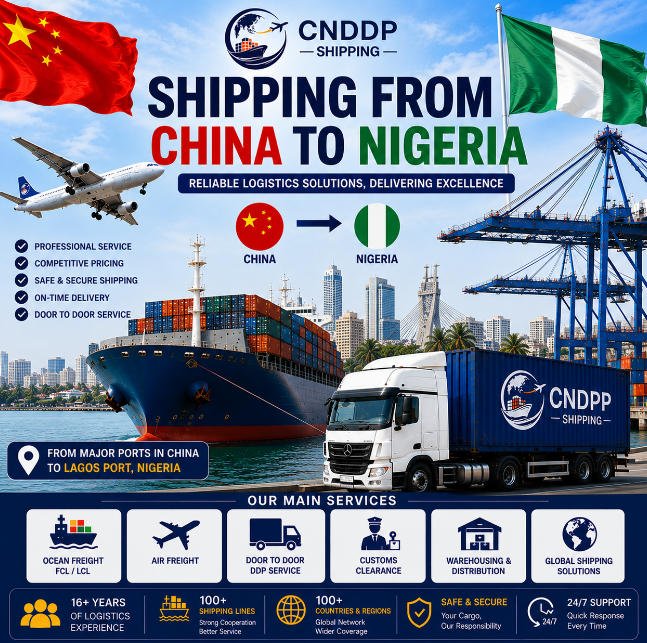
CNDDP is a freight forwarder specializing in shipments from China to Nigeria, offering quick quotes, air/sea/DDP shipping, customs clearance, and door-to-door delivery services.
How to ship from China to Nigeria
What are the available methods for shipping from China to Nigeria
Sea Freight (FCL & LCL)
Air Freight
Table of Contents
Shipping From China to Nigeria in 2026
With the continuous development of infrastructure and the diversification of consumer markets, trade relations between China and Nigeria have maintained rapid growth in recent years. Major imports from China to Nigeria include electronic products, building materials, hardware, furniture, machinery, and clothing. The transportation of goods from China to Nigeria shows the following trends:
Higher Logistics Transparency
More freight forwarders are offering online cargo tracking and online quotations, improving transportation transparency.
Rapid Growth in Full Container Load (FCL) Shipping Demand
Large wholesalers and engineering projects require stable, high-volume supplies, driving the growth of FCL shipping.
Increased Air Freight Volume
Especially for mobile phone accessories, small home appliances, and fashion retail goods, businesses are pursuing faster turnover, and high-value goods are more likely to be transported by air.
Stricter Customs Clearance Policies
The Nigerian Customs Service (NCS) has strengthened inspections, requiring more standardized documentation and cargo declarations.
Increased Demand for Multimodal Transport and Warehousing
With the development of e-commerce, the demand for overseas warehouses, urban distribution, and truck transportation is increasing.
How to Ship from China to Nigeria
In the era of globalization, trade between China and Nigeria is frequent. Exploring efficient and transparent transportation solutions is crucial to ensuring the safe and timely delivery of goods. This article will discuss these transportation methods, including their costs and efficiency. The following sections will provide a detailed overview of various transportation options:
| Shipping Mode | Transit Time (Days) | Average Cost (USD) | Ideal Cargo Type | Recommendation |
|---|---|---|---|---|
| Sea Freight (FCL) | 30–45 days | $2200–$4600 | Lightweight, bulky goods | The preferred choice for bulk cargo |
| Sea Freight (LCL) | 35–50 days | $60–$170 / CBM | Bulk goods, heavy cargo | Best cost per CBM |
| DDP Sea Freight | 40–55 days | $100–$300 / CBM (All-in) | SMEs, general trade | Hassle-free clearance |
| Air Freight | 5–9 days | $4.0–$9.0 / kg | Urgent, high-value cargo | Fastest option |
| DDP Air Freight | 8–12 days | $5–$12 / kg (All-in) | Electronics, eCommerce | Door-to-door & tax included |
| Express Courier (DHL / UPS / Aramex) | 5–8 days | $8–$15 / kg | Samples, small parcels | Fast but costly |
Sea Freight Services from China to Nigeria
When should you use sea freight?
You can use sea freight from China to the Nigeria in the following situations:
- When you need to ship a large quantity of goods or bulky items.
- When the shipment is not urgently needed.
- When you need the most economical shipping method.
- When you need container shipping (full container load or less than container load).
What documents are required for ocean shipping?
- Port of departure
- Port of destination
- Customs clearance invoice (packing list, including product, number of pieces, value, product images, customs code, quantity, dimensions, and weight)
- Shipping address
- Supplier contact information
- Container loading timeTransport time requirements
LCL (Less than Container Load):
Less than Container Load (LCL) is suitable for smaller shipments. If your shipment does not fill the entire container, you can load it into the same container with shipments from other shippers. This way, you only pay for the space used within the container, reducing shipping costs. LCL is suitable for personal shipments, small commercial shipments, and shipments that only occupy a portion of the container.
FCL (Full Container Load):
For larger shipments, when your shipment fills the entire container, you can choose to rent the entire container for transportation. No other shipments will be loaded. FCL is suitable for large commercial shipments, large machinery, or shipments where the integrity and safety of the shipment must be protected. The importer reserves the entire container for a fixed fee.
Sea Freight Steps from China to Nigeria
The process of shipping goods from China to Nigeria by sea involves multiple steps. Understanding the detailed procedures for each step not only helps ensure the timely and safe arrival of your goods but also helps you manage your time and costs effectively.
Choosing an Experienced Freight Forwarder
Choosing a reputable and experienced freight forwarder is crucial for smooth transportation. Discuss the specific transportation plan with the freight forwarder.
Cargo Preparation
First, confirm the type, specifications, and quantity of the goods to be transported. Choose the appropriate transportation method based on the nature of the goods (e.g., perishable goods, dangerous goods, machinery, etc.).
Cargo Packaging
Choose appropriate packaging materials based on the characteristics of the goods and ensure that the packaging meets international transportation standards.
Transportation to the Port
After the goods arrive at the port, they undergo port handling and quarantine procedures before being loaded onto the cargo ship. The freight forwarder will arrange the loading time and provide you with container loading information.
Sea Freight
The goods will depart from the port of origin in China, travel through several transit ports via a designated route, and finally arrive at the destination port in Nigeria. During transportation, the freight forwarder will track the progress of the goods in real time and ensure that the goods arrive at the destination port on time.
Arrival at the Nigerian Port
The goods will undergo port entry inspection and security checks. Depending on the nature of the goods, the port may conduct security checks and pre-clearance procedures.
Nigerian Customs Clearance
Provide the necessary documents, calculate and pay customs duties and value-added tax.
Destination Transportation and Delivery
After customs clearance is completed, the goods can be transported to the final destination (e.g., warehouse, store, etc.).
Sea Freight Rates from China to Nigeria (20ft, 40ft, LCL)
Sea freight is one of the most common and economical methods of international cargo transportation, especially suitable for large quantities of goods or non-urgent shipments. Shipping costs are not a fixed figure but are influenced by several factors, including:
- Container Type: A key factor in shipping costs is the type of container chosen. Common container types include standard 20-foot and 40-foot containers, and the cost varies significantly between different types. Refrigerated containers are typically more expensive than standard containers.
- Cargo Type and Weight: The volume and weight of the cargo also directly affect shipping costs. Generally, costs are calculated based on cargo volume (CBM) or weight (tons).
- Seasonal Fluctuations: Sea freight costs can be affected by peak and off-peak seasons. During peak seasons (usually before holidays or vacations), demand is higher, and freight rates tend to increase.
- Port Fees and Surcharges: Port fees in Nigeria (such as port handling fees, demurrage charges, transshipment fees, etc.) can also impact the total cost.
- Insurance Costs: Cargo insurance is therefore an essential part of the cost. Insurance costs are usually determined based on the value and type of the cargo.
| Sea Freight Service from China to Nigeria | LCL Shipping Cost | 20ft Container (USD) | 40ft Container (USD) |
|---|---|---|---|
| Shanghai → Lagos Port | $80 – $160 | $2,500 | $3,200 |
| Ningbo → Lagos Port | $70 – $155 | $2,400 | $3,000 |
| Shenzhen → Lagos Port | $80 – $165 | $2,350 | $3,000 |
| Guangzhou → Lagos Port | $65 – $155 | $2,200 | $2,800 |
| Shanghai → Harcourt Port | $80 – $165 | $2,400 | $2,900 |
| Ningbo → Harcourt Port | $75 – $160 | $2,250 | $2,750 |
| Shenzhen → Harcourt Port | $70 – $165 | $2,300 | $2,800 |
| Guangzhou → Harcourt Port | $80 – $170 | $2,100 | $2,900 |
Sea Freight Time from China to Nigeria
Shipping routes and transit times from China to Nigeria vary depending on the origin port, destination port, and chosen shipping route. Below is a detailed overview of common shipping routes and transit times from China to Nigeria:
Main Destination Ports (Nigeria)
Lagos Port
Lagos Port is the largest port in Nigeria, handling the vast majority of imports and exports. It includes Apapa Port and Tin Can Island Port, and is a major international trade center in Nigeria.
Port Harcourt
Located in southeastern Nigeria, Port Harcourt is a major industrial port primarily used for the import and export of oil, natural gas, and related industries.
Calabar Port
Located in southeastern Nigeria, Calabar Port is mainly used for regional trade. Although smaller in scale, it provides transportation services to specific regions.
Other influencing factors:
- Weather conditions: Adverse weather conditions (such as typhoons and storms) may cause delays in transit time.
- Seasonal fluctuations: Peak seasons for shipping (such as before and after the Chinese New Year and during the summer) may lead to vessel congestion and longer transit times.
- Port congestion: Some ports, such as Lagos Port, may experience congestion due to cargo backlogs or difficulties in unloading, affecting transit times.
- Route selection: Different routes have different transit times; some routes may involve fewer transshipment ports, resulting in shorter transit times.
| Origin Port (China) | Destination Port (Nigeria) | Transit Time (Days) | Remarks |
|---|---|---|---|
| Shanghai | Lagos | 38–45 days | Most frequent route, ideal for FCL cargo |
| Ningbo | Lagos | 40–46 days | Reliable and cost-efficient |
| Shenzhen | Lagos | 42–48 days | Suitable for southern Nigeria distribution |
| Guangzhou | Lagos | 40–47 days | Balanced option, moderate congestion |
| Qingdao | Lagos | 45–50 days | Less frequent but available for bulk goods |
| Tianjin | Lagos | 43–50 days | The distance is long, resulting in longer times |
Air Freight Services from China to Nigeria
When to use air freight?
You should use air freight in the following situations.
- If the goods need to be transported and used urgently, air freight is the best and most economical option.
- If there are many valuable or fragile items, air freight can reduce the risk of damage and loss.
- For small and lightweight shipments, air freight is the best option.
What information do I need for air freight?
- Product Name
- HS Code
- Weight
- Volume
- Product Value
- Departure Airport
- Destination Airport
Standard Air Freight
This common air freight service is suitable for general cargo, offering relatively stable delivery times and relatively affordable prices. It’s ideal for most non-urgent shipments, such as electronics, clothing, and mechanical parts.
Express Air Freight
This service offers fast shipping, typically through reputable courier companies (such as DHL, FedEx, and UPS). It’s ideal for shipments requiring extremely fast delivery, including small, high-value shipments that require rapid delivery.
Specialized Air Freight
This service offers customized shipping conditions to ensure the safety of goods requiring special handling, such as perishables, temperature-controlled goods (such as pharmaceuticals and food), and valuables.
Air Freight Steps from China to Nigeria
The air freight process from China to Nigeria involves a complete process from cargo preparation to delivery at the destination. The following are the various stages:
Cargo Preparation
First, determine the type, specifications, weight, and volume of the goods. For example, whether they are fragile goods, dangerous goods, temperature-controlled goods, etc., and whether they meet air transport requirements.
Packaging Requirements
Choose appropriate packaging based on the type of goods. Airlines and customs usually require that the packaging of goods meets international standards.
Selecting a Freight Forwarding Company
Contact an experienced freight forwarding company. They will be responsible for coordinating the entire transportation process, including booking flights, arranging transportation, and tracking the cargo.
Inspection of Goods and Packaging at the Departure Port
At the airport, the airline or freight forwarder will inspect the cargo packaging to ensure it meets air transport requirements and that there is no damage, leakage, or other problems.
Air Transportation
The goods are transported by air, usually via several transit ports (such as in the Middle East, Southeast Asia, or Europe), and finally arrive at the destination airport in Nigeria (such as Lagos, Abuja, etc.).
Customs Clearance at Destination
After the goods arrive in Nigeria, import customs clearance is required. This process requires submitting relevant documents, including commercial invoices, bills of lading, packing lists, etc., and paying customs duties and value-added tax based on the type and value of the goods.
Transportation from the Airport to the Destination
After the goods arrive at the destination, the consignee signs for them, confirming that the goods are intact and undamaged.
Air Freight Rates from China to Nigeria
Air freight rates are highly volatile and are also affected by changes in fuel prices. There are no fixed rates; the larger the shipment, the lower the per-kilogram fee. Below are our latest rates:
| Air Freight Service Types | Weight Range | Estimated Cost (per kg) |
|---|---|---|
| Standard Air Freight | 51 – 200 kg | $5.0 – $9.0 |
| Standard Air Freight | 201 – 500 kg | $4.5 – $8.5 |
| Standard Air Freight | 501 kg+ | $4.0 – $7.0 |
| Express Air Freight | 51 – 200 kg | $9.0 – $15.0 |
| Express Air Freight | 201 – 500 kg | $8.0 – $16.0 |
| Express Air Freight | 501 kg+ | $7.0 – $15.0 |
| Special cargo Air Freight | 51 – 200 kg | $6.0 – $12.0 |
| Special cargo Air Freight | 201 – 500 kg | $5.5 – $10.0 |
| Special cargo Air Freight | 501 kg+ | $4.5 – $9.0 |
Air Freight Time from China to Nigeria
Air freight is a relatively fast mode of transportation in international trade, suitable for goods with high time sensitivity. However, it is also affected by the following factors:
- Number of transfers and transit time: The speed of air freight is directly affected by the number of transfers, the layover time at each transfer point, and the efficiency of the transit airports.
- Airlines and flight frequency: The flight frequency and schedule offered by different airlines also affect air freight delivery times.
- Seasonal fluctuations: During certain busy seasons (such as Chinese New Year and Christmas), airlines may increase flights, but flight delays or congestion may also occur, affecting delivery times.
- Weather conditions: Weather also affects air freight delivery times; storms, fog, and monsoons can lead to flight delays or cancellations.
| Origin Airport (China) | Destination Airport (Nigeria) | Transit Time (Days) |
|---|---|---|
| Beijing (PEK) | Lagos (LOS) | 6–8 days |
| Shanghai (PVG) | Lagos (LOS) | 6–9 days |
| Guangzhou (CAN) | Lagos (LOS) | 7–10 days |
| Shenzhen (SZX) | Lagos (LOS) | 6–9 days |
| Hong Kong (HKG) | Lagos (LOS) | 5–8 days |
DDP Shipping from China to Nigeria
DDP (Delivered Duty Paid) shipping from China to Nigeria means that the seller’s designated freight forwarder assumes all transportation costs and risks until the goods are delivered to their destination.
DDP Shipping Process from China to Nigeria
If you plan to import goods from China to Nigeria, we provide a detailed overview of the DDP shipping process from China to Nigeria to help you fully understand the operation.
- Preparing Shipping Packaging: Prepare shipping packaging according to the type of goods, ensuring compliance with international shipping and Nigerian import standards. Fragile, perishable, or special goods may require additional packaging measures.
- Choosing a Freight Forwarder: The seller needs to select a suitable logistics company or freight forwarder to arrange transportation and sign the relevant transportation contract.
- Freight Forwarder’s Export Customs Clearance: The freight forwarder needs to submit relevant export declaration documents to Chinese customs and pay export duties and other related fees (if any). The seller is responsible for ensuring all export customs clearance procedures are completed smoothly so that the goods can leave China without incident.
- Transportation Process: Depending on the chosen mode of transport, goods will transit through the port of Lagos (if sea freight is chosen) or Murtala Muhammed International Airport (MMA) (if air freight is chosen) before finally arriving in Nigeria.
- Customs Clearance and Tax Payment in Nigeria: Upon arrival in Nigeria, the seller is responsible for handling import customs clearance to ensure smooth entry. Nigeria’s Value Added Tax (VAT) is typically 10%.
- Door-to-Door Delivery: After customs clearance, goods will be transported from the port or airport to their final destination. The freight forwarder is responsible for paying all transportation and related delivery costs to ensure the goods are delivered smoothly to the buyer’s designated location.
Door-to-door Shipping from China to Nigeria
Door-to-door shipping services make transporting goods from China to Nigeria easy and convenient, providing a hassle-free experience for businesses. This service covers every logistical step, from picking up goods from the supplier to delivery at the final destination. Key advantages include:
- Simplified Logistics: Say goodbye to the complexities of dealing with multiple logistics providers – reduce complexity through streamlined coordination.
- Reduced Cargo Handling: Minimize the handling of valuable goods, significantly reducing the risk of damage or loss.
- Lower Overall Transportation Costs: Cut down on warehousing, handling, and intermediate transportation costs for a more cost-effective solution.
Prepare the following shipping documents in advance:
- Commercial Invoice: Lists the value, quantity, weight, and other information about the goods.
- Packing List: Describes the details of the goods in each container or package.
- Air Waybill: The official document for air freight contracts, which must be provided by the carrier.
- Certificate of Origin: A document confirming the origin of the goods.
- Import/Export Licenses: Some specific categories of goods require relevant import or export licenses.
- Other Special Documents: If the goods are hazardous or require temperature control, a hazardous materials declaration or temperature-controlled transportation requirements document will also be needed.
Import Taxes and Duties in Nigeria
Import duties and taxes significantly impact the cost of shipping goods from China to Nigeria. Value-added tax (VAT) and customs duties are crucial and can substantially affect the final price you pay. These fees are calculated based on the value, classification, and shipping terms of the goods.
| Product Category | Customs Duty (%) | VAT (%) | Notes |
|---|---|---|---|
| Electronics | 5–20 | 7.5 | May vary based on specific items |
| Clothing | 12–20 | 7.5 | Depends on material and use |
| Machinery | 5–10 | 7.5 | Includes industrial machinery |
| Agricultural Products | 0–10 | 7.5 | Some items may have exemptions |
| Automotive Parts | 10–20 | 7.5 | Depends on the part and vehicle type |
Freight Forwarding from China to Nigeria
Freight forwarders are the backbone of international shipping, serving as a crucial link between shippers and transportation service providers. When shipping goods from China to Nigeria, these experts skillfully navigate the complexities of global trade regulations and logistics systems, ensuring your cargo arrives smoothly and on time.
Key services offered by freight forwarders:
- Document Handling: They manage and prepare all necessary shipping and customs documents, simplifying the process for you.
- Customs Clearance: Their expertise ensures your goods clear customs smoothly, minimizing delays.
- Cargo Tracking: Real-time tracking provides peace of mind and allows for better planning.
Choosing the right freight forwarder is crucial for ensuring smooth transportation from China to Nigeria. Here are key factors to consider:
- Familiarity with the China-Nigeria trade route: Understanding this specific corridor improves the efficiency and reliability of your cargo transportation.
- Network and Partnerships: A strong network means better transportation options and potentially lower costs.
- Service Scope: Look for comprehensive services covering everything from warehousing to distribution, making your business logistics easier.
- Customer Service Reputation: Prioritize freight forwarders known for excellent customer service, ensuring smooth communication and effective problem resolution.
Why Choose CNDDP Shipping?
CNDDP Shipping has handled over 50,000 international shipments, providing sea, air, rail, and DDP shipping solutions from China to destinations worldwide, with 24/7 freight tracking and customer support.

Sophie Miller
Amazon cross-border sellers
Smooth Amazon FBA delivery with complete DDP clearance. Reliable and cost-effective logistics partner.

Ryan Carter
Import trader
Our DDP shipments via CNDDP Shipping are always on schedule. Support is quick and solutions are practical.