
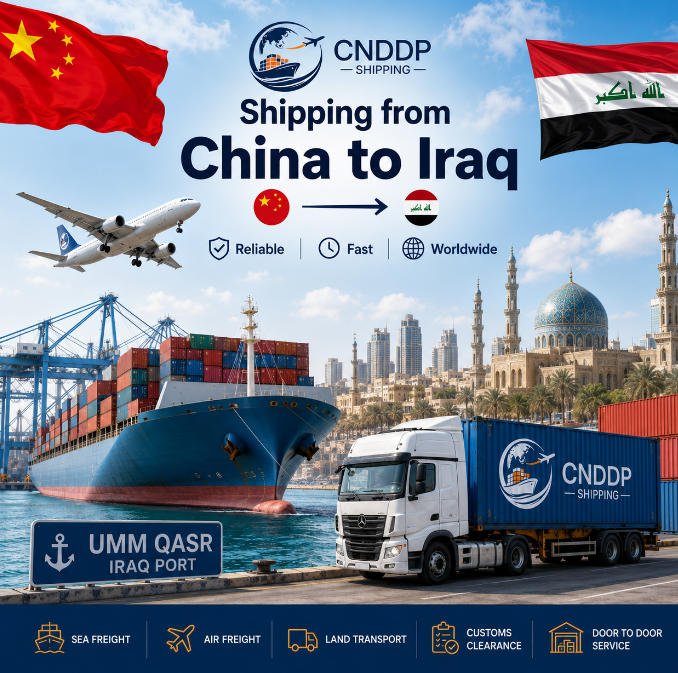
Shipping from China to Iraq
CNDDP is a freight forwarder specializing in shipments from China to Iraq, offering quick quotes, air/sea/DDP shipping, customs clearance, and door-to-door delivery services.
How to ship from China to Iraq
What are the available methods for shipping from China to Iraq
Sea Freight (FCL & LCL)
Air Freight
Table of Contents
Shipping From China to Iraq in 2026
More and more Middle Eastern countries are choosing to import goods from China, with Iraq being a significant market. China, with its competitive pricing, complete industrial chain, and high-quality products, has become one of Iraq’s main sources of imports. Major imported goods include:
- Machinery and electrical products
- Building materials (such as steel, cement, and tiles)
- Automobiles and auto parts
- Furniture, home appliances, and consumer electronics
- Textiles and apparel
International shipping involves multiple steps—choosing the mode of transport, calculating shipping costs, understanding tariff policies, and preparing customs clearance documents—a comprehensive understanding of this information is crucial for both business and individual importers.
How to Ship from China to Iraq
The logistics process of transporting goods from China to Iraq involves the selection of various transportation modes and routes. The most suitable mode of transport must be chosen based on the type of goods, transit time, cost budget, and specific requirements of the destination. The following is a summary of the different transportation modes:
| Shipping Mode | Main Route | Best For |
|---|---|---|
| Sea Freight (FCL/LCL) | via Dubai → Port of Umm Qasr | Bulk & heavy cargo |
| Air Freight | Direct or via Dubai → Baghdad | Urgent / high-value goods |
| DDP Air Freight | via Dubai / Muscat hubs | Small importers, e-commerce |
| DDP Sea Freight | via UAE transshipment | No import license required |
| Express (Aramex / UPS) | via UAE hub | Samples, light parcels |
How to Choose the Best Shipping Method
The right shipping method depends on the urgency, size, and cost of your shipment. Here’s how to choose the shipping method that best suits your needs:
When to Choose Air Freight
- Urgency: If you need fast delivery, air freight is the best option.
- High-Value Items: For expensive goods that require secure and expedited transportation, air freight offers reliability.
- Small Shipments: Air freight is best for shipments weighing less than 100 kg.
When to Choose Express Shipping
- Small Urgent Shipments: Express shipping is ideal for packages or documents that require fast delivery.
- Door-to-Door Convenience: If you need goods to be picked up from your location and delivered directly to the recipient, express shipping can provide this service.
- E-commerce Shipping: If you’re shipping goods sold online, express shipping services offer fast and reliable delivery to your customers.
When to Choose Sea Freight
- Bulk Cargo: Ocean freight is the most cost-effective way to transport large, heavy goods, such as machinery, industrial equipment, or raw materials.
- Non-Urgent Shipments: If you can tolerate longer delivery times and want to save on shipping costs, ocean freight is the best option.
- Large quantities: For businesses that need to ship large quantities of goods at once, ocean freight can offer significant cost savings over air freight or express delivery services.
Sea Freight Services from China to Iraq
Sea freight is the most commonly used mode of transportation. Compared to air freight, ocean freight offers significantly lower costs and is particularly suitable for transporting large, heavy cargo such as machinery, vehicles, and construction materials. Longer or bulky shipments typically take 20-30 days, depending on the voyage and weather conditions. Goods are loaded onto ships in containers and typically shipped via full container load (FCL) or less-than-container load (LCL).
- Full Container Load (FCL) Shipping: Full container load (FCL) shipping refers to cargo that is sufficient to fill a single container. This offers increased security and reduces the risk of damage and loss by not mixing with other shippers’ cargo. It is suitable for large shipments and is more economical. A container is used by a single shipper, eliminating the need for multiple port transfers and providing more manageable shipping times.
- Less-than-Container Load (LCL) Shipping: When cargo is insufficient to fill a single container, multiple smaller shipments are combined in a single container, sharing container space and reducing costs. LCL is a very suitable option for smaller shipments. LCL shipping does not require full container booking, and shippers can arrange transportation flexibly without worrying about empty containers.
- Ro-Ro shipping: Ro-Ro shipping from China to Iraq is the most efficient solution for transporting vehicles, trucks, buses, and heavy rolling equipment. Best suited for: cars, trucks, construction vehicles, and non-containerized wheeled cargo.
Major ports in Iraq
Umm Qasr Port
Umm Qasr Port, located in the Basra region, is Iraq’s main port, handling the majority of containers and bulk cargo entering the country.
Basra Port
As another important import gateway, this port provides convenient access to southern Iraq and is crucial to the country’s supply chain.
Air Freight from China to Iraq
Air freight is the fastest mode of transportation and is suitable for time-sensitive shipments. It generally offers higher security and is suitable for high-value, fragile, and perishable goods (such as electronics, pharmaceuticals, and perishable foods). It provides real-time tracking, ensuring transparency and control during shipment. Standard air freight or express delivery are primarily used:
Standard Air Freight
Standard air freight is primarily operated by airlines. It operates on a larger scale, often sharing flight seats between multiple shipments. Therefore, its freight rates are generally lower than express delivery, but its delivery time is also slower. It is used for shipments that have certain time requirements but do not require next-day or same-day delivery.
Express Delivery
Express delivery is a more efficient and convenient air freight method, typically provided by specialized express delivery companies (such as DHL, FedEx, UPS, and TNT). It is particularly suitable for small-volume, high-value, and urgent shipments. Unlike standard air freight, express delivery services offer greater timeliness and typically provide door-to-door service.
Major Airports in Iraq
Baghdad International Airport (BGW)
Iraq’s main cargo airport, serving the capital Baghdad and its surrounding areas.
Basra International Airport (BSR)
Facilitates cargo transport to southern Iraq.
Shipping time from China to Iraq
| Shipping Mode | Transit Time |
|---|---|
| Sea Freight (FCL/LCL) | 25–35 days |
| Air Freight | 5–8 days |
| DDP Air Freight | 8–12 days |
| DDP Sea Freight | 30–40 days |
| Express (Aramex / UPS) | 6–10 days |
The choice of transport mode from China to Iraq significantly impacts delivery time. Different modes of transport have different transit times, and the specific choice should be determined based on the urgency of the goods, cost budget, and transport requirements.
Time Requirements
If goods need to be delivered as quickly as possible, air freight is the most suitable option; if the goods are not urgent and cost is sensitive, sea freight is the best choice.
Cargo Type
Bulk goods and goods with less time-sensitive requirements are suitable for sea freight; high-value, perishable, and urgent goods are suitable for air freight.
Budget
Sea freight is cheaper than air freight, but takes longer. A trade-off between cost and time needs to be made.
Major Sea Freight Routes
Shipping from China to Iraq typically takes 30-45 days. The exact time depends on:
Transit Ports: Shipping routes usually pass through transit ports such as Dubai in the UAE or Bahrain. Each transit port may cause some delays.
Seasonal Factors: Different seasons affect shipping timeliness. Increased shipping volume during certain seasons may lead to longer voyages.
Port Congestion: Some major ports (such as Shanghai and Umm Qasr) may experience congestion due to excessive shipping demand, resulting in cargo delays.
| Origin Port (China) | Transit Port | Destination Port (Iraq) | Transit Time | Remarks |
|---|---|---|---|---|
| Shanghai | Dubai (Jebel Ali) | Port of Umm Qasr | 28–35 days | Most common route |
| Ningbo | Sohar (Oman) | Port of Umm Qasr | 25–32 days | Balanced cost and speed |
| Shenzhen | Dubai (Jebel Ali) | Port of Umm Qasr | 30–38 days | Suitable for East Iraq delivery |
| Guangzhou | Dubai | Basra Port | 30–35 days | Strong consolidation hub |
| Qingdao | Dubai | Basra Port | 35–40 days | Northern China cargo |
Major Air Freight Routes
Air freight is a fast but expensive mode of transport, suitable for goods requiring prompt delivery. Transit time from major Chinese airports to Iraq is typically 5-7 days.
- Airlines: Different airlines have different flight schedules; flight frequency and route selection affect transit time.
- Transit Airports: Some air freight shipments may require transit through airports such as Dubai International Airport or Abu Dhabi International Airport, which can add 1-2 days of transfer time.
- Customs Clearance and Destination Airport Handling: Customs clearance at Iraqi airports is relatively cumbersome and may cause slight delays in the delivery time of air freight.
| Route (Origin → Destination) | Transit Point | Transit Time | Frequency |
|---|---|---|---|
| Guangzhou (CAN) → Baghdad (BGW) | Direct / via Doha | 5–7 days | Daily |
| Shanghai (PVG) → Baghdad (BGW) | via Dubai | 5–8 days | 3–5 flights/week |
| Shenzhen (SZX) → Baghdad (BGW) | via Muscat / Doha | 6–9 days | Frequent |
| Shipping Mode | Estimated Cost (USD) |
|---|---|
| Sea Freight (FCL/LCL) | $70–120 / CBM |
| Air Freight | $4.5–8 / kg |
| DDP Air Freight | $5.5–9 / kg |
| DDP Sea Freight | $150–250 / CBM |
| Express (Aramex / UPS) | $8–15 / kg |
Shipping costs from China to Iraq vary depending on the chosen mode of transport. The appropriate mode depends on factors such as time requirements, cargo characteristics, and budget:
If you have a large quantity of goods and are not in a hurry to deliver, sea freight is the most economical option.
If your goods need to arrive quickly, air freight is the fastest method, but it is more expensive.
Ocean freight costs are typically calculated based on container type (e.g., 20ft, 40ft containers) or Less-than-Container Load (LCL) and are also affected by the following:
- Seasonal fluctuations: Shipping companies usually adjust freight rates based on peak seasons (such as holidays or peak shipping periods), with prices typically rising slightly during peak seasons.
- Destination port congestion: Congestion at destination ports such as Umm Kasr can increase port fees and waiting times, further impacting transportation costs.
| Type | Best For | Volume | Cost Range (USD) | Notes |
|---|---|---|---|---|
| LCL (Less than Container Load) | Small shipments | 1–10 CBM | $70–120 / CBM | Economical but slower |
| FCL (Full Container Load 20GP) | Bulk cargo | 28 CBM | $1,550–2,250 / container | Faster and more secure |
| FCL (40HQ) | High-volume cargo | 58 CBM | $2,250–3,500 / container | Ideal for heavy goods |
Air Freight Cost from China to Iraq
Air freight costs are typically calculated by weight (kilograms) or volume (cubic meters). Air freight companies usually charge based on the chargeable weight, which is the greater of the actual weight and the volumetric weight. The formula for calculating volumetric weight is: Volumetric weight (kg) = Length × Width × Height / 6000.
- Flight frequency and airline selection: Freight rates may vary between different airlines.
- Seasonal fluctuations: Air freight costs are typically affected by peak seasons (such as holidays) and off-seasons, with costs increasing during peak seasons.
- Customs clearance fees: Although air freight clearance time is shorter, certain customs duties and processing fees still apply.
| Weight Bracket (Chargeable Weight) | Average Rate (USD/kg) | Remarks |
|---|---|---|
| 45–99 kg | $6.0–9.0 / kg | General goods |
| 100–300 kg | $5.0–8.0 / kg | Standard air cargo |
| 300–500 kg | $4.5–6.5 / kg | Volume discount |
| 500 kg+ | $4.2–6.0 / kg | Bulk / contract rate |
DDP Shipping from China to Iraq
DDP (Delivered Duty Paid) is a common delivery term in international trade, meaning the seller assumes all costs and risks until the goods are transported to the named destination, and is responsible for all related expenses until the goods are delivered to the buyer. Specific costs are as follows:
Shipping Costs (varies depending on the mode of transport)
- Sea Freight: Ocean freight generally includes basic freight, fuel surcharges, port charges, etc.
- Air Freight: Air freight costs are usually calculated based on the weight (kg) or volume (cubic meters) of the goods, suitable for small-volume shipments with high time sensitivity.
Customs Clearance Costs
- Export Clearance Costs: Includes customs declaration service fees, customs inspection fees, export licenses, etc.
- Import Clearance Costs: Includes customs duties, value-added tax (VAT), other import taxes and fees levied by the destination country’s customs, and customs clearance agency fees.
Customs Duties and Taxes
The seller needs to pay customs duties, value-added tax (VAT), and other possible taxes and fees in the destination country.
Insurance Costs
The seller needs to purchase insurance for the goods to protect against accidental loss or damage during transportation. Insurance costs are typically calculated based on the value of the goods, the mode of transport, and the risk level of the destination.
Destination Port Charges
- Destination port unloading charges: including loading and unloading fees, storage fees, terminal charges, etc.
- Destination transportation costs: including inland transportation costs from the destination port or airport to the buyer’s designated location.
Supplementary Charges
- Fuel surcharge: Additional charges that shipping companies may impose based on fluctuations in fuel prices.
- Seasonal surcharges: Shipping companies may charge higher fees during peak shipping seasons (such as holidays or peak trade seasons).
The Basic Process of DDP Shipping from China to Iraq
Shipper Arranges Pickup
The shipper contacts a freight forwarder or logistics company to arrange for the pickup of the goods from the shipping location . This typically involves packing, labeling, and preparing the goods for shipment at the shipping location (e.g., a factory, warehouse, or store).
Customs Clearance (China Export Clearance)
Before shipment, goods must undergo export customs clearance. The shipper or freight forwarder will need to provide the necessary documents and confirm that the goods meet export requirements. This process typically takes 1-2 days.
Shipping from China to Iraq
The mode of transportation determines the shipping time:
- Air Freight: Air freight from major Chinese cities to Iraq, typically takes 2-5 days. Direct flights are faster, but transit may add 1-2 days.
- Sea Freight: Sea freight to Iraq takes longer, typically 20-35 days, depending on factors such as the route, weather, and port congestion.
Iraq Import Customs Clearance
Upon arrival in Iraq, goods must undergo import customs clearance. During this process, customs will verify the legality of the goods and confirm payment of duties, VAT, and other taxes. Import customs clearance typically takes 1-3 business days, but may take longer for goods requiring special inspection.
Last-Mile Delivery
Depending on the services of your freight or courier company, we can offer door-to-door delivery services, directly delivering goods to the recipient’s designated address.
Customs Clearance and Duties from China to Iraq
Goods shipped from China to Iraq inevitably undergo customs clearance and the collection of duties. By leveraging the right knowledge and professional assistance, importers can minimize risks, reduce delays, and streamline the customs clearance process for goods entering Iraq.
Document Preparation
For customs clearance, goods require a series of documents, typically including:
- Commercial Invoice: This document details the goods, including price and quantity.
- Packing List: This document lists the packaging and contents of the goods.
- Bill of Lading: This document serves as proof of transport, confirming that the goods have been shipped from China to Oman.
- Import License (if applicable): Certain goods, such as food, pharmaceuticals, and cosmetics, may require an import license.
- Certificate of Origin: This document certifies the origin of the goods.
- Customs Declaration: This document is required to declare the value, nature, and quantity of the goods to Omani Customs.
Import Duties and Taxes
Iraq levies import duties based on the HS code, value, and specific regulations of the goods. The following are points to consider:
- Duty Rates: Duty rates vary depending on the type of goods. For example, electronics, machinery, and consumer goods each have their own percentage duty rates.
- Value Added Tax (VAT): Iraq levies VAT on certain goods, typically between 5% and 10%. Some essential goods may be exempt.
- Calculation Method: Duties are generally calculated as a percentage of the declared CIF (cost, insurance, and freight) value of the goods.
How to choose the right freight forwarder
Choosing a freight forwarder is key to establishing a freight forwarder that aligns with your business objectives. To find the right freight forwarder partnership, you need to evaluate their experience, global network, service coverage, and customer service reputation.
Choose an Experienced Freight Forwarder
Prioritize freight forwarders with experience in your industry (e.g., machinery, electronics, consumer goods). A freight forwarder needs to understand the shipping routes, regulations, and customs requirements in Central Asia and the Middle East, which is crucial for delivery time and cost.
Freight Forwarder’s Network and Resources
A qualified freight forwarder typically has reliable relationships with shipping companies, airlines, trucking companies, and warehouse service providers, ensuring the smooth operation of every link in the transportation chain.
Service Quality and Reliability
Choose a freight forwarder that provides excellent customer support. A good freight forwarder should offer 24/7 support and communication channels and respond quickly to any problems that arise during transportation.
Customs Clearance and Tax Processing Capabilities
Customs clearance in Iraq can be complex; choosing a freight forwarder familiar with Iraqi customs policies and regulations is particularly important. Freight forwarders should be able to inform you of required documents in advance, assist in preparing necessary customs documents, and handle potential tariffs and VAT in a timely manner.
Transparent Costs
Freight forwarders should be able to clearly list all possible costs, including transportation costs, customs clearance fees, destination port fees, insurance costs, taxes, etc., ensuring there are no hidden costs. Choosing a freight forwarder with a transparent cost structure and no hidden fees can avoid unnecessary costs.
Service Types and Flexibility
Different goods have different requirements, and a suitable freight forwarding company can provide tailored logistics solutions. For example, whether they provide door-to-door service, warehousing and sorting, and packaging services.
Cargo Type Handling Capacity
Different goods (such as high-value goods, bulk cargo, dangerous goods, perishable goods, etc.) have different transportation requirements. Confirm whether the freight forwarder has the capacity to handle these special goods.
Cargo Tracking
Choosing a freight forwarder with a cargo tracking system allows you to view the real-time status of your goods, ensuring transparency and reducing customer anxiety. The freight forwarder can provide real-time updates during the transportation process.
Considering these factors will help you make an informed decision when choosing a freight forwarder that truly meets your logistics needs.
Why Choose CNDDP Shipping?
CNDDP Shipping has handled over 50,000 international shipments, providing sea, air, rail, and DDP shipping solutions from China to destinations worldwide, with 24/7 freight tracking and customer support.

Sophie Miller
Amazon cross-border sellers
Smooth Amazon FBA delivery with complete DDP clearance. Reliable and cost-effective logistics partner.

Ryan Carter
Import trader
Our DDP shipments via CNDDP Shipping are always on schedule. Support is quick and solutions are practical.