

Shipping from China to Tanzania
CNDDP is a freight forwarder specializing in shipments from China to Tanzania, offering quick quotes, air/sea/DDP shipping, customs clearance, and door-to-door delivery services.
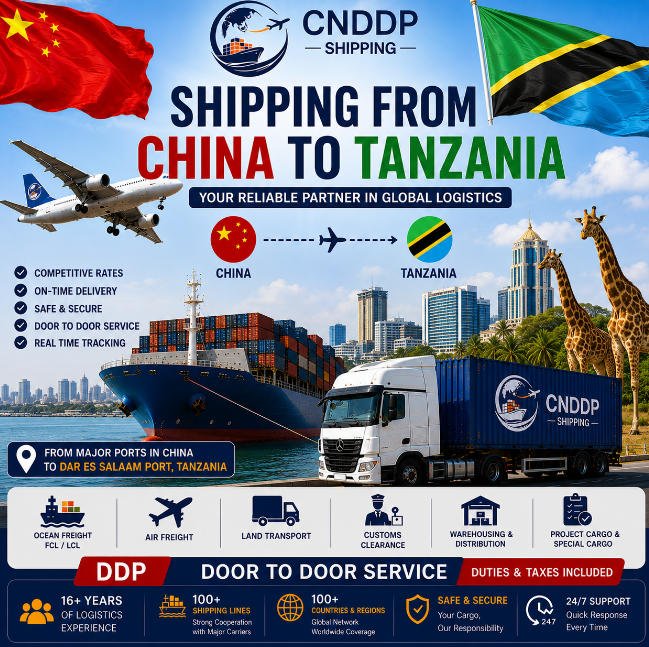
How to ship from China to Tanzania
What are the available methods for shipping from China to Tanzania
Sea Freight (FCL & LCL)
Air Freight
Table of Contents
Shipping From China to Tanzania in 2026
As a crucial node on the East African coast for the “Belt and Road” initiative, Tanzania serves as a strategic gateway for Chinese companies entering the East and Central African markets. Imports from China account for over 30% of Tanzania’s total imports, including machinery, electronics, construction materials, and solar products. Transportation between the two countries benefits from the following advantages:
- The Port of Dar es Salaam is undergoing continuous expansion, increasing its container handling capacity.
- Enhanced regional transshipment capabilities allow for distribution to landlocked countries such as Rwanda, Burundi, and Zambia.
- Collaboration between Chinese logistics companies and local customs clearance agents is becoming more mature.
- The introduction of new technologies such as automated warehousing and drone transportation significantly improves freight efficiency and reduces manual intervention and human error.
Shipping Methods from China to Tanzania
In the era of globalization, trade between China and Nigeria is frequent. Exploring efficient and transparent transportation solutions is crucial to ensuring the safe and timely delivery of goods. This article will discuss these transportation methods, including their costs and efficiency. The following sections will provide a detailed overview of various transportation options:
Sea Freight Dominates
In China-Tanzania cargo transportation, sea freight plays a dominant role, accounting for over 95% of the trade volume. The main routes depart from ports along China’s eastern coast, pass through the Strait of Malacca, cross the Indian Ocean, and finally arrive at Tanzanian coastal ports. This modern version of the “Maritime Silk Road” has become the lifeline of China-Africa trade.
Air Freight’s Supplementary Role
Although air freight accounts for less than 5% of the total cargo volume, it plays an irreplaceable role in the transportation of high-value and time-sensitive goods. With the increasing export of Chinese electronic products and medical supplies to Tanzania, the importance of air freight channels is growing year by year.
Emerging Multimodal Transportation Model
An innovative multimodal transportation model is gradually emerging: goods are first transported by sea to Tanzanian ports and then distributed to landlocked East African countries through inland transportation systems such as the Standard Gauge Railway (SGR). This “sea-rail intermodal” model is changing the regional logistics landscape.
Common Trade Terms
- FOB (Free On Board): Buyer designates the freight forwarder
- CIF (Cost, Insurance, and Freight): Seller is responsible for sea freight
- DDP/DDU (Delivered Duty Paid/Delivered Duty Unpaid): Increasingly favored by small and medium-sized buyers
| Shipping Mode | Cost Range | Main Destination |
|---|---|---|
| Sea FCL 20GP | $2000 – $4500 | Dar es Salaam |
| Sea FCL 40HQ | $2500 – $5500 | Dar es Salaam |
| Sea LCL | $60 – $150 / CBM | Dar es Salaam, Dodoma |
| Air Freight | $4.0 – $9.0 / KG | Julius Nyerere Airport |
| DDP Sea LCL | $160 – $280 / CBM | All Tanzania cities |
| DDP Air | $5.0 – $12.5 / KG | All Tanzania cities |
Sea Freight from China to Tanzania
Sea freight is the most common and economical international shipping method, offering lower costs and the capacity to handle large volumes of cargo. Sea routes are stable, and shipping schedules are relatively regular, making it suitable for planned imports. The main service models are FCL (Full Container Load) and LCL (Less than Container Load).
Port of Dar es Salaam
The largest and most important port in Tanzania, handling over 90% of the country’s container imports and exports, and serving several landlocked countries. It is a regional logistics hub with multiple shipping routes, suitable for both FCL and LCL shipments. Customs clearance speed depends on the completeness of documents and the experience of the agent.
Sea Freight Process
- Port Selection: Departing from major Chinese ports, crossing the Indian Ocean, and finally arriving at the Port of Dar es Salaam in Tanzania.
- Ocean Transportation: Sea freight typically takes 25-35 days, depending on the ship’s route, season, and weather conditions.
- Customs Clearance and Destination Port Handling: Upon arrival at the Port of Dar es Salaam, goods need to undergo customs clearance by Tanzanian customs. Customs duties and import taxes are paid according to the type of goods. After customs clearance, the goods can be picked up from the port warehouse or a designated logistics company for further transportation.
- Inland Transportation to Destination: Transportation from the Port of Dar es Salaam to other locations within Tanzania is usually done by land (truck) or rail. For cross-border transportation to neighboring countries such as Uganda and Kenya, further transportation can be done by road or rail.
The cost depends on whether you choose Less than Container Load (LCL) or Full Container Load (FCL), plus a range of surcharges, port fees, and handling charges.
- LCL shipments are priced per cubic meter (CBM).
- FCL shipments depend on the container size (20-foot, 40-foot, or 40-foot high cube).
Other charges may include fuel surcharge (BAF), terminal handling charges (THC), documentation fees, port fees, and destination port handling charges. The following are the average costs for shipping from various Chinese ports to Dar es Salaam in 2026:
| Method | Typical Cost | Best For | Notes |
|---|---|---|---|
| LCL Sea Freight | $60–$150 | 1–12 CBM mixed cargo | Minimum 1–2 CBM charges apply; origin/destination fees additional |
| FCL 20GP | $2,000–$4,500 | 18–25+ CBM bulk shipments | Stable cost per CBM; varies by line, season, and China origin port |
| FCL 40GP | $2,500–$5,500 | 55–68+ CBM large-volume cargo | Better cost-to-volume ratio; peak season may push rates higher |
Sea Freight Time from China to Tanzania
Sea freight has a relatively long transportation cycle, generally taking 25-35 days. The exact time depends on the distance between the departure and destination ports and the vessel’s schedule. Sea freight is not suitable for goods that require rapid delivery due to the long transit time.
- Weather conditions: Adverse weather conditions (such as typhoons and storms) may cause delays in transportation time.
- Seasonal fluctuations: Peak shipping seasons (such as before and after the Chinese New Year and during the summer) may lead to vessel congestion, resulting in longer transportation times.
- Port congestion: Ports may experience congestion due to cargo backlogs or difficulties in unloading, affecting transportation time.
- Route selection: Different shipping routes have different transit times. Some routes may involve fewer transshipment ports, resulting in shorter transportation times.
The following are the main sea routes between the two countries:
| Route | Transit Time | Frequency | Remarks |
|---|---|---|---|
| Shenzhen → Dar es Salaam | 40–45 days | Weekly | Most common route |
| Ningbo → Dar es Salaam | 38–42 days | Weekly | Stable schedule |
| Shanghai → Dar es Salaam | 36–40 days | Weekly | High-volume route |
| Guangzhou → Dar es Salaam | 35–40 days | Weekly | Preferred for electronics |
| Qingdao → Dar es Salaam | 42–48 days | Weekly | Heavy industrial goods |
Air Freight from China to Tanzania
Air freight offers fast transportation speeds, short transit times, and high security, reducing the risk of cargo damage and loss. The operational process is relatively simple, making it suitable for small quantities of valuable goods that require urgent delivery.
Main Airport
Tanzania’s largest international airport and a central hub for air cargo handling, suitable for transporting high-value goods and urgent orders.
Air Freight Process
- Airline Selection: Goods depart from major international airports in China and are transported by air to Julius Nyerere International Airport (DAR) in Tanzania.
- Air Transportation: Air freight typically takes 3-7 days, which is much faster than sea freight, but the cost is higher.
- Customs Clearance and Pickup: Upon arrival at the Tanzanian airport, the goods need to undergo customs clearance. After customs clearance, the goods can be picked up through the airport logistics company or a destination agent.
- Destination Transportation: For goods that need further transportation to other regions of Tanzania or neighboring countries, land transportation is usually used.
Air Freight Rates from China to Tanzania
Air freight charges are primarily calculated based on chargeable weight, which is the greater of either the volumetric weight or the actual weight. Therefore, large but lightweight goods may incur higher costs due to their volumetric weight. The formula for calculating volumetric weight is: Length × Width × Height (cm) ÷ 6000
Other factors include:
- Airline choice (direct flight or transit through a Middle Eastern hub)
- Fuel surcharge and security surcharge
- Type of cargo (general cargo, battery-powered goods, fragile goods, restricted goods)
| Weight Break | Typical Cost (USD per kg) | Notes |
|---|---|---|
| 45–100 kg | $5–$9 / kg | Small shipments have the highest rate; significant effect from volumetric weight. |
| 100–500 kg | $4.5–$8 / kg | Medium shipments; commonly booked by importers needing fast restocking. |
| 500–1000 kg | $3.5–$6 / kg | More cost-efficient; airlines often offer better space allocation at this tier. |
| 1000 kg+ | $3–$5 / kg | Best cost per kg; suitable for large urgent shipments. |
Standard Air Freight
This common air freight service is suitable for general cargo, offering relatively stable delivery times and relatively affordable prices. It’s ideal for most non-urgent shipments, such as electronics, clothing, and mechanical parts.
Express Air Freight
This service offers fast shipping, typically through reputable courier companies (such as DHL, FedEx, and UPS). It’s ideal for shipments requiring extremely fast delivery, including small, high-value shipments that require rapid delivery.
Specialized Air Freight
This service offers customized shipping conditions to ensure the safety of goods requiring special handling, such as perishables, temperature-controlled goods (such as pharmaceuticals and food), and valuables.
Air Freight Time from China to Tanzania
Air freight is much faster, with goods typically delivered within 5-10 days. This method is often used for urgent situations and small shipments, but it is relatively more expensive and is also affected by the following factors:
- Customs Clearance: Customs clearance procedures can extend the delivery time. Preparing all relevant documents in advance can expedite this process.
- Flight Availability: The number of weekly flights from China to Tanzania may vary, so delivery times may be subject to slight adjustments.
- Weather Conditions: Adverse weather conditions (such as strong winds) can cause flight delays, so it’s essential to check the weather forecast.
The following are the average air freight transit times from China to Tanzania.
| Route | Transit Time | Frequency |
|---|---|---|
| Guangzhou (CAN) → Julius Nyerere Int’l Airport (DAR) | 8–10 days | Daily |
| Hong Kong (HKG) → Julius Nyerere Int’l Airport (DAR) | 6–9 days | Daily |
| Shanghai (PVG) → Julius Nyerere Int’l Airport (DAR) | 7–9 days | 4 times per week |
| Shenzhen (SZX) → Julius Nyerere Int’l Airport (DAR) | 8–10 days | 3 times per week |
DDP Shipping from China to Tanzania
When shipping from China to Tanzania, most importers prefer door-to-door delivery because it eliminates the hassle of customs clearance or dealing with local agents. Two common international delivery terms are DDP (Delivered Duty Paid) and DAP (Delivered at Place). The advantages of DDP include:
- Zero customs hassle: The freight forwarder handles customs clearance under the Importer of Record (IOR) and TRA regulations.
- Prepaid taxes: All customs duties and VAT are included – no hidden costs whatsoever.
- Nationwide delivery: Last-mile delivery to Dar es Salaam, Dodoma, Arusha, Mwanza, and other locations.
- Fast turnaround: Customs clearance is completed before the vessel arrives, minimizing port storage costs.
- No license required: Ideal for new importers or e-commerce sellers.
Prepare the following shipping documents in advance:
- Commercial Invoice: Lists the value, quantity, weight, and other information about the goods.
- Packing List: Describes the details of the goods in each container or package.
- Air Waybill: The official document for air freight contracts, which must be provided by the carrier.
- Certificate of Origin: A document confirming the origin of the goods.
- Import/Export Licenses: Some specific categories of goods require relevant import or export licenses.
- Other Special Documents: If the goods are hazardous or require temperature control, a hazardous materials declaration or temperature-controlled transportation requirements document will also be needed.
Customs Clearance for Shipments from China to Tanzania
All goods imported into Tanzania are regulated by the Tanzania Revenue Authority (TRA) through the electronic platform TANCIS. Adherence to HS code classification, valuation, and documentation requirements is crucial to avoid delays and additional costs. Detailed steps include:
- Document Submission: Invoices, packing lists, bills of lading or air waybills, and supporting documents are verified and submitted to TANCIS.
- HS Classification and Valuation: The TRA confirms the HS code and assesses the customs value (CIF basis) to calculate duties.
- Tax Assessment: The system calculates import duties, VAT, levies, and any excise taxes applicable to specific goods. Import duties generally range from 0-25%, and VAT is 18%.
- Port/Airport Handling: After compliance checks, the TRA issues a release order; terminal/warehouse handling and last-mile delivery are then arranged.
Freight Forwarding from China to Tanzania
Choosing the right freight forwarder will help you effectively manage various shipping challenges and ensure smooth logistics operations.
Please contact CNDDP Shipping for a quote. To provide an accurate estimate, we require the following information:
- Cargo Specifications: Length × Width × Height (cm), Gross Weight (kg), Number of Cartons/Pallets
- Product Information: Product Name, HS Code (if available), Declared Value and Currency
- Addresses: Pickup location in China (factory/warehouse) + Delivery city in Tanzania
- Timing: Delivery Date, Preferred Estimated Arrival Time, Special Deadlines (promotions, production start)
- Service Preferences: Sea Freight DDP/Air Freight DDP/Full Container Load (FCL)/Less than Container Load (LCL)/Express; Insurance Required (Yes/No)
Why Choose CNDDP Shipping?
CNDDP Shipping has handled over 50,000 international shipments, providing sea, air, rail, and DDP shipping solutions from China to destinations worldwide, with 24/7 freight tracking and customer support.

Sophie Miller
Amazon cross-border sellers
Smooth Amazon FBA delivery with complete DDP clearance. Reliable and cost-effective logistics partner.

Ryan Carter
Import trader
Our DDP shipments via CNDDP Shipping are always on schedule. Support is quick and solutions are practical.