
Economic and trade ties between China and the Philippines remain robust, making the Philippine market a key focus for Chinese cross-border e-commerce sellers, export-oriented factories, and trading companies expanding into Southeast Asia. Demand for shipments to cities such as Manila, Cebu, and Davao is rising year by year. However, many shippers are unfamiliar with local customs policies and tax regulations; under traditional FOB or CIF terms, the consignee is responsible for handling customs clearance and tax payments, leaving newcomers vulnerable to issues like cargo detention and exorbitant port demurrage fees.
DDP (Delivered Duty Paid)—a one-stop, door-to-door logistics solution—offers the most hassle-free shipping experience for the Philippines and is the flagship dedicated service provided by CNDDP Shipping for the China-Philippines route.
What is DDP shipping from China to the Philippines?
DDP stands for “Delivered Duty Paid,” a standard term within the International Commercial Terms (Incoterms). Under DDP terms, the freight forwarder designated by the seller assumes responsibility for all costs associated with transporting the goods to the buyer’s specified destination, including freight charges, customs duties, and taxes.
When shipping from China to the Philippines via DDP, the freight forwarder handles the entire process: export customs clearance in China, transport to the Philippines, import customs clearance in the Philippines, payment of duties and taxes (such as GST/VAT), and last-mile delivery. The consignee does not need to handle any customs clearance or tax payment procedures; the goods are delivered directly to the designated address.
For DDP shipments from China to the Philippines, the freight forwarder typically manages the following:
- Picking up goods from the Chinese supplier’s warehouse.
- Transporting goods to the freight forwarder’s warehouse (if LCL/consolidation is required).
- Export customs clearance in China.
- International transport (via air, sea, rail, or express courier).
- Import customs clearance in the Philippines.
- Payment of customs duties and import taxes in the Philippines.
- Filing Philippine customs declarations.
- Door-to-door delivery to the final address.
- Tracking and logistics process management.
For buyers, DDP shipping means fewer customs issues and a smoother shipping process. Since all duties and taxes are prepaid under DDP terms, no additional fees are required upon the arrival of the goods.
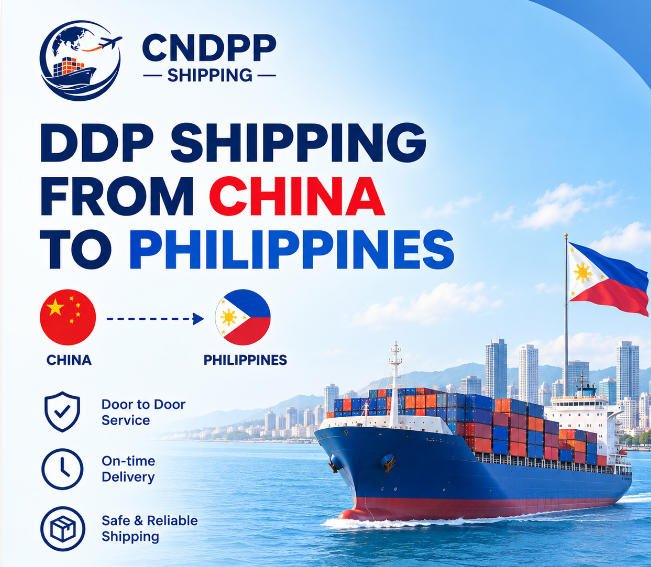
CNDDP Shipping offers a comprehensive DDP service from China to the Philippines, covering domestic warehouse pickup, export declaration, main-leg sea or air transport, Philippine import clearance, payment of duties and VAT, port charges, and local trucking delivery in the Philippines. CNDDP Shipping assumes all risks, customs matters, and import tax liabilities until the goods reach the delivery address; the recipient simply waits for the shipment without needing local import qualifications. This service is ideal for cross-border e-commerce, small and medium-sized foreign trade enterprises, and factories shipping trial orders.
Overview of DDP Shipping Channels from China to the Philippines
For shipments from China to the Philippines, CNDDP Shipping offers three established DDP channels—LCL sea freight, FCL sea freight, and air freight—tailored to shipment volume and delivery urgency. Using Manila as the central hub, the service supports onward transport to other inland cities and islands across the Philippines.
- Sea Freight LCL (DDP): Ideal for loose cargo, samples, e-commerce restocking, and small-to-medium batch shipments. It offers low logistics costs and is suitable for routine inventory replenishment where delivery speed is not critical.
- Sea Freight FCL (DDP): Best suited for large-volume shipments—such as construction materials, furniture, machinery, or full-warehouse stock—offering significant cost advantages per unit for bulk cargo.
- Air Freight (DDP): Designed for urgent orders, high-value goods, and rapid restocking for platform promotions. It features short transit times and is ideal for small, time-sensitive shipments.
DDP Shipping cost from China to the Philippines
The table below outlines reference DDP rates for CNDDP Shipping 2026 services from China to the Philippines. These rates cover domestic pickup, export customs clearance, main-haul transport, Philippine customs clearance, duties and VAT, and delivery to standard commercial addresses in the Philippines.
| Shipping Mode | Destination Port/Airport | Cost Range (USD) |
|---|---|---|
| LCL Sea Freight DDP | Manila Port, Philippines | $70‑150 per CBM |
| FCL 20GP Sea Freight DDP | Manila Port, Philippines | $1000‑3500 per container |
| FCL 40HQ Sea Freight DDP | Manila Port, Philippines | $1500‑4800 per container |
| Air Freight DDP | Ninoy Aquino International Airport (MNL) | $3.5‑8.5 per KG |
Note: Separate inquiries are required for oversized items, hazardous materials, goods requiring special certification, and shipments to remote islands. Rates are subject to fluctuation during peak seasons due to fuel costs and capacity constraints. Residential delivery and cargo insurance are optional value-added services and are not included in the base quote.
DDP Shipping time from China to the Philippines
| Shipping Mode | Destination Port/Airport | Door‑to‑Door Transit Time | Applicable Cargo |
|---|---|---|---|
| LCL Sea Freight DDP | Manila Port, Philippines | 14‑22 Days | Small batch cargo, e-commerce inventory, samples, light industrial goods |
| FCL 20GP Sea Freight DDP | Manila Port, Philippines | 12‑18 Days | Bulk commercial goods, machinery, furniture, building materials |
| FCL 40HQ Sea Freight DDP | Manila Port, Philippines | 12‑18 Days | Large-volume stock, heavy equipment, full warehouse shipment |
| Air Freight DDP | Ninoy Aquino International Airport (MNL) | 3‑7 Days | Urgent replenishment, high-value goods, small parcels, order rush |
DDP Shipping Process from China to the Philippines
- Requirement Assessment & Quotation: The client provides shipment details—including HS code, product description, volume, gross weight, cargo value, and the delivery address in the Philippines. CNDDP Shipping selects the appropriate shipping channel based on these details and provides an all-inclusive DDP quote.
- Domestic Pickup & Warehousing/Packing: We arrange for a truck to collect the goods from the client’s factory or warehouse and provide value-added services such as pallet reinforcement and outer carton packaging as needed.
- Export Documentation & Customs Declaration: We prepare customs clearance documents—such as the commercial invoice and packing list—and complete the domestic export declaration.
- Mainline Transport & Shipment Tracking: Once the goods are loaded onto the vessel or aircraft, we provide the client with a tracking number to monitor the shipment’s status in real-time.
- Import Customs Clearance & Tax Payment in the Philippines: CNDDP Shipping works with local customs brokers to declare the shipment to the Philippine Bureau of Customs (BOC) and pays the required customs duties and import VAT.
- Last-Mile Local Delivery: Following customs release, we arrange for local trucking to deliver the goods to the designated address, completing the delivery process.
Philippines Import Duties, VAT, and Customs Clearance
Philippine Customs determines duty rates based on HS codes, with rates ranging from 0% to 30%. Duties for general hardware, daily consumer goods, and packaging materials typically fall within the 5%–15% range, whereas rates for textiles, electronics, and certain agricultural products are generally higher; however, some goods qualifying under free trade agreements may be eligible for zero-duty treatment. A 12% import VAT is levied on the vast majority of imported goods, calculated based on the CIF value plus the applicable import duty.
Philippine Customs strictly enforces declaration accuracy. Commercial invoices must truthfully state the product category, material, quantity, and declared value; under-declaring value or misrepresenting product descriptions can easily trigger customs inspections, cargo detention, and fines. Special categories—such as food, cosmetics, medical devices, and pharmaceuticals—require advance preparation of documents like FDA registration certificates (CPR), LTO licenses, and phytosanitary certificates; failure to provide compliant documentation will prevent successful customs clearance.
CNDDP Shipping pre-reviews the complete set of documents and guides clients on proper declaration procedures to minimize the likelihood of inspections. For goods requiring special qualifications, we inform clients of the necessary documentation in advance to prevent cargo delays at the port and the resulting high demurrage and detention charges.
DDP Shipping to the Philippines: Prohibited Items and Important Notes
- Prohibited Items: Flammable, explosive, or hazardous materials; infringing or counterfeit goods; pornographic publications; controlled substances; live animals or plants; etc. These cannot be shipped via DDP channels.
- Goods Containing Batteries or Magnets: For items with built-in lithium batteries or magnetic components, MSDS reports and battery documentation must be submitted in advance; misdeclaring product attributes is strictly prohibited.
- Delivery Address Classification: Delivery times are stable for commercial addresses in the Manila metropolitan area; however, remote towns, villages, and islands are classified as remote areas, resulting in longer delivery times and requiring a separate shipping cost calculation.
- Branded Goods: For goods bearing brand logos, please prepare brand authorization documents prior to shipment; goods without proper authorization risk being detained.
- Random Customs Inspections: Even when using all-inclusive DDP channels, random customs inspections are an uncontrollable factor; the CNDDP team will monitor and manage the customs clearance process throughout.
FAQ
Q1: Does the consignee need to pay additional taxes when using the CNDDP Shipping Philippines DDP channel?
A1: No. The base DDP quote already includes Philippine import duties and VAT. Once the shipment clears customs at a commercial address, the consignee will not receive a tax bill. Residential delivery fees and cargo insurance are optional value-added services and are not included in the base price.
Q2: Is billing based on actual weight or volumetric weight?
A2: Sea freight LCL (Less than Container Load) is billed by volume (CBM). Air freight is billed based on the higher of volumetric weight or actual weight, using a conversion standard of 1 CBM = 167 kg. Please provide accurate dimensions and weight before receiving a quote to avoid additional charges later.
Q3: Besides Manila, can shipments be sent to cities like Cebu or Davao?
A3: Yes. Manila serves as the main hub; after arrival, goods are transshipped to inland areas. Delivery to inland cities takes an additional 3–7 days, and shipping costs must be calculated separately.
Q4: Who is responsible for port demurrage fees resulting from customs inspections?
A4: If the customer declares goods accurately and provides complete, truthful documentation, CNDDP Shipping handles the customs clearance process. However, if goods are detained or incur demurrage fees due to the customer providing false information or under-declaring the product name or value, the shipper is responsible for all associated costs.
Q5: Can I purchase cargo insurance for the shipment?
A5: Yes. The base DDP quote does not include cargo insurance; however, CNDDP Shipping offers insurance services based on the cargo’s value, providing claims support for damage or loss during transit.
Q6: Can small personal samples be shipped via the Philippines DDP line?
A6: Yes, we accept e-commerce samples and small personal packages. However, for oversized or overweight items, or sensitive product categories, please provide details in advance to confirm whether shipment is possible.