
Nigeria is the largest economy in West Africa and one of China’s most important trading partners on the continent; large volumes of goods—including building materials, hardware and machinery, household goods, home appliances, auto parts, and consumer products—are regularly shipped there from China. Compared to air freight, ocean freight is the primary mode of transport for exports to Nigeria, offering the best cost-performance ratio and highest capacity, making it ideal for large-scale foreign trade orders.
The shipping route from China to Nigeria is a long-haul West African route characterized by lengthy transit times, frequent transshipments, and high rates of port congestion. Freight rates fluctuate significantly due to factors such as carrier capacity adjustments, Red Sea navigation conditions, and seasonal stocking surges in West Africa, resulting in marked price differences across different months. Furthermore, Nigeria’s customs clearance regulations are complex and port-related miscellaneous fees are numerous; foreign trade clients often encounter issues such as non-transparent pricing, delays and demurrage, and cost overruns caused by hidden fees.
CNDDP Shipping has specialized in the China-Nigeria ocean freight route for 13 years. By integrating direct shipping resources from major ports across China and leveraging deep expertise in West African route operations and local customs policies, the company offers comprehensive services. The following section analyzes the latest 2026 market trends, breaking down shipping rates for 20ft and 40ft containers, container suitability, factors influencing freight costs, and the specific advantages of this dedicated shipping service.
Shipping from China to Nigeria
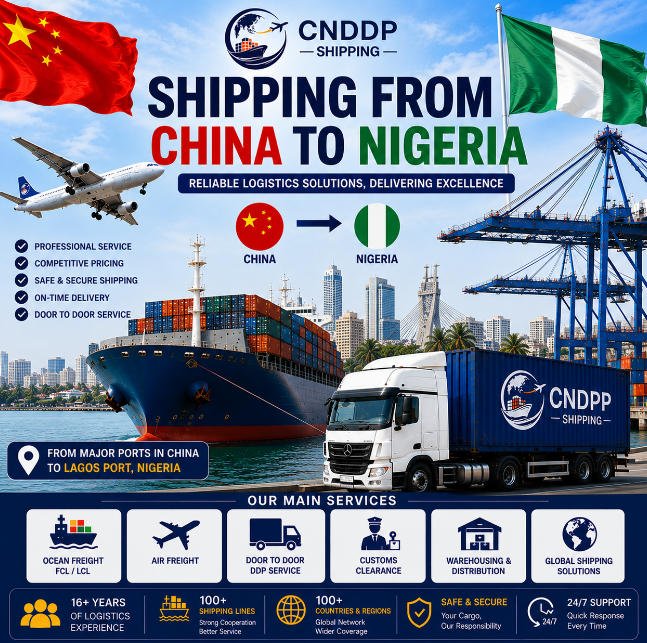
Located on the coast of the Gulf of Guinea in West Africa, Nigeria serves as a key hub for goods entering the region, with its ports providing access to the entire West African market. Major exports from China to Nigeria span a wide range of categories—including construction materials, engineering machinery, automotive and motorcycle parts, kitchen and bathroom appliances, textiles and apparel, consumer goods, plastic products, and hardware tools—with strong demand for both small-batch and large-volume Full Container Load (FCL) shipments.
The primary container destinations in Nigeria are centered around two main port areas in Lagos: Apapa Port and Tin Can Island Port. Apapa Port is the region’s busiest hub, boasting the highest throughput and the densest network of shipping routes, making it the preferred port of call for the vast majority of Chinese cargo. Tin Can Island Port primarily handles overflow volume and generally experiences less congestion. Stable shipping routes operate from major Chinese ports such as Shanghai, Ningbo, Shenzhen, Guangzhou, and Tianjin; however, most involve transshipment via North Africa or the Mediterranean rather than direct service, resulting in longer overall transit times.
CNDDP Shipping specializes in providing one-stop ocean freight services—covering both FCL (20ft/40ft) and LCL (Less than Container Load)—for shipments from China to Nigeria. We maintain long-standing partnerships with leading carriers serving the West African route, such as MSC, CMA, and Maersk, ensuring consistent access to shipping space year-round. With extensive experience in West African logistics, our team is well-versed in local port congestion, demurrage regulations, customs clearance requirements, and documentation standards. We effectively mitigate common industry challenges—such as transshipment delays, cargo holds due to inspections, exorbitant demurrage fees, and hidden surcharges—to deliver transparent, reliable, and cost-effective shipping solutions for export manufacturers and cross-border traders.
20ft & 40ft Container Shipping Cost from China to Nigeria
The following are real-time USD quotes from CNDDP Shipping for port-to-port transport services from China to Nigeria for 2026. These rates cover all standard domestic charges, including the base ocean freight. The quotes exclude destination-related costs such as customs duties, VAT, customs brokerage fees, terminal demurrage, and inland delivery charges. This pricing structure spans the full cycle of peak and off-peak seasons, reflecting the rate fluctuations characteristic of the West Africa route while offering tiered rates tailored to different ports.
| Origin Port | Arrival Port | 20ft Container (USD) | 40ft Container (USD) |
|---|---|---|---|
| Shanghai | Apapa (Lagos) | $2,200 – $3,800 | $2,700 – $4,300 |
| Shanghai | Tin Can Island | $2,150 – $3,750 | $2,650 – $4,250 |
| Ningbo | Apapa (Lagos) | $2,100 – $3,700 | $2,600 – $4,200 |
| Ningbo | Tin Can Island | $2,050 – $3,650 | $2,550 – $4,150 |
| Shenzhen | Apapa (Lagos) | $2,300 – $3,900 | $2,800 – $4,400 |
| Shenzhen | Tin Can Island | $2,250 – $3,850 | $2,750 – $4,350 |
| Guangzhou | Apapa (Lagos) | $2,280 – $3,880 | $2,780 – $4,380 |
| Guangzhou | Tin Can Island | $2,220 – $3,820 | $2,720 – $4,320 |
| Tianjin | Apapa (Lagos) | $2,180 – $3,780 | $2,680 – $4,280 |
| Tianjin | Tin Can Island | $2,120 – $3,720 | $2,620 – $4,220 |
Average reference price:
- 20ft container from China to Nigeria: approximately USD 2,000–4,000
- 40ft container from China to Nigeria: approximately USD 2,500–4,500
Notes:
- Reference LCL (Less than Container Load) rates: $85–160/CBM; suitable for small-batch samples and piecemeal restocking orders.
- The peak season for shipping to West Africa runs from June to November, driven by a surge in import demand in Nigeria. During this period, shipping lines impose peak season and fuel surcharges, causing rates to rise significantly. Long-term contracted clients of CNDDP Shipping enjoy exclusive benefits—such as locked-in rates and guaranteed space/priority loading—thereby avoiding price hikes and the risk of cargo being “rolled” (left behind) due to capacity constraints.
- Standard quotes apply to general cargo; shipments containing batteries, magnetic materials, liquids, powders, branded goods, or items sensitive to intellectual property concerns require separate inquiries for customized pricing.
- Sea freight from China to Nigeria primarily utilizes transshipment routes, with a total transit time of 30–45 days; delivery times are subject to significant fluctuation due to congestion at transshipment ports and weather conditions in the Gulf of Guinea.
Cost of Shipping a 20ft Container from China to Apapa Port, Nigeria
For high-density, heavy cargo such as machinery or raw materials, a 20-foot container is often the best choice. As of early 2026, the cost of shipping a 20-foot container from China to Nigeria typically ranges from $2,000 to $4,000. Please note that these prices are port-to-port prices and do not include load and unloading charges (THC) at the port of origin or destination.
| 20ft container cost component | Average Cost (USD) |
|---|---|
| Base Shipping Rate | $2,000 – $4,000 |
| Documentation & B/L Fees | $50 – $100 |
| Fuel Surcharge | $100 – $200 (Depending on oil price fluctuations) |
| Origin Port Fees | $50 – $150 |
| Destination THC | $100 – $300 |
| Customs Duties | Depends on the value of the goods. |
| Insurance | $50 – $150 |
Cost of Shipping a 40ft Container from China to Apapa Port, Nigeria
If you are shipping larger cargo such as furniture, textiles, or electronics, the price per cubic meter of a 40-foot container (or 40HC container) is more advantageous. Currently, the cost of shipping a 40-foot container from China to Nigeria is between $2,500 and $4,500.
| 40ft container cost component | Average Cost (USD) |
|---|---|
| Base Shipping Rate | $2,500 – $4,500 |
| Documentation & B/L Fees | $50 – $100 |
| Fuel Surcharge | $100 – $250 (Depending on oil price fluctuations) |
| Origin Port Fees | $80 – $200 |
| Destination THC | $200 – $400 |
| Customs Duties | Depends on the value of the goods. |
| Insurance | $100 – $200 |
Factors Affecting Container Shipping Costs from China to Nigeria
Differences Between Ports of Origin and Destination
Ports in East China (Shanghai and Ningbo) offer the most extensive West African route networks, the highest frequency of sailings, and the most competitive rates, making them the top choice for exports to Nigeria. Ports in South China (Shenzhen and Guangzhou) benefit from concentrated cargo sources and flexible cargo cut-off times, making them ideal for large-volume shipments from the region. In North China, the Port of Tianjin allows factories to ship locally, thereby reducing inland logistics costs. Regarding destination ports, Apapa Port has dense route coverage but suffers from high congestion and slightly higher rates; conversely, Tin Can Port handles less diverted cargo and experiences less congestion, resulting in lower prices and more reliable transit times.
Seasonal Fluctuations Specific to the West Africa Route
Shipping patterns for Nigeria differ from those of Europe and the US. The period from January to May is the off-season, characterized by ample space, stable low rates, and minimal port congestion—making it a prime window for shipping. June through November marks the peak season; demand surges due to local festival stocking and infrastructure material imports. Coupled with carrier peak-season surcharges and fuel surcharge hikes, freight rates rise sharply, with price differences reaching the magnitude of a thousand US dollars. Additionally, Red Sea navigation issues and congestion at Mediterranean transshipment hubs can temporarily drive up rates for West African routes.
Cargo Characteristics and Transport Modes
Unbranded, non-sensitive general cargo incurs the lowest rates and involves the simplest handling procedures. “Sensitive” cargo—such as items containing batteries or magnets, powders, liquids, or branded goods—requires specialized declarations and handling, leading to additional costs. Full Container Load (FCL) shipping offers stable transit times, lower risk, and no container-stripping fees, making it suitable for bulk shipments. Less than Container Load (LCL) shipping offers greater flexibility and suits smaller replenishment orders, but it entails higher destination-port stripping fees and a greater likelihood of customs inspections.
Impact of Nigerian Ports and Customs Clearance Costs
Nigeria’s port infrastructure is aging, and congestion is chronic, often leading to hidden costs such as container demurrage and port storage fees. Furthermore, local customs policies are volatile and document reviews are rigorous; discrepancies or missing documentation can easily cause clearance delays and result in hefty fines. The hidden costs arising from inadequate compliance practices are a defining characteristic distinguishing West African shipping routes from those serving Europe and the Americas, as well as a key factor influencing overall logistics costs.
How to Choose a Shipping Container: 20ft vs. 40ft
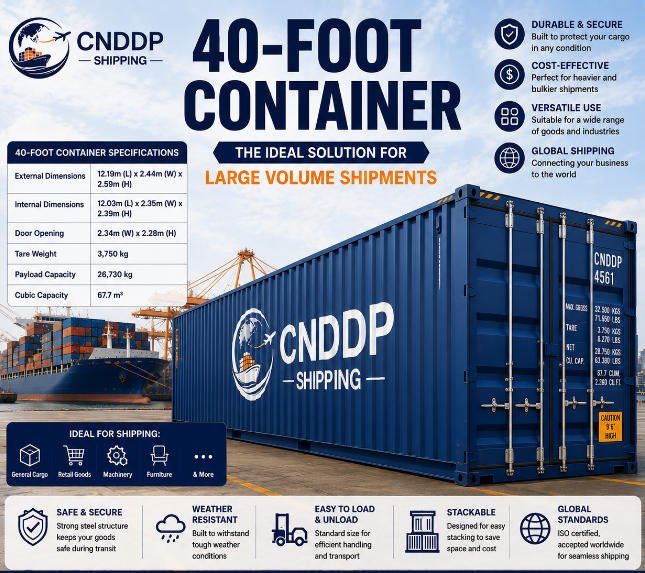
When shipping containers from China to Nigeria, deciding between a 20ft and a 40ft container isn’t as simple as assuming “bigger is automatically more cost-effective.” They differ in terms of dimensions, load capacity, and suitable use cases:
| Container Type | Dimensions (L×W×H) | Volume | Max Payload | Suitable |
|---|---|---|---|---|
| 20GP | 6.06 m × 2.44 m × 2.59 m | 28-30 m³ | 24,000 kg | Suitable for compact but heavy goods |
| 40GP | 12.19 m × 2.44 m × 2.59 m | 58-60m³ | 30,480 kg | Suitable for large quantities of bulk goods |
| 40HQ | 12.19 m × 2.44 m × 2.89 m | 68-70 m³ | 30,480 kg | Suitable for goods that are tall or require special stacking. |
20ft Standard Container
The 20ft standard container boasts excellent load-bearing capacity, handling up to 28 tons. Its compact volume makes it ideal for transporting high-density, heavy goods—perfectly matching the mainstream heavy cargo categories imported into Nigeria, such as hardware and building materials, ceramic tiles, small machinery, auto parts, metal products, and industrial consumables. Shipping via a dedicated 20ft container (FCL) eliminates the need for consolidation (LCL), thereby avoiding risks associated with mixed cargo—such as cross-inspection, damage, loss, or collateral cargo seizure—and ensuring greater transport security. With a low threshold for shipment volume and controllable logistics costs, it is an excellent choice for small and medium-sized foreign trade enterprises and regular, small-to-medium batch orders. CNDDP Shipping matches shipments with the nearest domestic port of origin based on the cargo’s location, reducing inland trucking costs and enhancing overall cost-efficiency.
40ft GP / 40ft HQ (General Purpose / High Cube)
40ft GP and 40ft HQ containers offer ample space, with the 40ft HQ (High Cube) specifically suited for lightweight, bulky cargo. These containers are designed for large-volume, lightweight shipments, accommodating high-demand Nigerian imports such as home furnishings and appliances, textiles and apparel, consumer goods, plastic products, and large-scale equipment sets; they are the preferred choice for large-scale foreign trade factories and major trading companies.
In terms of logistics costs per cubic meter, shipping large volumes in 40ft containers is far more cost-effective than using 20ft containers, as it allows for the effective amortization of costs per unit of volume. Space on West Africa routes is often tight during peak seasons, carrying a high risk of “rolled” cargo (shipment delays). CNDDP Shipping secures dedicated 40ft container space with shipping lines, ensuring priority space allocation and loading during peak periods. We handle large-volume, consolidated orders to guarantee stable delivery for our clients’ overseas supply chains.
Key Considerations for Shipping Goods from China to Nigeria by Sea
Ensure Documentation is Complete and Consistent:
Nigerian Customs enforces strict inspections; product descriptions, values, quantities, and origin details across commercial invoices, packing lists, bills of lading, and certificates of origin must match perfectly. Under-declaration or mis-declaration is strictly prohibited. Missing or non-compliant documentation can lead to cargo detention, heavy fines, or even forced return shipment—representing the single greatest risk for West Africa-bound sea freight.
Allow Sufficient Time for Transit:
Standard transit time from China to Nigeria is 30–45 days. However, factoring in transshipment delays, port congestion, and customs clearance/inspection periods, clients are advised to plan shipments 45–55 days in advance to avoid disrupting overseas sales or infrastructure project delivery schedules.
Strengthen Cargo Packaging and Protection:
The long-haul voyage to West Africa involves rough seas and multiple transshipment handling points, making cargo highly susceptible to moisture, breakage, and crushing. Building materials, home appliances, and precision equipment require robust moisture-proofing, shock absorption, and reinforced packaging to minimize the risk of damage during transit.
Manage Risks of Hidden Costs:
Routes to West Africa involve numerous miscellaneous fees. While some freight forwarders attract business with low initial rates, they may later impose additional charges for container demurrage, document amendments, or transshipment.
Select the Optimal Destination Port:
For large-volume, time-sensitive shipments, consider Apapa Port, which offers extensive route coverage and faster delivery. For shipments where speed is less critical and cost-efficiency is the priority, Tin Can Port is a suitable alternative, offering less congestion and lower miscellaneous fees.
How to Choose a Freight Forwarder for Shipments from China to Nigeria
Addressing the industry pain points associated with the Nigeria route—such as long transit times, multiple transshipments, port congestion, complex customs clearance, and numerous hidden fees—CNDDP Shipping offers not only traditional booking services but also comprehensive DDP (Delivered Duty Paid) logistics solutions. We ensure stable shipments and cost control for our clients.
- Customized West Africa Shipping Solutions: Based on cargo volume, cargo characteristics, delivery timelines, and destination ports, we precisely match the optimal container type (20FT/40FT) and shipping schedule. We prioritize avoiding congested ports and strategically plan transshipment routes to minimize total logistics costs.
- End-to-End One-Stop Service: Our service covers the entire logistics chain—including domestic pickup, warehouse loading, export customs declaration, ocean transshipment, destination customs clearance assistance, temporary warehousing, and inland delivery. We support DDU and DDP (tax-inclusive) services, eliminating the need for clients to coordinate with multiple parties.
- Full-Process Transshipment Tracking: Given the frequent transshipments and fluctuating transit times on West Africa routes, a dedicated operations specialist monitors every node and arrival status. We provide real-time tracking updates and immediately coordinate solutions for issues such as port congestion, vessel delays, or customs inspections.
- Peak Season Rate and Space Guarantees: For long-term partners, we offer quarterly rate locking and dedicated space allocation. This effectively mitigates risks associated with skyrocketing rates, space shortages, and shipment “rolling” (delays) during peak seasons, ensuring a stable overseas inventory supply.
- West Africa Documentation and Compliance Support: We are well-versed in Nigerian customs import policies and documentation requirements. We provide free assistance in reviewing complete document sets—including invoices, packing lists, bills of lading, and certificates of origin—to prevent cargo seizure, fines, or demurrage costs caused by documentation errors. We also assist in handling claims related to cargo damage or delays.