

A 20ft general cargo container (20GP/20DV) is the most basic and widely used standard ocean freight container in international trade. It is suitable for various export scenarios, including small-to-medium batch shipments, direct full container loads, and mixed cargo loading. It is also the core container type for overseas importers to calculate full container logistics costs and plan cargo volume.
Many foreign trade practitioners and buyers often confuse the internal and external dimensions, rated load capacity, and actual loadable volume of a 20ft container. They also have a vague understanding of the breakdown of full container shipping costs, leading to problems such as wasted container space, overweight penalties, and inaccurate freight forecasts.
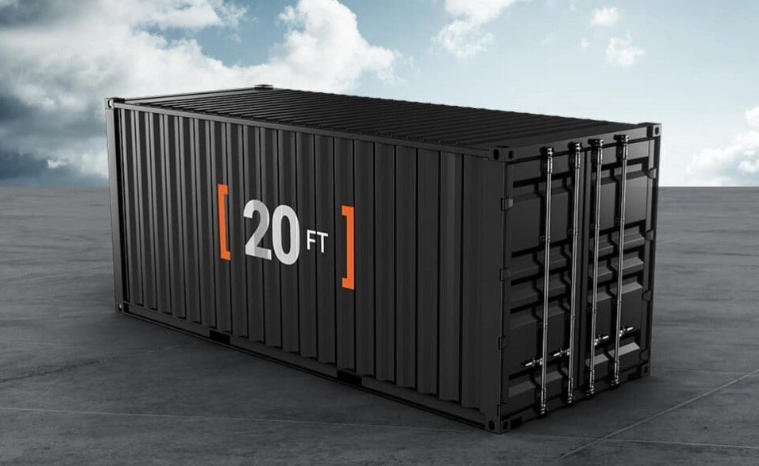
Introduction to 20FT Standard Containers
The 20ft container, short for 20 Feet General Purpose (20GP/20DV), is a standard 20-foot dry cargo container. It’s a globally accepted standard container type, widely used for transporting general cargo, miscellaneous goods, light industrial products, hardware accessories, and other goods without special temperature control or oversized/overweight requirements. This container type is compact, highly maneuverable, and has fewer restrictions on port loading/unloading and inland trucking, making it the preferred container type for small-batch full container shipments in China’s cross-border export trade.
By default, 20-foot containers on the market are standard dry cargo containers, distinct from high cube containers, open top containers, refrigerated containers, and other special container types. Dimensions, load capacity, and costs are all industry-standard, with only minor dimensional variations between different shipping companies, which do not affect routine container loading plans.
20-ft Container at a Glance
| Spec | Value |
|---|---|
| External (L×W×H) | 6.10 × 2.44 × 2.59 m |
| Internal (L×W×H) | 5.90 × 2.35 × 2.39 m |
| Door opening (W×H) | 2.34 × 2.28 m |
| Usable volume | ~33 m³ |
| Tare weight | ~2,300 kg |
| Max payload | ~28,200 kg |
Precise Dimensions of a 20FT Container
Container dimensions consist of three core parameters: external dimensions, usable internal dimensions, and door opening dimensions. These directly determine whether goods can be loaded and the total cargo capacity, and are fundamental data that must be verified before shipment. Below are the universal dimensions for an international ISO standard 20GP container, with units in both meters and millimeters, suitable for both domestic and international accounting scenarios.
| Attribute | Measurement |
|---|---|
| External Length | 20 feet (6.06 meters) |
| External Width | 8 feet (2.44 meters) |
| External Height | 8.6 feet (2.59 meters) |
| Internal Length | 19.4 feet (5.9 meters) |
| Internal Width | 7.7 feet (2.35 meters) |
| Internal Height | 7.9 feet (2.39 meters) |
| Door Opening Width | 7.7 feet (2.34 meters) |
| Door Opening Height | 7.5 feet (2.28 meters) |
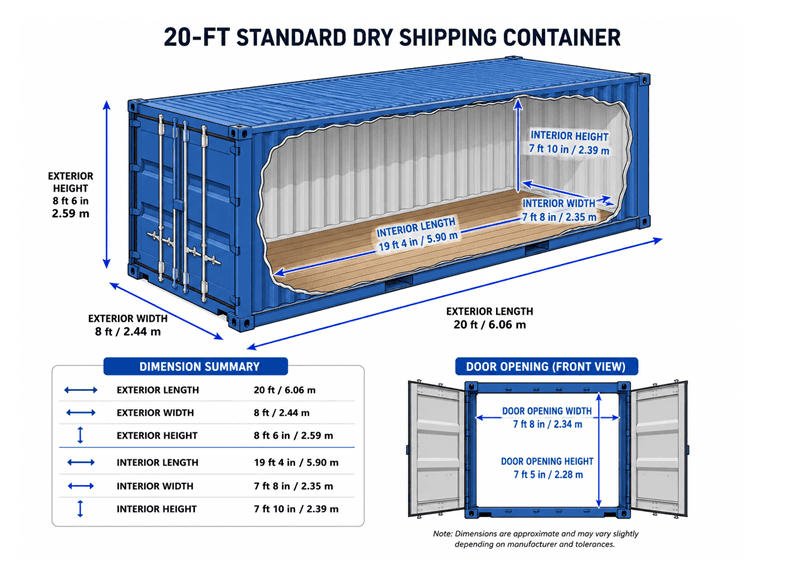
Practical Tip: The length, width, and height of the cargo’s outer packaging must be smaller than the container door opening dimensions. Oversized or overweight cargo cannot be properly loaded into a standard 20GP container and must be replaced with an open-top container or a flat rack container.
20FT Container Volume vs. Actual Loading Capacity
Theoretical Volume vs. Actual Effective Volume
The theoretical maximum volume of a 20-foot standard container is approximately 33 CBM. However, due to factors such as cargo packaging specifications, spacing, pallet space, and the need to prevent cargo from being compressed, the actual loading volume is far lower than the theoretical value. This is a key point where errors are most likely to occur during container loading in foreign trade.
Actual Loading Capacity for Different Goods
Regulated cardboard boxes and standard packaged goods without gaps: Actual loading capacity is 27–28 CBM; Irregular goods, goods with wooden frames/pallets, and fragile, spaced-out packaging: Actual loading capacity is 24–26 CBM; Heavy goods (hardware, stone, machinery parts): Subject to weight restrictions, typically 22–25 tons is sufficient, and the volume cannot be fully filled.
20FT Container Weight Parameters and Load Limitations
Load limits are the core red line for shipping 20-foot containers. They are divided into three main indicators: container tare weight, rated maximum load capacity, and maximum gross weight. They are also subject to triple constraints: shipping company weight limits, destination port weight limits, and inland truck weight limits. Exceeding the weight limit will result in hefty fines or even refusal of loading.
| Weight Parameter | Value (KG) | Value (LBS) | Remarks |
|---|---|---|---|
| Container Tare Weight | 2200 – 2400 KG | 4850 – 5290 LBS | Empty container weight |
| Max Gross Weight | 30480 KG | 67200 LBS | Total weight of container + cargo |
| Max Payload (Theoretical) | 28000 KG | 61600 LBS | Pure cargo weight limit |
| Actual Shipment Limit | 26000 – 27000 KG | 57200 – 59400 LBS | Considering shipping line & truck road restriction |
Typical cargo capacity of different types of 20ft containers
| Container Type | Tare Weight | Max Gross Weight | Payload Capacity |
|---|---|---|---|
| Standard 20ft Container | 2,300 kg | 24,000 kg | 21,700 kg |
| High Cube 20ft Container | 2,400 kg | 30,000 kg | 27,600 kg |
| 20ft Reefer Container | 3,000 kg | 25,000 kg | 22,000 kg |
Key Practical Points: The standard weight limit for major routes from China to the United States and from China to the Middle East is 26–27 tons. Exceeding this weight requires splitting the container, and the overweight penalty is 50–120 USD/ton, resulting in extremely high costs and losses.
Cost of shipping a 20FT container from China
The cost of shipping a 20FT FCL full container from China is divided into three main parts: domestic port charges, international main freight, and destination port charges. There are no hidden costs. All costs are priced in US dollars, which are the current mainstream market prices for exports from major Chinese ports and can be directly used for cost accounting and customer quotations.
| Cost Item | Estimated Cost (USD) | Billing Side | Remarks |
|---|---|---|---|
| Ocean Freight (Main Rate) | 1000 – 2800 | Per 20GP | Fluctuates with shipping season & route |
| BAF / CAF / Surcharges | 150 – 400 | Per 20GP | Fuel & currency adjustment fee |
| Terminal Handling Charge (THC) | 180 – 260 | Per 20GP | China port standard charge |
| Document Fee | 40 – 60 | Per Booking | Bill of lading document fee |
| Customs Declaration Fee | 50 – 80 | Per Shipment | China export customs filing |
| Container Sealing Fee | 10 – 20 | Per Container | Standard container seal |
| Trucking Fee (Factory to Port) | 100 – 350 | Per 20GP | Depends on factory distance |
| Destination Port Charge | 200 – 500 | Per 20GP | Varies by destination country |
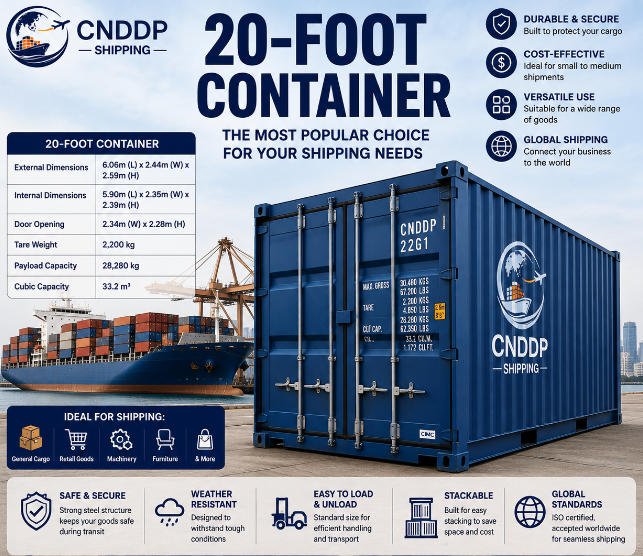
If you are interested in the cost of shipping containers from China to different countries, you can read:
- Cost of Shipping 20ft & 40ft Containers from China to Germany
- Cost of Shipping 20ft & 40ft Containers from China to the Netherlands
- Cost of Shipping 20ft & 40ft Containers from China to Tanzania
- Cost of Shipping 20ft & 40ft Containers from China to South Africa
- Cost of Shipping 20ft & 40ft Containers from China to UAE
- Cost of Shipping 20ft & 40ft Containers from China to Saudi Arabia
- Cost of Shipping 20ft & 40ft Containers from China to Jordan
- Cost of Shipping 20ft & 40ft Containers from China to Egypt
- Cost of shipping 20ft & 40ft containers from China to Iraq
Key Advantages of 20FT Full Container Load (FCL) Shipping
Compared to Less-than-Container Load (LCL), 20GP FCL shipping is better suited for stable foreign trade orders. Its core advantages are as follows:
- Lower Costs: For the same cargo volume (25 CBM or more), the average unit freight cost of FCL is significantly lower than that of LCL, with no premium for volumetric weight-based splitting.
- Enhanced Cargo Security: FCL cargo has its own dedicated container space throughout the entire process, preventing mixing with other customers’ goods and greatly reducing the risk of damage, loss, and contamination.
- More Stable Delivery Times: No need to wait for LCL cargo consolidation; customs clearance, departure, and arrival times are controllable, resulting in significantly better logistics stability than LCL.
- Easier Customs Clearance: Single container, single shipment, unified documentation, simplified customs clearance process at the destination port, and a lower probability of inspection.
Key Points for Avoiding Pitfalls in 20FT Container Shipping
- Strictly Control Weight Limits: Calculate the total weight of the cargo in advance to avoid exceeding the route’s weight limit and eliminate the risk of overweight penalties and container returns.
- Distinguish between theoretical and actual volume: Do not prepare goods based on a theoretical volume of 33 CBM. Leave 5-7 CBM for packaging and placement clearance to avoid overloading and inability to fit in the container.
- Plan ahead for oversized cargo: Goods exceeding the container door dimensions (length, width, height) must not be forcibly loaded into the container; a special container type must be used in advance.
- Allow for freight rate fluctuations during peak season: Ocean freight rates fluctuate significantly between peak and off-peak seasons (peak season increases of 30%-80%). During peak seasons, it is necessary to lock in cargo space and prices in advance to control logistics costs.
FAQ
Q1: What is the maximum volume of cargo that can be packed in a 20ft container?
A1: The theoretical volume is 33 CBM. In practice, regular, well-shaped cartons can hold 27-28 CBM. Palletized and irregularly shaped cargo can only hold 24-26 CBM. Heavy cargo is subject to weight restrictions.
Q2: What is the maximum weight capacity of a 20GP container? Will there be penalties for exceeding the weight limit?
A2: The theoretical maximum weight capacity is 28 tons. In practice, the weight limit on mainstream routes is 26-27 tons. Exceeding the weight limit will incur a penalty of 50-120 USD/ton, and in severe cases, the shipping company may refuse to carry the cargo.
Q3: Which is more cost-effective, a 20ft full container load (FCL) or less than container load (LCL)?
A3: For cargo volumes of 20 CBM or more, a 20GP FCL is preferred due to its lower unit logistics cost. For cargo volumes below 15 CBM, LCL offers better value.
Q4: Does the freight for a 20FT container include destination port taxes and fees?
A4: Standard FCL ocean freight quotes only include port of origin charges and international ocean freight, excluding destination port duties, VAT, customs clearance fees, and delivery fees. These costs are borne by the buyer.
Q5: How should I choose between 20GP and 40GP?
A5: For cargo volumes under 28 CBM and weights under 27 tons, choose 20GP; for cargo volumes over 55 CBM, choose 40GP. For smaller orders, 20GP offers greater flexibility and better value.