Canada is a significant import market in North America. A wide variety of goods are exported from China to Canada, with consistent, long-term shipments of furniture, outdoor gear, hardware and construction materials, mechanical and electrical equipment, photovoltaic (PV) components, household goods, and automotive parts. Full Container Load (FCL) shipping—offering large capacity and low per-unit costs—is the preferred choice for manufacturing exporters and cross-border e-commerce sellers moving large volumes of stock.
The China-Canada shipping route, which traverses the Pacific Ocean, is divided into two main categories: direct services to the Canadian West Coast, and East Coast services (via all-water or intermodal rail-sea transport). These options differ significantly in terms of freight rates and transit times. Canadian Customs enforces the CARM system and ACI (Advance Commercial Information) pre-declaration requirements; these strict regulations often lead to challenges for shippers, such as declaration errors, customs inspections, cargo holds, and unpredictable additional costs during inland transit.
CNDDP Shipping specializes in the China-Canada ocean freight lane. By leveraging direct access to shipping space at major Chinese ports and possessing deep expertise in Canadian customs policies and inland rail/trucking logistics, we provide comprehensive solutions. In this guide—updated for the latest 2026 market conditions—we break down the costs for shipping 20ft and 40ft containers from China to Canada, offer guidance on container selection, examine the factors influencing freight rates, and outline our specialized shipping services.
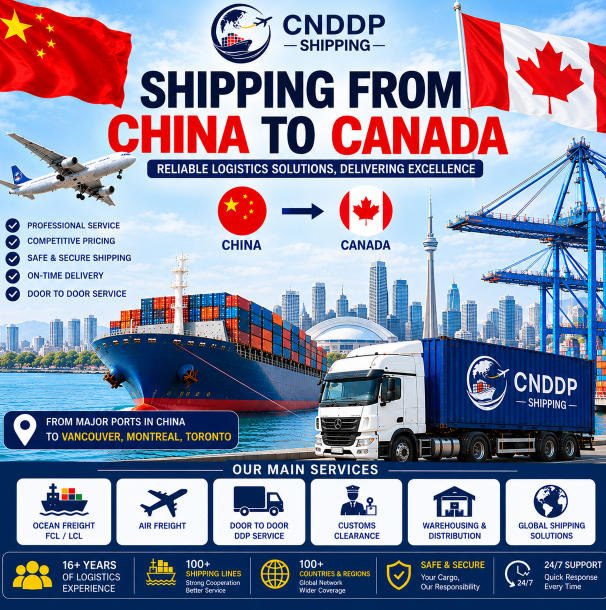
Shipping Containers from China to Canada
Ocean freight from China to Canada is divided into two main regions: the West Coast and the East Coast. Key ports on the West Coast include Vancouver and Prince Rupert; these serve as the fastest gateways for Asian cargo entering Canada, offering numerous direct shipping services. Upon arrival, goods can be transshipped via rail to cities in Eastern Canada, such as Toronto and Ottawa.
Key ports on the East Coast include Montreal and Halifax. Montreal is subject to the freezing conditions of the St. Lawrence River, which can lead to service suspensions or delays during the winter months. Halifax, serving as an alternative deep-water port in Eastern Canada, offers greater stability during the winter season. Toronto itself lacks a deep-water seaport, so the vast majority of cargo destined for the area is transported via a combination of ocean and rail (intermodal) services, typically routed through Vancouver.
Major Chinese ports—including Shanghai, Ningbo, Shenzhen, Guangzhou, and Qingdao—maintain stable shipping routes to Canada. Popular exports to Canada often consist of “light/bulky” (low-density) goods, with a high volume of furniture, outdoor equipment, and inventory for e-commerce; there is also significant demand for heavier items such as stone products, hardware, and machinery.
CNDDP Shipping provides comprehensive end-to-end logistics solutions from China to Canada, including FCL , LCL , and DAP/DDP services. Through long-standing partnerships with major shipping lines and expertise in ACI (Advance Commercial Information) manifest filing and the CARM (CBSA Assessment and Revenue Management) import declaration process, we help clients proactively avoid penalties and port demurrage risks associated with non-compliant declarations.
The China-Canada shipping route is heavily influenced by seasonal demand—driven by the North American “back-to-school” season, Black Friday, and Christmas inventory stocking—resulting in significant price fluctuations between peak and off-peak periods. Generally, the cost for a 40-foot container on these routes is approximately $500 higher than that of a 20-foot container.
How to Choose a Shipping Container: 20ft vs. 40ft
| Container Type | Dimensions (L×W×H) | Volume | Max Payload | Suitable |
|---|---|---|---|---|
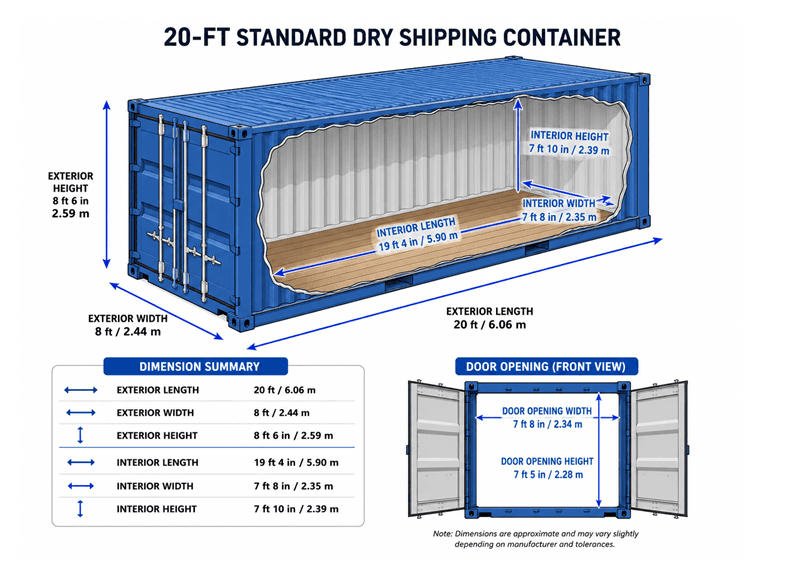
| 20GP | 6.06 m × 2.44 m × 2.59 m | 28-30 m³ | 24,000 kg | Suitable for compact but heavy goods |
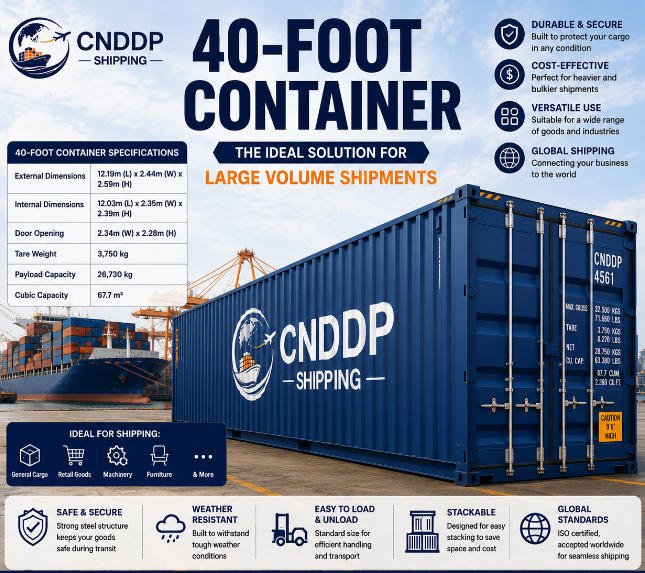
| 40GP | 12.19 m × 2.44 m × 2.59 m | 58-60m³ | 30,480 kg | Suitable for large quantities of bulk goods |
| 40HQ | 12.19 m × 2.44 m × 2.89 m | 68-70 m³ | 30,480 kg | Suitable for goods that are tall or require special stacking. |
20ft Container
The 20ft container offers a high weight capacity, making it ideal for dense, heavy cargo. With a volume of approximately 33 CBM and a maximum payload of up to 28 metric tons, it is well-suited for heavy goods such as stone products, hardware, small machinery, auto parts, and metalware.
Customs inspections in Canada are highly unpredictable. Shipping via a dedicated Full Container Load (FCL) helps avoid the risks associated with Less-than-Container Load (LCL) shipments—such as being caught up in inspections triggered by other cargo, or facing potential damage or loss. This approach offers greater flexibility, making it an excellent choice for small to medium-sized foreign trade businesses that handle smaller, recurring, or phased shipments. CNDDP Shipping can arrange for the most convenient port of departure based on the factory’s location, optimizing domestic trucking costs and providing a more cost-effective solution for our clients.
40ft / 40ft High Cube (40HQ) Container
A standard 40ft container (40GP) provides a volume of approximately 67 CBM, while a 40ft High Cube (40HQ) offers up to 76 CBM. With their superior space capacity, these containers are the primary choice for shipping furniture, outdoor gear, textiles, general consumer goods, and large-scale inventory for e-commerce. The freight cost per cubic meter is significantly lower than that of a 20ft container, offering excellent value when shipping larger volumes.
Space on routes to Eastern Canada is often tight, and during peak seasons, shipments are frequently “rolled” (bumped to a later sailing) due to vessel overbooking. CNDDP Shipping secures container space with carriers well in advance, ensuring that your peak-season inventory is loaded onto the vessel as scheduled. If your cargo is destined for an inland city—such as Toronto or Ottawa—we can proactively plan rail transshipment via Vancouver, coordinating with local Canadian rail providers to minimize wait times during inland transit.
20ft & 40ft Container Shipping Cost from China to Canada
The table below provides the latest reference rates (in USD) from CNDDP Shipping for port-to-port shipments from China to Canada. These rates cover the base ocean freight from the port of origin in China; they do not include Canadian import duties, GST, customs clearance fees, terminal handling charges, or costs for rail/inland trucking and final delivery. Please note that these rates are subject to dynamic fluctuations based on vessel space availability, fuel prices, and peak-season surcharges.
| Origin Port | Arrival Port | 20ft Container (USD) | 40ft Container (USD) |
|---|---|---|---|
| Shanghai | Vancouver | $1,750 – $4,100 | $2,250 – $4,600 |
| Shanghai | Montreal | $2,450 – $4,800 | $2,950 – $5,300 |
| Ningbo | Vancouver | $1,700 – $4,000 | $2,200 – $4,500 |
| Ningbo | Halifax | $2,350 – $4,700 | $2,850 – $5,200 |
| Shenzhen | Vancouver | $1,850 – $4,200 | $2,350 – $5,500 |
| Shenzhen | Prince Rupert | $1,800 – $4,150 | $2,300 – $4,650 |
| Guangzhou | Vancouver | $1,850 – $4,150 | $2,350 – $4,680 |
| Guangzhou | Montreal | $2,500 – $4,800 | $3,000 – $5,350 |
| Qingdao | Vancouver | $1,750 – $4,050 | $2,250 – $4,580 |
| Qingdao | Halifax | $2,400 – $4,750 | $2,900 – $5,250 |
Average reference price:
- 20ft container from China to Canada: approximately USD 1700–4,800
- 40ft container from China to Canada: approximately USD 2,200–5,500
Notes:
- LCL (Less than Container Load) reference rates: $75–145/CBM; suitable for samples and small-batch replenishment.
- The period from July to October is the peak season for China-Canada ocean freight, driven by inventory stocking in North America. During this time, carriers impose a Peak Season Surcharge (PSS), causing rates to rise by 30%–50%. Long-term contracted clients of CNDDP Shipping benefit from locked-in rates, guaranteed space, and priority booking.
- The base rates apply to general cargo. Shipments containing batteries, magnets, branded goods, or items subject to anti-dumping duties require a separate inquiry.
- Estimated transit times: 14–20 days for direct sailings from China to Vancouver; 28–38 days for all-water shipments to Montreal. Rail transshipment from Vancouver to Toronto adds 7–12 days. During the winter ice season, shipments to Montreal may face an additional 5–10 days of delay.
You might also be interested in:
- How Much does it Cost to Ship from China to the United States
- Cost of shipping 20ft & 40ft containers from China to the USA
Cost of Shipping a 20ft Container from China to Vancouver, Canada
For high-density, heavy cargo such as machinery or raw materials, a 20-foot container is often the best choice. As of early 2026, the cost of shipping a 20-foot container from China to Canada typically ranges from $1700 to $4,800. Please note that these prices are port-to-port prices and do not include load and unloading charges (THC) at the port of origin or destination.
| 20ft container cost component | Average Cost (USD) |
|---|---|
| Base Shipping Rate | $1700 – $4,800 |
| Documentation & B/L Fees | $50 – $100 |
| Fuel Surcharge | $100 – $200 (Depending on oil price fluctuations) |
| Origin Port Fees | $50 – $150 |
| Destination THC | $100 – $300 |
| Customs Duties | Depends on the value of the goods. |
| Insurance | $50 – $150 |
Cost of Shipping a 40ft Container from China to Montreal, Canada
If you are shipping larger cargo such as furniture, textiles, or electronics, the price per cubic meter of a 40-foot container (or 40HC container) is more advantageous. Currently, the cost of shipping a 40-foot container from China to Canada is between $2,200 and $5,500.
| 40ft container cost component | Average Cost (USD) |
|---|---|
| Base Shipping Rate | $2,200 – $5,500 |
| Documentation & B/L Fees | $50 – $100 |
| Fuel Surcharge | $100 – $250 (Depending on oil price fluctuations) |
| Origin Port Fees | $80 – $200 |
| Destination THC | $200 – $400 |
| Customs Duties | Depends on the value of the goods. |
| Insurance | $100 – $200 |
Factors Influencing Ocean Freight Rates from China to Canada
Destination Ports and Transshipment Options
Vancouver and Prince Rupert are direct ports on the West Coast, offering the shortest transit times and lowest freight rates. The all-water route to Montreal is more expensive and can be affected by river freezing during the winter. Halifax serves as an alternative port in Eastern Canada; while it offers greater stability during the winter ice season, it has fewer scheduled sailings. Shipments destined for inland cities incur additional intermodal (sea-rail) transport costs—a significant cost factor that distinguishes the China–Canada trade route from routes to Europe.
North American Seasonal Demand Patterns
The period from January to June is the “off-peak” season, characterized by ample vessel space, lower freight rates, and fewer customs inspections. The “peak” season runs from July to October, driven by inventory stocking for the back-to-school period, Black Friday, and Christmas. During this time, cargo volumes surge, and shipping lines often increase surcharges. Additionally, the pre-Lunar New Year rush for shipments from China can lead to short-term spikes in freight rates.
Canadian Customs Compliance Costs (ACI & CARM)
All ocean freight bound for Canada requires an Advance Commercial Information (ACI) filing. Simultaneously, importers must register and submit declarations through the CARM (CBSA Assessment and Revenue Management) system. Errors or delays in these filings can result in penalties under the Administrative Monetary Penalty System (AMPS). Many low-cost freight quotes exclude these compliance services, which can lead to unexpected charges—such as fees for document amendments or government penalties—ultimately increasing the total landed cost.
Cargo Characteristics and Packaging Requirements
General, non-hazardous cargo is the simplest to handle, whereas items containing batteries, magnetic components, or branded goods require additional documentation and review. Canada enforces IPPC (International Plant Protection Convention) quarantine requirements for wood packaging; any wooden packaging lacking a valid fumigation/treatment mark may be subject to immediate return or destruction, incurring substantial handling fees.
Container Shipping Transit Times from China to Canada
The transit time for ocean freight from China to Canada depends on factors such as the port of origin, port of destination, shipping method, weather conditions, port congestion, and—in the case of the St. Lawrence River—seasonal ice. Typical transit times are as follows:
- Southern Chinese ports → Vancouver (direct service): 14–20 days. This is the fastest route between China and Canada, making it the preferred choice for shipments destined for Western Canada or those requiring onward transport to inland cities.
- Chinese ports → Prince Rupert: 16–21 days. This route offers stable schedules and less congestion, making it ideal for shipments where consistent transit times are a priority.
- Chinese ports → Halifax (all-water route): 24–32 days. An alternative port for Eastern Canada; it remains unaffected by river ice during the winter months.
- Chinese ports → Montreal (all-water route): 28–38 days. Between December and March, the St. Lawrence River freezes, significantly increasing the likelihood of delays—often by an additional 7–15 days.
- Vancouver (intermodal rail): For inland destinations such as Toronto or Ottawa, please add 7–12 days for rail transit following the vessel’s arrival at the port.
Note: The timeframes above cover only the ocean voyage and transshipment; they do not include the time required for container loading in China, customs declaration, cargo cut-off procedures, or customs clearance and inspections at the destination port. During peak seasons, port congestion and customs inspections may further extend the total delivery time. CNDDP Shipping provides clients with comprehensive delivery estimates in advance to assist with inventory planning and scheduling.
DDP Shipping from China to Canada
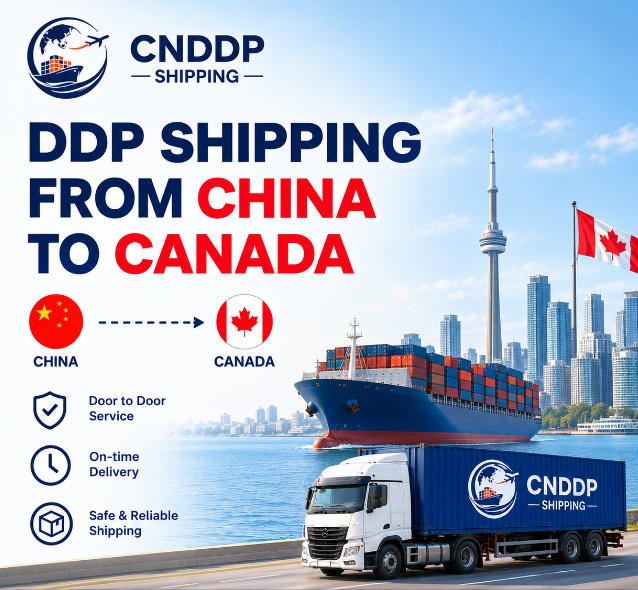
Many foreign trade clients and cross-border sellers, unfamiliar with Canada’s CARM customs system, GST, and duty declaration procedures, often opt for DDP shipping solutions. CNDDP Shipping provides full-container DDP services from China to destinations across Canada, covering major port cities—such as Vancouver, Toronto, Montreal, and Calgary—as well as various inland locations.
Under DDP terms, we manage the entire logistics process: domestic pickup, container loading, export customs clearance, ocean freight, ACI (Advance Commercial Information) manifest filing, Canadian import customs clearance, payment of duties and GST, terminal handling, and final delivery to the consignee’s address via rail or truck. The consignee simply waits to receive the goods, with no need to handle customs clearance or tax payments personally.
DDP pricing is influenced by the following factors:
- HS Code and cargo value: These directly determine the amount of duties and GST.
- Final delivery address: There is a significant price difference between port pickup and delivery to inland cities; trucking costs are higher for remote inland locations.
- Type of goods: Requirements for documentation and operational costs vary depending on whether the shipment consists of general cargo, electronics (products containing batteries), or branded goods.
- Peak-season surcharges and rail transshipment fees.
⚠️ Important Reminder: Canadian DDP shipments require a high level of declaration accuracy; under-declaring the value of goods is strictly prohibited. Customs audits can lead to fines, seizure of goods, and negative impacts on your import record. CNDDP Shipping insists on accurate declarations and conducts thorough pre-shipment document reviews to minimize the risk of customs inspections. For clients with consistent, long-term shipping needs, please contact us to request a customized DDP quote.
You might also be interested in: DDP Shipping from China to the USA
Key Considerations for Ocean Freight from China to Canada
- Strict Adherence to ACI (Advance Commercial Information) Requirements: Cargo manifests must be submitted prior to vessel departure. All information provided must be accurate and consistent; under-declaration or incorrect declaration can lead to substantial fines and may negatively impact the importer’s CARM (CBSA Assessment and Revenue Management) account standing.
- Compliance with Wood Packaging Regulations: Solid wood packaging must bear an IPPC fumigation mark. While plywood and composite wood products do not require fumigation, the specific type of packaging must be declared accurately.
- Winter Buffer for Eastern Canada Shipments: The St. Lawrence River freezes annually between December and March, causing instability in shipping schedules to Montreal. For shipments destined for the interior of Eastern Canada during the winter months, consider routing via Halifax or planning inventory well in advance.
- Distinction Between Port Delivery and Inland Delivery: There is a significant cost difference between picking up cargo at the Port of Vancouver and transporting it by rail to Toronto. Clarify the final delivery method during the quotation stage to avoid unexpected inland transportation charges later.
- No Hidden Fees: CNDDP Shipping provides transparent price quotes, detailing all costs prior to contract signing. We ensure there are no surprise surcharges at the port of destination, such as unexplained container de-vanning fees or document amendment charges.
Freight Forwarding from China to Canada
Addressing the unique challenges of the China-Canada trade route—such as long transoceanic transit times, ice-related risks in Eastern Canada, stringent ACI (Advance Commercial Information) filing requirements, and complex inland intermodal (sea-to-rail) transport—CNDDP Shipping offers a comprehensive, one-stop logistics solution tailored specifically for the Canadian market.
- Customized Route Planning: Based on the destination (whether on the West Coast, in Eastern Canada, or in an inland city), we recommend the optimal shipping method—direct service, all-water transport, or sea-to-rail intermodal via Vancouver—to strike the right balance between transit time and cost.
- Compliance and Filing Support: Our expert team assists with ACI pre-filing and guides clients through CARM (CBSA Assessment and Revenue Management) requirements. We meticulously verify invoices, packing lists, and bills of lading to minimize the risk of customs inspections and penalties.
- Peak-Season Rate and Space Guarantees: Long-term partners can secure quarterly fixed rates and guaranteed space, protecting against price hikes and “rolled” (bumped) cargo during peak seasons, ensuring a steady flow of inventory to overseas warehouses.
- End-to-End Milestone Tracking: A dedicated operations team monitors every stage—from cargo cut-off and vessel departure to arrival, rail transshipment, and customs clearance. In the event of vessel delays, port congestion, or ice-related disruptions, we provide immediate updates and coordinate alternative solutions.
- Comprehensive, One-Stop Service: We manage the entire supply chain—including domestic pickup, container loading, export customs clearance, ocean freight, destination customs clearance support, warehousing, and final-mile delivery via rail or truck within Canada. We offer DDU and DDP (duties and taxes paid) options, allowing clients to streamline their logistics by working with a single, unified provider.