
As the gateway to East Africa, Kenya is a crucial hub for trade between China and Africa. With increasing numbers of importers frequently traveling between the two countries, customs clearance is often the most underestimated yet riskiest part of international shipping. Comprehensive knowledge of customs clearance can help you: avoid the risk of goods being seized or returned, reduce unforeseen costs and penalties, and shorten delivery times.
Concepts and requirements of customs clearance in Kenya
Customs clearance refers to the entire process of declaring goods to customs, paying relevant taxes and fees, and undergoing inspection and verification before obtaining legal release. In Kenya, customs clearance is primarily managed by the customs department under the Kenya Revenue Authority (KRA). Customs clearance requirements include:
- Registration Requirements: All importers must register with the Kenya Revenue Authority (KRA) and obtain a Personal Identification Number (PIN) and a tax compliance certificate.
- Agent Requirements: A licensed customs clearance agent must be hired to handle customs clearance procedures. This agent must be registered with the Kenya Customs Agents Registration Board (CARB).
- Document Completeness: All documents must be accurate, consistent, and complete. Any discrepancies may lead to delays or penalties.
- Classification and Valuation: Goods must be correctly classified according to the Kenyan Customs Tariff (based on HS codes) and valued according to the World Trade Organization Valuation Agreement.
- Compliance: Goods must comply with the technical standards and regulations of the Kenya Bureau of Standards (KEBS) and other relevant agencies.
Any deviation in any of these steps can directly lead to customs clearance delays.
Shipping from China to Kenya
Different transportation methods are suitable for different scenarios during the shipping process from China to Kenya, and they will have different impacts on the customs clearance process.
Sea Freight
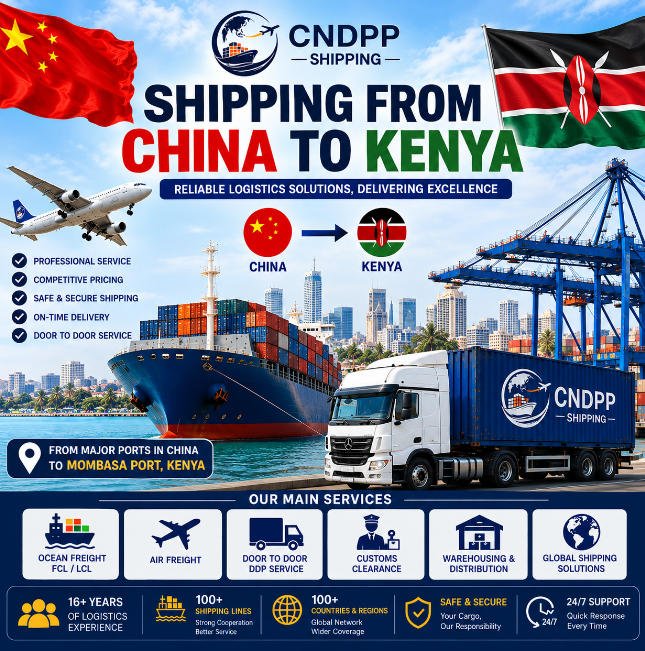
Sea freight is the most economical option for transporting large quantities of goods. It is relatively inexpensive, and sea routes are usually well-established. It is suitable for large-scale, planned shipments of goods, usually cleared through the port of Mombasa. The customs clearance process is relatively complex, but the costs are more controllable. Special attention should be paid to separate customs clearance and demurrage risks for consolidated shipments.
Impact on Customs Clearance:
- Uncertain arrival time: The long transportation time means the arrival time of goods at Kenyan ports is uncertain, leading to potential delays or demurrage during the customs clearance process.
- Higher frequency of customs inspections: Sea freight shipments require more customs inspections, especially for large quantities of goods or goods subject to stricter regulations (such as chemicals, food, etc.). This may lead to longer customs clearance times.
- Timely customs clearance after arrival: If sea freight goods are delayed at the port, demurrage charges may be incurred. Therefore, timely customs clearance and cargo collection are very important.
Air Freight
Air freight is the fastest mode of transportation, reducing inventory time and capital tie-up. It is suitable for high-value, urgent, or small-volume goods. Customs clearance is mainly conducted through Jomo Kenyatta International Airport in Nairobi. Customs clearance is fast, but requires higher accuracy of documents.
Impact on Customs Clearance:
- High-value goods: Air freight shipments usually involve higher value goods, and therefore may be subject to stricter customs inspections. It is necessary to ensure that all documents (such as invoices, packing lists, etc.) are accurate to avoid unnecessary delays.
- Air freight duties and fees: Air freight costs are higher, and Kenyan customs may assess duties based on the value of the goods, so higher taxes and fees may be incurred.
If it is a DDP shipping from China to Kenya, a selected freight forwarding company will be responsible for customs clearance.
Kenya Customs Requirements: Prepare the Necessary Documents
Understanding and preparing the correct documents is crucial for smooth customs clearance. Kenyan Customs has strict document requirements for imported goods. The main documents are as follows:
- Commercial Invoice: Must accurately reflect the transaction amount, clearly listing the goods’ names, quantities, unit prices, and total price. The currency and payment method must be consistent and reasonable.
- Packing List: Clearly states the weight, dimensions, and contents of each package, and must be consistent with the invoice and bill of lading information.
- Bill of Lading/Air Waybill: An important transportation document for sea or air freight. Consignee information must be accurate.
- Certificate of Origin: Proves the country of origin of the goods and serves as the basis for customs inspection of the goods’ source.
- Import Declaration Form (IDF): A mandatory import document in Kenya, which must be applied for before the goods are shipped. Errors or omissions will directly affect customs clearance.
- Certificate of Conformity (e.g., COC): Most products require a certificate proving compliance with Kenyan standards, issued by a designated inspection agency in the exporting country.
Customs Clearance Process for Shipping from China to Kenya
Goods transported from China to Kenya, after arriving in Kenya via sea or air freight, need to go through a series of customs clearance procedures before they can be successfully released:
Preparation Before Goods Arrival
- Obtain Importer PIN and Tax Compliance Certificate: Importers must register with KRA (Kenya Revenue Authority).
- Engage a Customs Clearance Agent: Choose a reliable agent registered with CARB (Customs Agents Registration Board).
- Submit Import Declaration Form (IDF): Complete through the iTax system and pay the corresponding fees.
- Apply for necessary licenses and certificates: Such as KEBS (Kenya Bureau of Standards) conformity certificates.
- Prepare all documents: Ensure completeness and consistency.
Customs Clearance After Goods Arrival
The carrier notifies the customs clearance agent that the goods have arrived, and the agent submits all necessary documents to customs. Customs processing includes:
- Customs assessment of document completeness
- Determination of HS code and applicable tariffs
- Calculation of payable taxes and duties
- Possible risk assessment
Payment of Taxes and Duties: Pay customs duties, VAT, etc., through designated banks or electronic systems.
Goods Release and Collection
Customs issues a release order, pay warehousing and handling fees, and arrange transportation from the port/airport to the final destination.
Import Taxes on Shipping from China to Kenya
Import duties are a significant factor in the customs clearance of goods shipped from China to Kenya. Kenya’s Value Added Tax (VAT) remains at 16%, while customs duties depend on the HS code and category of the goods. For example, electronics may be subject to duties of up to 25%, while clothing can incur duties as high as 35%.
| Product Category | Customs Duty | VAT (16%) |
|---|---|---|
| Electronics | 25% | 16% |
| Clothing | 35% | 16% |
| Machinery | 10% | 16% |
| Automotive Parts | 20% | 16% |
| Agriculture Products | 0% | 16% |
Kenya Special Customs Clearance Regulations
Understanding and complying with Kenya’s special customs clearance regulations is crucial for ensuring smooth customs clearance.
Kenya implements stricter regulations on certain goods, such as:
- Used equipment and vehicles
- Food, cosmetics, and pharmaceuticals
- Communication equipment and electronic products
These goods usually require additional licenses or inspections.
The Kenya Bureau of Standards (KEBS) is responsible for ensuring that all goods entering Kenya comply with national standards. KEBS requires compliance certification for most imported goods.
SCCP (Standardization Compliance Certification Program): All imported goods (especially consumer goods, food, building materials, etc.) require compliance certification from KEBS. Without a compliance certificate, goods will be refused entry.
PVoC (Pre-Export Verification of Conformity Program): PVoC applies to certain products and requires goods to undergo compliance checks at the country of origin before shipment. KEBS-designated certification bodies will verify the goods and issue a certificate of conformity.
How to Reduce Customs Clearance Delays and Extra Costs
Reducing customs clearance delays and extra costs is a concern for every importer. Here are some effective strategies to ensure smooth customs clearance and minimize additional expenses:
Prepare all necessary documents in advance
Ensure the accuracy and consistency of documents, and confirm the document checklist with your customs broker in advance.
Accurately declare the value and category of goods
Use the correct HS code and ensure that the declared value matches the actual value.
Choose a reliable freight forwarding company
Select an experienced agent, ensuring their qualifications and reputation, and that they can communicate with customs promptly.
Prevent cargo demurrage and port storage fees
Confirm transportation timelines in advance, arrange for timely cargo pickup, and maintain contact with your agent so that goods can be processed and transported quickly after customs clearance.
Customs clearance for shipments from China to Kenya is not just a single step, but a critical point throughout the entire logistics chain. The earlier you plan and the more thoroughly you prepare, as discussed in this article, the more controllable the customs clearance process will be.