

In the international freight and logistics industry, CBM (cubic meter) is a crucial concept that directly relates to cargo transportation costs, space management, and overall efficiency. This article provides a better explanation of CBM, helping you better understand how to improve logistics efficiency through reasonable calculations and effective management.
What is CBM? – Definition and Basic Concepts
CBM is an abbreviation for Cubic Meter, a commonly used unit of measurement for cargo volume in international logistics. It is also the core basis for determining volumetric and volumetric cargo in cross-border freight. In the international trade and transportation system, CBM is used to accurately quantify the space occupied by cargo in the transport carrier (container, cargo plane, logistics truck), and is the only standard for distinguishing between heavy and volumetric cargo and calculating volumetric freight charges.
Unlike the rough estimation methods used in domestic logistics, international freight uses highly standardized measurement and calculation methods for CBM. It must be calculated based on the maximum length, width, and height dimensions of the cargo’s outer packaging, including the dimensions of all packaging materials such as cartons, wooden frames, and pallets, without deducting gaps or open spaces, ensuring accurate and compliant billing volume.
Application Scenarios of CBM in International Freight Forwarding
CBM is used throughout the entire international freight forwarding process. All cross-border transportation channels use CBM as the volumetric calculation standard. Key application scenarios include:
- LCL/FCL: LCL sea freight is calculated entirely based on CBM, serving as the core basis for LCL freight pricing. For FCL cargo, CBM is used to calculate the container load and determine if it fits the container volume.
- International Air Freight and Express Transportation: CBM is used to calculate volumetric weight, which is compared with the actual gross weight of the cargo, and the larger value is used as the final chargeable weight.
- Cross-border Land Transportation and Multimodal Transport: All LCL and palletized cargo are calculated using CBM to determine cargo volume and settle transportation costs.
- Warehousing and Port Storage: Overseas warehousing and destination port warehousing fees are calculated monthly/daily based on CBM to account for warehousing costs.
International Freight CBM Standard Calculation Formula
The international logistics CBM calculation rules are globally unified and have no regional differences. Whether exporting from China or importing overseas, the following standardized formula is used, divided into two methods: calculation for a single piece of cargo and calculation for a whole shipment.
Single Piece Cargo CBM Calculation Formula
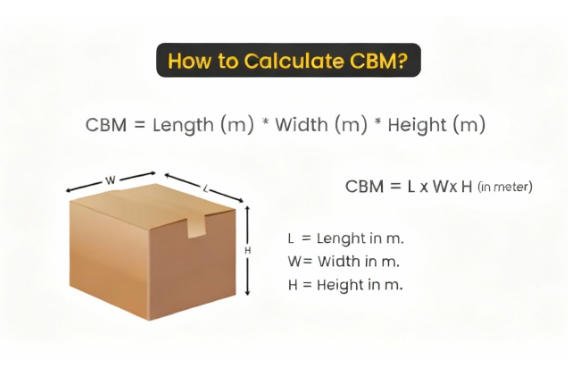
CBM (Volume per Container) = Length (m) × Width (m) × Height (m)
Note: The unit must be consistent in meters (m) when calculating. If the cargo dimensions are in centimeters (cm) or millimeters (mm), the units must be converted in advance to avoid volume calculation errors. For irregularly packaged goods, the longest, widest, and highest dimensions of the outer packaging must be measured, and the CBM should be calculated based on the largest volume.
Whole Shipment CBM Calculation Formula
Total CBM = Single Piece CBM × Total Number of Containers / Total Number of Pieces
This formula is applicable to full container load (FCL) shipments and bulk LCL shipments. It is the core basis for freight forwarders to calculate the overall cargo volume and quote freight rates, and it is also the standard reference data for allocating space for LCL shipments.
CBM Online Calculator
Click the link: CBM Calculator
International Freight Volumetric Weight to Actual Weight Conversion
The core principle of international logistics billing is to use the larger of the actual weight and volumetric weight for final chargeable pricing. Goods are categorized into two types: actual weight cargo and volumetric weight cargo. The conversion ratio for volumetric weight varies significantly across different transportation channels, which is crucial for freight cost calculation.
Actual Weight: The actual gross weight (G.W.) of the goods after weighing, in kg;
Volumetric Weight: A virtual chargeable weight calculated from CBM volume, without actual weighing evidence.
Conversion Ratios for Different Modes of Transport
International sea freight, air freight, and commercial express delivery have clearly defined industry standards for volumetric weight conversion (volume conversion factor). Specific conversion rules and billing standards are shown in the English table below. All fees are denominated in US dollars.
| Shipping Mode | Conversion Formula (Volume Weight) | Volume Weight Ratio | Average Freight Cost (USD) | Billing Rule |
|---|---|---|---|---|
| Sea Freight LCL | 1 CBM = 1000 KG | 1:1 | 50 – 150 USD/CBM | Charge by CBM if volume weight > gross weight |
| International Air Freight | 1 CBM = 167 KG | 1:167 | 3.5 – 8.5 USD/KG | Take the larger one of gross weight and volume weight |
| Express (DHL/FedEx/UPS) | 1 CBM = 200 KG | 1:200 | 6 – 12 USD/KG | Calculate by volume weight for light bulky goods |
| Cross-border Trucking | 1 CBM = 333 KG | 1:333 | 100 – 200 USD/CBM | Dual billing standard (weight & volume) |
Criteria for Determining Actual Weight and Volumetric Weight Cargo
Based on the above conversion ratios, the type of goods can be quickly determined, and the billing method can be accurately predicted:
- Actual Weight Cargo: The actual gross weight of the goods > the volumetric weight. The final freight charge is settled based on the actual weighed weight. This is common for high-density goods such as hardware, machinery, building materials, and electronic products.
- Volumetric Weight Cargo: The volumetric weight of the goods > the actual gross weight. The final freight charge is settled based on the volumetric weight. This is common for lightweight and bulky goods such as clothing, home textiles, toys, plastic products, and packaging materials.
Practical Conversion Case Study (Precise Calculation)
To facilitate intuitive understanding, this example demonstrates the complete process of CBM calculation, volumetric weight conversion, and freight cost calculation, using a typical export shipment as an example, in accordance with internationally accepted standards.
Case Parameters: Shipment from China to Saudi Arabia; single carton dimensions: 0.5m × 0.4m × 0.3m; single carton weight: 8KG; total quantity: 50 cartons; shipment via international air freight.
- Single piece CBM calculation: 0.5 × 0.4 × 0.3 = 0.06 CBM
- Total cargo volume: 0.06 × 50 = 3 CBM
- Air freight volumetric weight conversion: 3 × 167 = 501 KG
- Total actual cargo weight: 8 × 50 = 400 KG
- Billing determination: Volumetric weight 501KG > Actual weight 400KG, final billing is based on 501KG.
Freight calculation: Based on an average price of 5 USD/KG, the total freight cost is approximately 2505 USD.
Key Points to Avoid in CBM and Weight Conversion Practices
In international freight operations, most freight cost discrepancies and overruns stem from errors in CBM calculation and misuse of conversion rules. Based on practical experience in cross-border logistics, here are 5 key points to avoid these pitfalls:
- Dimensional measurements must include the outer packaging: Freight forwarders, shipping companies, and airlines all charge based on the maximum external dimensions of the cargo. Protrusions in cartons, corners of wooden frames, and protruding parts of pallets must all be included in the dimensions. Measuring only the dimensions of the cargo itself will lead to an underestimation of the CBM and excessive actual freight costs.
- Conversion factors for different channels must not be mixed: It is strictly forbidden to calculate air freight using a 1:1 ratio for sea freight. An incorrect conversion standard will directly result in a freight cost estimation deviation of over 30%, significantly increasing logistics costs.
- Palletized cargo must be calculated based on the entire pallet volume: Palletized cargo must have its CBM calculated based on the overall length, width, and height of the pallet, not the sum of individual box volumes. Pallet gaps and pallet thickness are also included in the chargeable volume. This is the most easily overlooked detail in billing.
- Prioritize Optimizing Packaging and Volume Compression for Lightweight Goods: Lightweight goods such as clothing and foam products can have their CBM (volume fraction) reduced by compressing packaging, minimizing outer box gaps, and using lighter packaging. This effectively reduces volumetric weight charges, potentially saving up to 20%-30% on air freight costs.
- Allow for Reasonable Error Margin: Actual dimensions measured at ports and airports may differ from manual calculations by 1%-3%. Allow for this margin when estimating freight costs to avoid final charges exceeding the budget.
FAQ
Q1: Does a higher CBM value always mean higher freight costs?
A1: Yes. Under the same transportation channel, route, and cargo volume, CBM volume is directly linked to freight costs. For bulky cargo, CBM is the core basis for freight cost calculation; the larger the volume, the higher the chargeable weight, and the higher the logistics costs. Although actual weight cargo is charged based on actual weight, excessively large volumes will incur warehousing and storage surcharges (USD 10-30/CBM).
Q2: Why is the volume conversion factor for air freight 167?
A2: This is a unified standard of the International Air Transport Association (IATA). The standard weight limit for 1 cubic meter of space is 167KG. Cargo lighter than this weight would waste aircraft loading space. Therefore, charging based on volumetric weight balances air transport space costs and is a globally universal rule without national differences.
Q3: Is volumetric weight used for LCL (Less than Container Load) freight?
A3: For LCL freight, 1 CBM = 1000KG; volumetric weight is equivalent to actual weight. For sea freight, there is no distinction between light and heavy cargo; the total CBM and total weight (tons) are directly compared, and the larger value is used for billing. The freight rate is the same for 1 CBM and 1 ton, making the billing rules far simpler than for air freight and express delivery.
Q4: How is CBM calculated for irregularly shaped goods?
A4: Calculated based on the maximum dimension of the circumscribed rectangle. For irregularly shaped goods, machinery parts, and irregular equipment, the maximum length, width, and height of the cuboid that can completely enclose the goods must be measured. CBM is calculated based on this, not on the actual space occupied by the goods. This is a unified international logistics billing standard.
Q5: Are there any hidden costs in CBM calculation?
A5: There are no hidden costs with standardized operations. Reputable logistics service providers strictly adhere to the measured CBM and published unit price for billing. The difference in freight costs only occurs when the customer’s self-calculated dimensions are too small or the packaging is not standardized, leading to a second measurement and increased volume. Accurately calculating CBM in advance and optimizing packaging can completely avoid such additional costs.
In summary:
CBM (Convertible Volumetric Weight) is the core unit for volumetric weight calculation in international freight forwarding, forming the basis for volumetric weight conversion, freight settlement, and cargo space planning. The conversion ratios for volumetric weight vary significantly across different cross-border transportation channels, directly determining the cargo billing method and overall logistics costs. Accurately mastering CBM measurement methods, conversion formulas, and judgment rules can effectively avoid billing errors, reduce unnecessary logistics losses, precisely control cross-border trade costs, and improve the professionalism and cost-effectiveness of import and export logistics.