
In the context of a constantly changing global trade environment and increasingly complex supply chains, Incoterms remain a core tool for regulating the responsibilities and risk allocation between buyers and sellers. EXW plays a significant role in manufacturing exports, cross-border procurement, and trade in emerging markets. This article will provide a detailed introduction to the EXW term, including its meaning, pricing methods, and the advantages and disadvantages of using EXW.
EXW (Ex Works) Overview
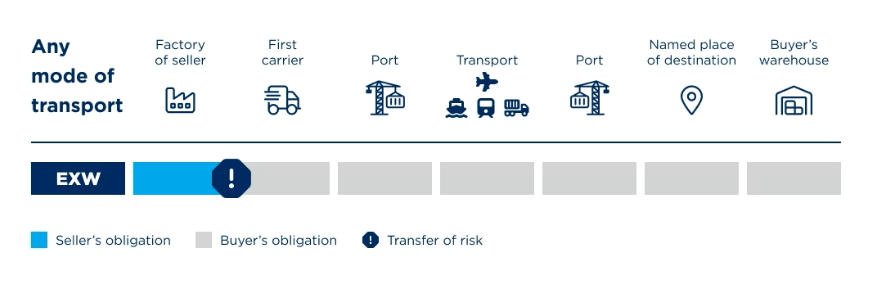
EXW (Ex Works) means that the seller delivers the goods to the buyer at the seller’s premises (such as a factory, warehouse, or other designated location), thus fulfilling their delivery obligation.
- The seller delivers the goods at their warehouse and bears minimal obligations.
- The buyer is responsible for arranging pickup, import and export customs clearance, and international transportation.
- All risks transfer to the buyer after the goods are delivered for pickup.
Applicability of EXW (Ex Works)
EXW is not suitable for all international trade scenarios; it is more suitable for the following situations:
The buyer has strong logistics capabilities
- Possesses mature international freight forwarding resources
- Is familiar with the customs clearance procedures of the exporting country
- Can independently coordinate multi-segment transportation
The buyer wants complete control over logistics and costs, EXW allows the buyer to:
- Freely choose the mode of transport (sea freight / air freight / DHL / UPS)
- Flexibly negotiate freight rates and surcharges
- Precisely control overall supply chain costs
Key Responsibilities under EXW
Under EXW (Ex Works) terms, understanding the key responsibilities of both parties is crucial:
Seller’s Main Responsibilities
Under EXW terms, the seller’s responsibilities are relatively limited:
- To deliver the goods to their factory, warehouse, or another agreed-upon location.
- To provide necessary commercial documents, such as:
- Commercial invoice
- Packing list
- Proforma invoice (if applicable)
- To ensure the goods are properly packaged and ready for collection.
- To assist with export customs clearance procedures as required by local regulations.
Buyer’s Main Responsibilities
Under EXW terms, the buyer has greater responsibilities, including:
- Arranging for the collection, transportation, and loading of the goods from the seller’s premises.
- Handling export customs clearance procedures if required by the country of origin.
- Assuming all costs and risks after the goods leave the seller’s premises, including:
- International transportation and freight costs.
- Import duties, VAT/sales tax, and customs clearance fees.
- Local transportation to the final destination.
- Ensuring that all necessary and correct import documents are prepared for smooth customs clearance.
Pros and Cons of EXW Terms
Advantages: Minimized seller responsibility and maximized buyer control
For the seller, EXW offers a straightforward process requiring minimal involvement beyond preparing the goods and relevant documentation; it avoids complex export procedures and reduces administrative and compliance burdens.
Buyers gain full control over logistics, allowing them to select preferred carriers and routes, consolidate shipments from multiple suppliers, and potentially lower overall freight and procurement costs.
Disadvantages: Requires strong logistics capabilities from the buyer; sellers may face tax-related issues.
The seller loses control over the goods once they leave the premises; if the buyer is slow to clear customs, delays or complications may arise, potentially affecting export timelines and tax rebates.
Buyers must possess solid expertise in international logistics and customs clearance, and they bear all transportation risks and costs. A lack of familiarity with regulations in the country of export can lead to delays, additional storage fees, or even fines.
Differences between EXW and other international trade terms
The EXW (Ex Works) term differs from other common international trade terms such as FOB, FCA, and DDP. Understanding these differences is helpful in choosing the appropriate trade term:
| Incoterm | Seller’s Responsibility | Buyer’s Responsibility | Best Use Case |
|---|---|---|---|
| EXW (Ex Works) | Only makes goods available at the factory | Buyer handles all transport and customs | Best for experienced importers managing logistics independently |
| FCA (Free Carrier) | Delivers goods to the carrier nominated by the buyer | Buyer manages international transport | More flexible than EXW, suitable for multimodal transport |
| FOB (Free on Board) | Loads goods onto the vessel at the port of departure | Buyer handles ocean freight, import customs, and inland transport | Ideal for sea shipments where the buyer prefers control over freight costs |
| DDP (Delivered Duty Paid) | Handles all shipping, import duties, and customs clearance | Receives goods at their door | Best for hassle-free, door-to-door shipping with all costs covered |
How to Efficiently Handle EXW Shipping?
Ensuring a smooth shipping process when dealing with EXW (Ex Works) requires proper planning and coordination. Follow these key strategies to efficiently handle EXW cargo transportation:
Partner with a Reliable Freight Forwarder
- Collaborating with an experienced freight forwarding company like CNDDP Shipping ensures seamless logistics management.
- Freight forwarders can handle pickup, export documentation, customs clearance, and international transportation, relieving the burden on the buyer.
- Freight forwarders negotiate better rates for sea, air, or rail freight and manage cargo consolidation to save costs.
Optimize Shipping Costs
- Consolidate shipments whenever possible to reduce Less-than-Container Load (LCL) costs.
- Avoid peak seasons to minimize high freight rates and delays caused by port congestion.
- Compare quotes from multiple carriers to obtain competitive pricing.
Specify Operational Terms in the Contract
It is recommended to clearly define:
- Loading responsibilities
- List of required documents
- Pickup time window
- Risk allocation details
By partnering with professional logistics providers, understanding customs procedures, and purchasing cargo insurance, importers can effectively manage EXW shipments while minimizing risks and costs. Contact CNDDP Shipping today and let our team handle your international freight needs with professionalism and expertise!