As Africa’s largest economy, South Africa offers immense market potential. Due to a relatively weak domestic manufacturing base, the country relies heavily on imports across a wide range of product categories, including electromechanical goods, textiles, smartphones, automobiles, and various consumer products. As South Africa’s largest trading partner, China is naturally the preferred sourcing destination for the country’s cross-border e-commerce enterprises and local retailers.
For businesses importing for the first time, every step of the process—from finding suppliers, confirming orders, and arranging transportation to handling customs clearance and paying taxes—impacts the final cost and delivery time.
International trade involves complex regulations and logistics. To help your business get off to a smooth start, this article details the entire process of importing goods from China to South Africa.
Registering As An Importer in South Africa (SARS)
In South Africa, any entity engaged in commercial importing activities must register as a compliant importer with the South African Revenue Service (SARS).
- Core Process: Complete and submit Form DA 185 along with the relevant supporting documents.
- Required Materials: Proof of company registration, proof of business address, copies of identity documents (IDs) for directors or members, proof of bank account details, etc.
- Note: If goods are shipped before a formal importer code is obtained, they will be detained by South African customs, resulting in substantial storage fees.
How to Find Suppliers in China
China boasts established B2B e-commerce platforms such as Alibaba, Global Sources, and Made-in-China.
- Online Screening: Prioritize manufacturers that hold “Gold Supplier” or “Verified” status.
- Request Samples: Before placing bulk orders, pay for samples and the associated shipping costs to verify product quality, packaging, and instruction manuals against South African market standards.
- Fraud Prevention: Never make large payments via unprotected channels (such as direct private transfers); instead, prioritize using the platforms’ built-in secure payment services, such as Trade Assurance.
Verifying Product Compliance and Customs Clearance Restrictions
South Africa enforces strict legal regulations on various types of imported goods. Before importation, each product must be classified under the correct HS (Harmonized System) tariff code. This code—determined using the SARS tariff schedule—dictates your import duty rates, licensing requirements, and the applicability of anti-dumping duties.
- ITAC Permits: Certain controlled goods (such as second-hand items, specific industrial raw materials, and particular textiles) require an import permit from the International Trade Administration Commission of South Africa (ITAC).
- Technical and Safety Standards: Products such as electronics and automotive parts must meet the certification requirements of the South African Bureau of Standards (SABS); communication equipment (e.g., smartphones, routers) requires type approval from the Independent Communications Authority of South Africa (ICASA).
- Prohibited Goods: The importation of pirated or infringing goods, toxic substances, and unauthorized animal or plant products is prohibited.
Choosing the Right Trade Terms
Before any logistics operations begin, you need to select the appropriate trade terms. The most important terms are “Incoterms”—which define who is responsible for paying shipping, insurance, and customs costs at each stage.
The most common Incoterms for imports from China to South Africa include:
- FOB (Free On Board): The supplier is responsible for transporting the goods to a port in China. You arrange and pay for the shipping from that point onward. This is most common among experienced importers.
- CIF (Cost, Insurance, and Freight): The supplier is responsible for arranging shipping and insurance to a port in South Africa. You assume responsibility once the goods reach the port. This is common among first-time importers.
- DAP (Delivered at Place): The supplier delivers the goods to your address in South Africa. You are responsible for importation, customs clearance, and duties.
- DDP (Delivered Duty Paid): The seller is responsible for transporting the goods to the location specified by the buyer in South Africa and bears almost all costs and risks associated with the transport.
Shipping Method from China to South Africa
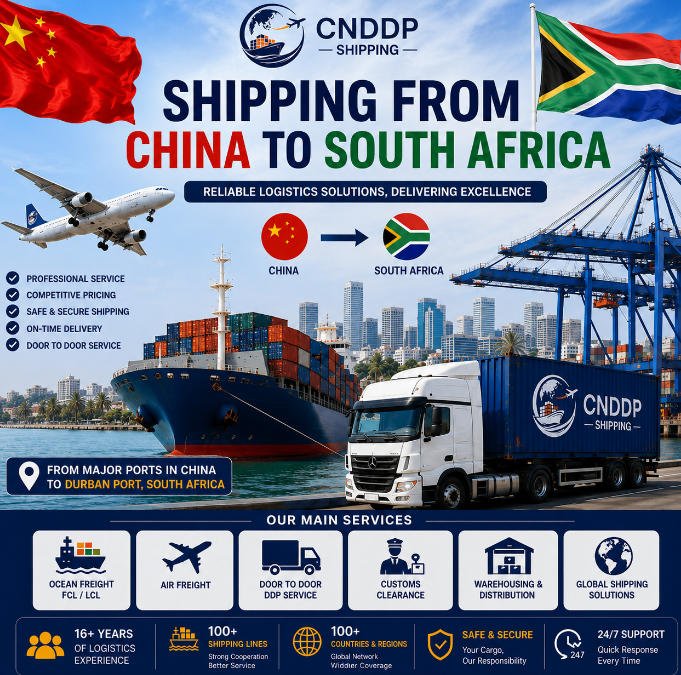
When shipping goods from China to South Africa, select an appropriate international logistics method based on the type of cargo, shipping costs, transit time, and trade terms.
| Category | Sea Freight | Air Freight |
|---|---|---|
| Transit time | 25 – 45 days From major Chinese ports (such as Shenzhen, Shanghai, and Ningbo) to major South African ports (such as Durban and Cape Town) | 5 – 10 days From major air cargo departure airports in China to Johannesburg International Airport (JNB) and Cape Town International Airport (CPT) |
| Shipping Cost | $80 – $150/CBM (depending on volume) | $5.0 – $9.5/kg (Air freight charges are typically calculated based on the actual weight or volumetric weight of the shipment, whichever is greater) |
| Best for | Large volumes, heavy goods, non-urgent | Small volumes, high-value, urgent restocks |
| Minimum | 1 CBM or 1 pallet (LCL) / full container (FCL) | No minimum (courier) or 45kg+ (cargo) |
- Sea freight is the most economical and commonly used logistics method for trade between China and South Africa, suitable for the vast majority of commercial cargo; air freight is suitable for products requiring rapid delivery.
Calculating Landed Costs for Shipping from China to South Africa
Landed costs encompass not only the purchase price of goods and international shipping fees but also various other components, such as customs duties, Value-Added Tax (VAT), insurance, customs clearance charges, port fees, and local logistics and distribution costs. A comprehensive and accurate calculation of landed costs enables businesses to formulate sound procurement plans and effectively control operating expenses.
| Category | Illustrate |
| Product cost | Agreed price with supplier (in USD or RMB) |
| Shipping (sea or air freight) | Per CBM (sea) or per kg (air) — get quotes from forwarder |
| Insurance | Typically 1 – 2% of the goods value plus freight (insured value) |
| Import duty | FOB customs value × duty rate (varies by HS code, 0 – 45%) — international freight and insurance are NOT part of the duty base in South Africa |
| Anti-dumping duty (if applicable) | Additional % on specific China-origin goods |
| VAT on imports | (CIF + duty + 10% uplift) × 15% |
| Customs clearance fee | $1,50 – $3,00 per shipment (broker fee) |
| Port handling / delivery | Varies by port and volume |
Learn more: Cost of Shipping 20ft & 40ft Containers from China to South Africa
Import Customs Clearance Documents for South Africa
Preparing Customs Clearance Documentation: Ensure your Chinese supplier provides complete and accurate trade documents at the time of shipment; even a single data discrepancy can lead to customs clearance delays.
- Commercial Invoice: Must detail the product description, unit price, total price, and trade terms (e.g., FOB, CIF).
- Packing List: Must specify the net weight, gross weight, and volume of each package.
- Bill of Lading / Air Waybill: Sea waybill or air waybill, serving as proof of title to the goods.
- Certificate of Origin: Certifies that the goods originated in China.
- SAD 500 Customs Declaration: Prepared by your South African customs broker.
- Import Permit: Required for certain controlled goods (permits may be needed for Chinese textiles).
- Proof of Payment: SARS may require bank confirmation of the transaction amount.
Customs Clearance via SARS
Your customs agent will electronically submit the SAD 500 declaration to SARS. SARS levies duties based on the customs value and HS code; import VAT is charged at 15% of the ATV (Customs Value + 10% uplift for non-SACU origins + non-rebateable taxes). You must pay the duties and VAT before SARS releases the goods. Payment is typically made to SARS via EFT.
SARS may select your shipment for a physical inspection—a routine procedure for first-time importers or goods known for undervaluation (such as Chinese apparel, electronics, and footwear). Please allow an additional 1 to 3 working days if an inspection is requested.
Pickup or Delivery to Your Warehouse
Once customs releases the goods, they can be picked up directly from the port or airport, or delivered straight to your warehouse or a third-party logistics center.
Key Considerations for Shipping from China to South Africa
Don’t Underestimate Delays at the Port of Durban
As Africa’s busiest port, the Port of Durban frequently experiences congestion during peak seasons or adverse weather conditions. When planning inventory for events like Black Friday or Christmas, be sure to place your orders two to three months in advance.
Check Licensing Requirements
Certain textiles, footwear, and electronic products imported from China require specific import permits. Without the necessary permits, your goods may be detained at the border.
Manage Exchange Rate Risk
The South African Rand (ZAR) is subject to significant volatility against the US Dollar (USD). Since payments to Chinese suppliers are typically made in USD, it is advisable to lock in exchange rates when they are favorable to prevent currency fluctuations from eroding your profits.
Find a Reliable Cross-Border Freight Forwarder
A professional logistics partner is invaluable. They are not only well-versed in the latest South African customs regulations but can also provide timely, compliant solutions should your shipment face customs clearance issues.
By understanding the process of importing goods from China to South Africa—and by proactively handling supplier vetting, transport planning, and customs clearance preparations, while selecting an experienced international freight forwarder—you can achieve a safer, more efficient, and cost-effective import process.