
Are you planning to import goods from China to South Africa but feeling overwhelmed by the complex logistics process? Shipping costs often constitute a significant portion of the overall procurement cost, and understanding the shipping costs from China to South Africa is crucial for maintaining business profitability. The total cost largely depends on the shipping method you choose, the weight and volume of your goods, and current market demand. This comprehensive guide will analyze various shipping options, provide cost estimates, and help you reduce logistics expenses.
Shipping from China to South Africa
The choice of shipping method from China to South Africa depends on your travel arrangements, budget, cargo volume, and urgency; choosing the most suitable option helps improve supply chain efficiency.
Sea Freight from China to South Africa
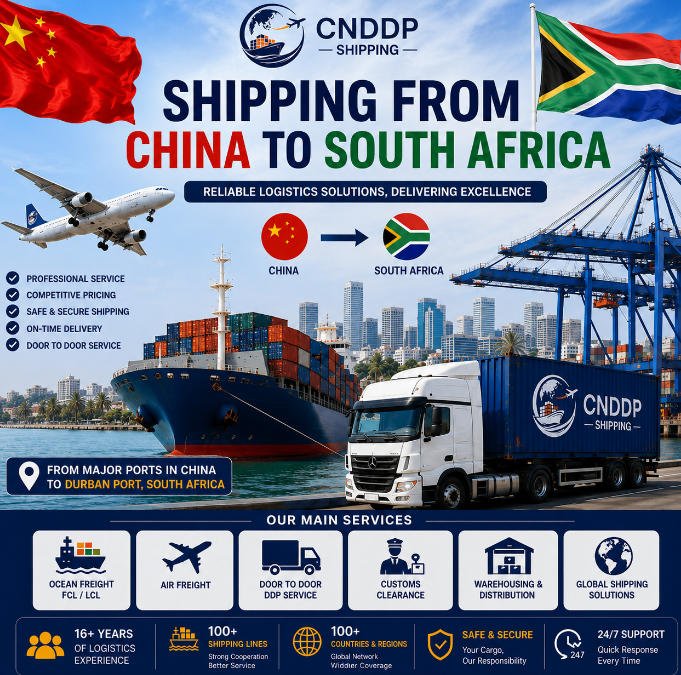
Major freight destinations from China to South Africa are divided into port cities and inland cities. Sea freight primarily calls at Durban, South Africa’s largest container port, where the vast majority of direct-ship vessels call; followed by Cape Town, serving the western region of South Africa; and Port Elizabeth, mainly serving local trade in the east. The core inland city is Johannesburg, which has no seaport. After arriving at Johannesburg, goods need to undergo several hundred kilometers of inland truck transshipment, incurring additional inland freight costs and time.
Major ports of arrival in South Africa include:
- Durban – handles the majority of containerized cargo;
- Cape Town – primarily serves the Western Cape region;
- Port Elizabeth – a suitable option depending on the destination and shipping schedule.
These ports all offer Full Container Load (FCL) and Less than Container Load (LCL) services. Differences Between LCL and FCL and the Composition of Shipping Costs
LCL (Less than Container Load): Suitable for smaller shipments that do not fill an entire container. Your goods share container space with other shipments, resulting in lower costs—making it ideal for small to medium-sized imports. LCL is typically billed by the cubic meter (CBM), calculated based on length × width × height.
FCL (Full Container Load): Means your goods occupy the entire container (typically 20-foot, 40-foot, or 40-foot High Cube). This offers high security as there is no need to consolidate cargo with other customers; customs clearance is relatively fast, and the risk of damage or loss is lower. It is highly suitable for large, heavy, or fragile items, as well as high-volume shipments.
Air Freight from China to South Africa
Air freight is the fastest way to transport goods from China to South Africa, making it ideal for high-value, urgent, or time-sensitive shipments. Faster delivery helps prevent stock shortages, production delays, and missed sales opportunities. Air freight shipments depart from major Chinese airports, including Shanghai Pudong International Airport (PVG), Guangzhou Baiyun International Airport (CAN), and Shenzhen Bao’an International Airport (SZX).
- Major destination airports in South Africa:
- O.R. Tambo International Airport – Johannesburg (JNB)
- Cape Town International Airport (CPT)
Air freight charges are generally calculated based on the greater of the actual weight or the volumetric weight. The formula for volumetric weight is: Length × Width × Height (cm) ÷ 6,000.
International Express
International express is the fastest shipping method, typically utilizing networks such as DHL, FedEx, UPS, and EMS. It offers the fastest transit times, door-to-door service with full tracking, low loss rates, high security, and mature service standards; transit time is approximately 2–5 days.
DDP Shipping
Suitable for importers seeking a simplified end-to-end service. Instead of managing each step separately, the freight forwarder handles the entire shipment process from the Chinese supplier to the final destination in South Africa—including transport, customs clearance, and inland delivery. This approach offers simplicity, transparency, and cost control, with all fees consolidated into a single quote to make budget planning more predictable.
Shipping Costs from China to South Africa
| Shipping Method | Average Cost (USD) |
|---|---|
| Express Courier | $8.00 – $15.00 / kg |
| Air Freight | $4.00 – $9.50 / kg |
| Sea Freight (LCL) | $80 – $150 / CBM |
| Sea Freight (20ft FCL) | $1,800 – $4,000 / Container |
| Sea Freight (40ft FCL) | $2,200 – $5,000 / Container |
- Sea Freight (LCL) is the cheapest option for shipments larger than 2CBM or weighing over 200kg. For extremely small parcels under 20kg, postal services or budget express lines are more cost-effective.
The total shipping cost from China to South Africa is not simply the cost of sea or air freight. The complete total cost includes five major components: domestic segment fees, trunk line freight, destination port fees, customs duties, and inland delivery fees.
Cost of Shipping 20ft & 40ft Containers from China to South Africa
Sea freight is the preferred option for large-volume exports to South Africa due to its lowest cost. Full Container Load (FCL) is suitable for shipments of 15 CBM or more; machinery, furniture, solar modules, and building materials are typically shipped in large quantities via FCL.
| Origin Port | Arrival port | 20ft Container (USD) | 40ft Container (USD) |
|---|---|---|---|
| Shanghai | Durban | $1,850 – $3,950 | $2,250 – $4,450 |
| Shanghai | Cape Town | $1,900 – $3,650 | $2,450 – $4,650 |
| Ningbo | Durban | $1,850 – $3,450 | $2,350 – $4,550 |
| Ningbo | Cape Town | $1,850 – $3,850 | $2,400 – $4,600 |
| Shenzhen | Durban | $1,950 – $3,950 | $2,500 – $4,700 |
| Shenzhen | Cape Town | $1,900 – $3,900 | $2,300 – $4,300 |
| Guangzhou | Durban | $2,050 – $3,850 | $2,250 – $4,150 |
| Guangzhou | Cape Town | $2,050 – $3,650 | $2,650 – $4,850 |
LCL Shipping Cost from China to South Africa
LCL shipping is suitable for small-batch replenishment, costing approximately $80 to $150 per cubic meter. Goods from different customers are consolidated into the same container, then split at the port of Durban.
| POL (port of loading) | POD (port of discharge) | LCL Cost/CBM |
|---|---|---|
| Shanghai | Cape Town | $85-$140 |
| Shenzhen | Cape Town | $80-$150 |
| Qingdao | Cape Town | $82-$145 |
| Ningbo | Cape Town | $85-$150 |
| Shanghai | Durban | $70-$140 |
| Shenzhen | Durban | $85-$130 |
| Qingdao | Durban | $75-$150 |
| Ningbo | Durban | $95-$140 |
Air Freight Cost from China to South Africa
Air freight is suitable for high-value goods with urgent delivery dates, such as electronic components, e-commerce replenishment, and urgent sample orders. The main landing point is Johannesburg JNB Airport.
Air freight costs are calculated based on the greater of volumetric weight and actual weight. For bulky goods (large volume but light weight), the unit cost will be significantly higher. Large shipments over 100kg will have a more competitive unit price, approximately $4 to $9.5 per kilogram. Smaller shipments of a few dozen kilograms are best handled by international express delivery. During peak seasons, air freight capacity is limited, and prices can fluctuate significantly.
| Weight Bracket | Estimated Cost (USD/kg) |
|---|---|
| +45 kg | $7.00 – $9.50 |
| +100 kg | $5.00 – $8.00 |
| +300 kg | $4.50 – $7.00 |
| +500 kg | $4.00 – $6.50 |
General cargo air freight does not include taxes; customers need to handle customs clearance and tax payment locally in South Africa. DDP (Delivered Duty Paid) air freight packages customs clearance, taxes, and last-mile delivery all in one package, simplifying the process.
Key Factors Affecting Shipping Costs from China to South Africa
Shipping costs from China to South Africa are not fixed; they are influenced by several factors:
Type of Goods
Different types of goods have varying transport requirements, leading to differences in cost. Goods requiring special packaging, testing, or certification typically incur higher shipping fees.
Inland Transport Distance
Shipping costs to port cities are generally lower, whereas delivery to inland cities incurs higher costs due to the need for truck transshipment.
Market Supply and Demand
Supply and demand dynamics in the international logistics market directly impact shipping rates. Peak seasons (such as Christmas, Black Friday, and the period before Chinese New Year), tight cargo space, container shortages, and reduced flight schedules can drive up both sea and air freight rates.
Trade Terms (Incoterms)
International trade terms determine the scope of costs and risks borne by the buyer and the seller.
- EXW (Ex Works): The buyer bears all transportation costs starting from the factory.
- FOB (Free on Board): The seller covers pre-export costs, while the buyer bears the cost of sea freight and subsequent charges.
- CIF (Cost, Insurance, and Freight): The seller covers sea freight and insurance costs, while the buyer is responsible for import customs clearance and taxes.
Ports of Origin and Destination
Shipping from major Chinese hubs—such as Shenzhen, Guangzhou, Shanghai, or Ningbo—to key South African ports (Durban, Cape Town, Port Elizabeth) is generally more cost-effective due to the frequency of available routes.
Practical Tips for Reducing Shipping Cost from China to South Africa
Consolidate Shipments
If sourcing from multiple Chinese suppliers, utilize a freight forwarder’s warehouse in China to consolidate goods into a single Less-than-Container Load (LCL) or Full Container Load (FCL) shipment, thereby avoiding multiple express shipping charges.
Optimize Packaging
Request that suppliers pack goods as compactly as possible to minimize wasted space.
Book in Advance
Ocean freight rates tend to spike during peak seasons (the holiday period from August to November and the weeks leading up to the Chinese Lunar New Year); it is advisable to book cargo space 3 to 4 weeks in advance.
Partner with an Experienced Freight Forwarder
Collaborate with logistics experts who are familiar with Chinese export regulations and South African import procedures to avoid incurring high port storage fees (demurrage).
How long does it take to ship from China to South Africa?
| Shipping Mode | Transit Time | Suitable Cargo |
|---|---|---|
| Sea FCL 20GP | 22‑32 days | Bulk machinery, large volume goods |
| Sea FCL 40HQ | 22‑32 days | Furniture, building materials, mass stock |
| Sea LCL (per CBM) | 30‑42 days | Small batch goods 1‑14CBM |
| Sea DDP LCL (per CBM) | 35‑48 days | Small‑batch door‑to‑door shipment |
| Air Freight (per KG) | 3‑8 days | High‑value urgent goods above 100kg |
| Air DDP (per KG) | 5‑12 days | E‑commerce goods door‑to‑door |
| Express Courier(per KG) | 3‑6 days | Samples, small parcels below 45kg |
Direct shipping from Chinese ports to Durban offers stable delivery times, but space is limited during peak season, so booking 7-10 days in advance is recommended. Direct shipping from Cape Town is less frequent, with most shipments requiring transshipment, adding approximately one week to the delivery time.
Note: If the final destination is Johannesburg, even if shipped to Durban, inland trucking will be required, adding 7-12 days and incurring significant costs.
CNDDP Shipping offers full container load (FCL) booking, domestic trucking and customs clearance, and destination port customs clearance. They support various terms including CIF and DDP and have specialized experience handling large equipment and overweight containers.
DDP Shipping from China to South Africa
DDP stands for Delivery After Taxes. The freight forwarder handles export customs declaration, sea/air freight, destination port customs clearance, payment of customs duties and VAT, and direct delivery to the South African address. The recipient only needs to wait for receipt and does not need to handle any customs clearance or tax payment processes. This is ideal for cross-border e-commerce, small and medium-sized wholesalers, and customers unfamiliar with South African customs clearance procedures.
There are several significant risks associated with shipping to South Africa via DDP:
- Mandatory PVoC/SABS Certification: Controlled goods such as furniture, toys, home appliances, and building materials must undergo PVoC inspection before shipment. Lack of certification will result in direct detention, high demurrage fees, and even return of the goods.
- Prohibition of Under-Declaration: South African customs has been strictly enforcing regulations against under-declared value in recent years due to SARS. If discovered, additional taxes and fines will be imposed. Accurately declaring the value of goods under the DDP model is crucial for ensuring timely delivery.
- Inland Delivery Surcharges: Land transportation costs from Durban to Johannesburg are high. Some low-priced DDP quotes only cover Durban and do not include inland delivery. Please confirm the service end point before placing your order.
CNDDP Shipping’s South Africa DDP service will verify in advance whether the product requires a PVoC certificate, fully calculate customs duties and VAT, and provide a complete breakdown of quotes to avoid unexpected additional charges at the destination port. Both sea freight and air freight DDP are accepted.
South African import duties, VAT and customs clearance
When importing goods into South Africa, you must comply with the regulations of the South African Revenue Service (SARS):
- Customs Value: Customs duties are calculated based on the Free on Board (FOB) price stated on the commercial invoice.
- Value-Added Tax (VAT): South Africa levies a 15% VAT on imported goods. This tax is calculated based on the “Value for VAT Purposes” (ATV), using the formula: (Customs Value + 10% of Customs Value) + Customs Duties Paid.
- Import Duties: Duty rates range from 0% to 45%, depending on the product’s HS Code (Harmonized System Code). Higher duty rates generally apply to clothing and textiles to protect domestic industries.
Documents Required for Import Clearance in South Africa
- Importers typically need to prepare the following documents:
- Commercial Invoice: This serves as a key basis for customs to calculate taxes and duties.
- Packing List: Used for customs inspections and logistics operations.
- Bill of Lading or Waybill: Proof of ownership of the goods.
- Import Permit (if applicable): Certain goods require an import permit.
- Certificate of Origin: Proof of origin may be required for certain goods—based on trade agreements or policy requirements—to qualify for preferential duty rates or to meet import regulations.
How to Choose a Freight Forwarder from China to South Africa
South Africa shipping routes are not ordinary routes; customs clearance rules and certification requirements are complex. Choosing a freight forwarder shouldn’t be based solely on price. Consider the following key points:
- Dedicated South Africa Line Experience: Familiarity with PVoC certification requirements, understanding of SARS customs inspection rules, and the ability to handle unexpected issues in Durban and Johannesburg inland transshipment. Many freight forwarders only handle ocean freight bookings and lack local South African customs clearance resources.
- Transparent and Complete Pricing: A qualified quote should clearly state: what fees are included, the service end point (port/warehouse door-to-door), and whether it includes customs duties and VAT. Be wary of quotes significantly below the market average, as these likely conceal substantial surcharges at the destination port.
- Comprehensive Service Options: The freight forwarder should be able to provide FCL (Full Container Load), LCL (Less than Container Load), DDP (Delivered Duty Paid), and DDP (Delivered Duty Paid) services simultaneously, allowing clients to switch options based on cargo volume. 4. Cargo Tracking and After-Sales Service: If goods are inspected or detained upon arrival at the port, the freight forwarder should have a local agent to promptly follow up and handle the situation, rather than shifting all the risk to the shipper.
CNDDP Shipping specializes in the China-South Africa logistics route and has its own partner local customs clearance agents. We provide a one-stop service including pickup, customs declaration, trunk transportation, destination port customs clearance, and door-to-door delivery. We can provide accurate quotes based on your cargo volume, product type, and delivery address.
FAQ:
Q1: Is shipping to Johannesburg significantly more expensive than to Durban?
A: Yes, Johannesburg is an inland city. Goods need to be transshipped by truck after arriving at the port of Durban, which increases freight costs and delivery time. Be sure to confirm the receiving city when providing a quote.
Q2: Can all products be shipped to South Africa via DDP?
A: No, regulated products require a PVoC certificate in advance. Some special restricted categories cannot be shipped via DDP. Send product information to CNDDP Shipping for pre-screening before shipment.
Q3: Why is the delivery time for LCL (Less than Container Load) sea freight via DDP much slower than regular sea freight?
A: After LCL shipments arrive at the port, the container needs to be unloaded, customs clearance and taxes need to be completed, and then inland delivery needs to be arranged. The overall process involves more steps, so the overall door-to-door delivery time will be longer.
Q4: When should I choose sea freight and when should I choose air freight?
A: For shipments larger than 1 CBM with non-urgent delivery dates, sea freight is preferred; for high-value shipments with tight delivery times, weighing tens to hundreds of kilograms, air freight or air freight DDP is preferred.
Q5: What is the South African customs VAT rate, and is it included in the DDP quote?
A: The standard VAT in South Africa is 15%, plus import duties applicable to the corresponding product category; a standard DDP quote will include both customs duties and VAT. Confirm with your freight forwarder whether the taxes are included when requesting a quote to avoid additional charges later.