
In international trade scenarios involving imports from China, FOB is one of the most commonly used and cost-effective shipping terms for overseas buyers. With its advantages of clear responsibilities, controllable costs, and high flexibility, it is widely used in cross-border import and export trade between China and the US, China and Europe, the Middle East, and South Asia. However, many importers often encounter problems in practice due to a lack of understanding of the boundaries of responsibilities, cost allocation, and risk points associated with FOB, leading to additional losses, logistics delays, and cost disputes.
This article, originally compiled by CNDDP Shipping, a professional freight forwarding company in China, is based on the latest Incoterms 2010 rules. It comprehensively breaks down the core definition of the Chinese export FOB term, the rights and responsibilities of both buyers and sellers, the detailed cost structure, practical precautions, and key points to avoid pitfalls. All logistics costs are uniformly priced in US dollars, providing overseas clients with a standardized and practical logistics reference standard for importing goods from China.
What is the FOB Term?
FOB Shipping Term Core Definition (Importing from China)
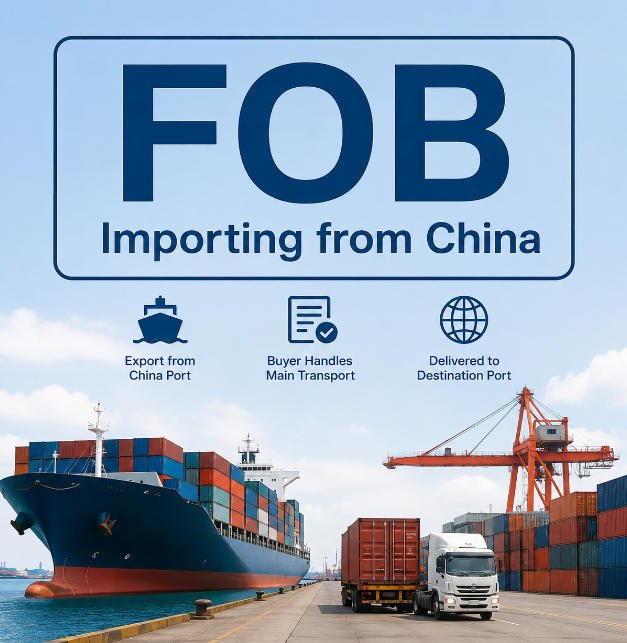
FOB stands for Free On Board, meaning the price paid on board the ship at the port of shipment. It is a core international trade term for Chinese export trade, specifically applicable to sea and inland waterway transportation. According to the official Incoterms 2010 rules, the core definition of FOB terms is: the Chinese seller fulfills all delivery obligations upon loading the goods onto the transport vessel designated by the overseas buyer at the designated Chinese port of shipment. The risk of loss, subsequent transportation costs, and related responsibilities simultaneously transfer from the seller to the overseas importing buyer.
Unlike traditional regulations, current general rules have eliminated the vague “ship’s rail” standard, clearly defining the actual loading of goods onto the ship as the dividing point for risk and cost, completely avoiding disputes over rights and responsibilities during the loading process. In importing from China trade, the FOB term must accurately specify the specific Chinese port of shipment, such as FOB Shanghai, FOB Ningbo, FOB Shenzhen, etc. The port designation directly determines the scope and cost standards of inland transportation.
Responsibilities of Buyers and Sellers under FOB Model
The core advantage of FOB trade is its clear division of rights and responsibilities. When importing goods from China, the work boundaries and responsibilities of both the buyer and seller are completely independent. CNDDP Shipping, drawing on ten years of practical experience in cross-border freight forwarding, has compiled a standardized list of rights and responsibilities to help importers clarify their obligations and mitigate cooperation risks.
Core Responsibilities and Obligations of the Chinese Seller (Exporter)
The seller primarily bears all the work and risks involved in the entire process before the goods are loaded onto the ship, ensuring that the goods leave the port in compliance with regulations. This includes four core areas:
- Preparation and Packaging: Completes the production, quality inspection, reinforcement, and standardized export packaging of the goods according to the purchase contract requirements, ensuring that the goods are suitable for long-distance sea transport and free from damage or non-compliant packaging issues.
- Domestic Logistics: Responsible for transporting the goods from the factory and warehouse to the designated Chinese port of shipment as agreed in the contract, completing pre-shipment work such as warehousing, storage, and port arrival.
- Export Compliance Procedures: Handles all necessary export documents in China, including customs declaration, commodity inspection, fumigation, and certificate of origin, ensuring smooth customs clearance and eliminating export compliance risks. 4. Loading and Delivery: Within the agreed shipping schedule, the buyer will safely load the goods onto the vessel designated by the buyer. After loading is completed, the buyer will promptly send the loading notice, a copy of the bill of lading, and other relevant documents to the buyer, thus completing the delivery loop.
Core Responsibilities and Obligations of the Overseas Buyer (Importer)
The buyer takes the lead in the entire cross-border transportation process and bears all risks, costs, and procedures after loading. This includes five core components:
- Booking and Vessel Allocation: The buyer will designate a shipping company in advance, reserve ocean freight space, determine the shipping schedule and route, and simultaneously provide the booking information and loading requirements to the Chinese seller and the freight forwarder (CNDDP Shipping can assist clients with booking, space locking, and schedule optimization services).
- Cross-border Transportation and Insurance: The buyer will bear all costs of international maritime transportation and independently purchase marine insurance to mitigate risks such as loss, damage, and moisture during ocean shipping.
- Import Customs Clearance and Tax Payment: After the goods arrive at the port of destination, the buyer will handle all import compliance procedures, including import customs clearance, tariff payment, and commodity inspection verification.
- Destination Port Follow-up Logistics: The buyer shall bear all last-mile logistics costs and work related to unloading, warehousing, and inland delivery at the destination port.
- Full Risk Assumption: After the goods are loaded onto the ship, the buyer shall bear all unforeseen risks, including shipping delays, cargo damage, lost items, and customs inspections.
Case Study: FOB Shenzhen Shipping Process
You order 5 cubic meters of furniture from a supplier in Foshan. The quotation states “FOB Shenzhen”.
After the supplier completes production, they pack the goods and arrange transport from their Foshan factory to their Shenzhen warehouse. The supplier will provide you with a commercial invoice, packing list, and other export documents agreed upon by both parties.
Your freight forwarder will book space on a ship departing from Shenzhen. The supplier will ensure the goods pass through the port system smoothly according to the freight forwarder’s instructions. After export customs clearance is completed, the goods will be received and processed before being loaded onto the ship.
Once the goods are loaded, the risk transfers to you. Upon the ship’s arrival, your local freight forwarder will handle customs clearance, pay taxes, and arrange delivery to your warehouse or logistics center. If it’s DDP shipping from China, then the freight forwarding company CNDDP Shipping can handle customs clearance and tax payment in both China and locally.
This is why FOB is often the ideal option for exporting to China: suppliers can handle what they do best in their own country, while you can control the downstream shipping schedule and delivery reliability.
Detailed breakdown of costs for importing FOB goods from China
FOB Price Formula: FOB Price (USD) = Cost of Goods at the Factory + All Miscellaneous Charges in China (Pre-shipment).
Excludes any international sea freight, insurance, and destination port charges. To facilitate accurate cost calculation for overseas importers, CNDDP Shipping has compiled a standardized FOB cost breakdown table. All costs are uniformly denominated in US dollars, aligning with international trade settlement practices.
| Cost Item | Responsible Party | Estimated Cost (USD) |
|---|---|---|
| Product Ex-factory Cost | Seller | Subject to product quotation |
| Domestic Trucking Fee (Factory to Port) | Seller | 80 – 350 |
| Port Terminal Handling Charge (THC) | Seller | 120 – 280 |
| Customs Declaration Fee (China Export) | Seller | 50 – 120 |
| Inspection & Quarantine Fee | Seller | 30 – 100 |
| Warehousing & Storage Fee (Port) | Seller | 20 – 80 |
| Loading Fee (On-board Loading) | Seller | 40 – 90 |
| Ocean Freight & Surcharges | Buyer | Real-time market price |
| Marine Insurance Fee | Buyer | 0.15% – 0.3% of goods value |
| Destination Port Fee & Import Duty | Buyer | Subject to local policy |
Additional notes: Under the FOB model, the buyer does not need to bear any export miscellaneous charges within China, and all pre-shipment costs are included in the seller’s FOB quotation; CNDDP Shipping can provide free cost calculation services for its partners, and issue accurate one-to-one USD cost quotations based on the specific port of shipment, cargo volume, and shipping schedule.
FOB vs EXW and CIF: Advantages of FOB
EXW (Ex Works) places almost all responsibility on the buyer. The seller delivers the goods at the factory (or other designated location), while the buyer is responsible for picking up the goods, handling export customs clearance, and the entire logistics process. This can be risky for novice importers, as clearing Chinese export customs can be very difficult without proper channels and documentation.
CIF (Cost, Insurance and Freight) refers to the seller paying for transportation and basic insurance to the destination port. This sounds simple, but buyers often find that CIF shipping can lead to higher destination charges, less transparent freight rates, and less flexibility in route and carrier selection.
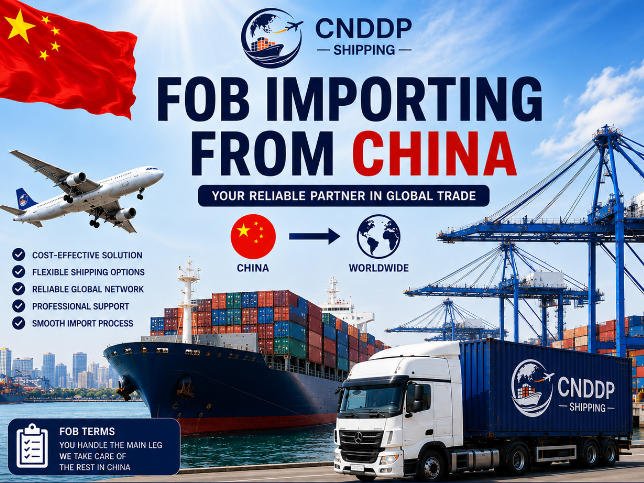
Compared to EXW, CIF, DDP, and other trade terms, FOB is the preferred model for overseas customers importing from China, especially suitable for long-term, stable purchases and large-volume cross-border trade. Its core advantages are threefold:
1, Controllable Logistics Costs: Buyers can independently book shipping space and choose shipping companies, directly contacting shipping companies to obtain first-hand ocean freight rates, avoiding markups by seller intermediaries, and significantly reducing overall cross-border transportation costs.
2, Independent Delivery Time: Buyers can independently lock in shipping schedules and plan transportation pace based on their own sales and inventory needs, without being constrained by the seller’s delivery schedule, allowing for flexible adjustments to logistics plans.
3, Minimally Few Disputes Regarding Rights and Responsibilities: Risk and cost milestones are clearly defined, and responsibilities are completely separated before and after loading, effectively avoiding the shifting of responsibility for damaged, delayed, or lost goods, and reducing the probability of trade disputes.
Common Misconceptions and Avoidance Guidelines in FOB Operations
Based on CNDDP Shipping’s years of experience in freight forwarding, many overseas importers easily fall into common misconceptions when importing from China under FOB terms, leading to unnecessary costs and logistical problems. The following four points should be avoided:
- Confusing the Risk Transfer Point: Some clients mistakenly believe that risk transfers after payment or when goods leave the factory. In reality, risk only belongs to the buyer after the goods are loaded onto the designated vessel. Risks of damage, loss, and inspection before loading are borne by the Chinese seller.
- Neglecting to Coordinate Specific Vessel Schedules: After booking, the buyer must promptly synchronize the vessel schedule and booking information with the seller and freight forwarder. If loading is delayed due to information lag, the resulting port demurrage and rescheduling fees (USD 50-200/time) must be borne by the buyer.
- Omitting Export Document Verification: Under the FOB model, the seller is responsible for issuing customs declarations, bills of lading, certificates of origin, etc. The buyer must verify the document information in advance to avoid customs clearance delays at the destination port and incurring high demurrage fees.
- Default includes marine insurance: FOB has no mandatory insurance requirement, and the seller does not bear the insurance cost. If the buyer does not purchase insurance independently, all cargo damage incurred during sea transport will not be compensated. It is recommended to purchase marine insurance as a standard practice.
What services can CNDDP Shipping provide for your FOB imports?
As a professional freight forwarding company deeply rooted in China’s cross-border logistics, CNDDP… Shipping specializes in providing end-to-end FOB logistics services for global clients importing goods from China. Leveraging resources from major domestic ports and a mature logistics system, we offer one-stop, worry-free solutions. Our core services include:
FOB Booking Service:
Covering bookings at all Chinese ports including Shanghai, Ningbo, Shenzhen, Guangzhou, and Qingdao, securing prime shipping schedules and preferential ocean freight rates, with all transactions settled in USD.
Accurate Cost Calculation:
Free breakdown of all FOB costs for clients, clearly defining the boundaries between buyer and seller fees, and providing a standardized USD cost list to eliminate hidden charges.
Full Logistics Tracking:
Connecting with domestic factories, ports, and shipping companies to provide real-time updates on cargo loading, departure, and arrival, and promptly handling unexpected issues such as inspections and delays.
Document Compliance Control:
Assisting in verifying all export documents, including customs declarations, certificates of origin, and bills of lading, to ensure smooth customs clearance at the destination port.
Customized Logistics Solutions:
Optimizing FOB transportation solutions based on client needs regarding cargo volume, timeliness, and budget, reducing overall import logistics costs.
In summary:
FOB, as a core trade term for Importing from China, essentially means that the seller is responsible for the entire pre-export process from China, while the buyer leads the cross-border transportation and destination port process. With its clear responsibilities, transparent costs, and high flexibility, it has become the mainstream choice for cross-border imports. For overseas buyers, mastering FOB cost allocation, risk points, and practical operational points, coupled with the full support of professional freight forwarders like CNDDP Shipping, can effectively mitigate logistical risks, reduce import costs, and improve trade efficiency.
FAQ
Based on frequent inquiries from CNDDP Shipping’s global import clients, we’ve compiled five of the most representative common FOB China import questions, providing precise answers to core issues such as practical pain points, cost disputes, and misunderstandings about rights and responsibilities, helping clients quickly resolve trade doubts.
Q1: Under FOB terms, who bears the demurrage and port charges incurred at Chinese ports?
A1: The core dividing point is the completion of cargo loading. Before loading, demurrage and port charges (USD 30–150/day) incurred due to seller delays in preparation, customs declaration errors, or substandard packaging are entirely borne by the Chinese seller. After loading, domestic port surcharges arising from buyer changes of vessel, abandonment of cargo, or delays in customs clearance at the destination port are borne by the overseas buyer. CNDDP Shipping will monitor loading timelines throughout the process to proactively avoid various port delinquency charges.
Q2: Does the FOB price include VAT and tax refund fees? Do importers need to pay them separately?
A2: The standard FOB price only includes the cost of goods and miscellaneous Chinese export logistics costs, excluding VAT and tax refund-related fees. Value-added tax (VAT) is declared and paid by the Chinese seller. Export tax refunds are the seller’s exclusive right; overseas importers do not need to bear this responsibility and cannot enjoy this policy. No additional fees are required when purchasing; only the FOB price needs to be verified to include all port handling costs.
Q3: Under the FOB model, the buyer books shipping space independently. If the shipping company is overbooked, preventing timely loading, who is responsible for the losses?
A3: Booking rights are tied to liability; the buyer bears the corresponding risks and losses. Under FOB terms, the buyer is responsible for booking space and allocating vessels. Any delays caused by shipping company overbooking, schedule delays, or cancellations, including temporary rescheduling fees and cargo storage costs, are borne by the buyer. It is recommended that overseas clients entrust CNDDP Shipping to assist with booking, leveraging long-term shipping company partnerships to secure stable space and mitigate the risk of overbooking.
Q4: Is marine insurance mandatory for imports from China via FOB? What are the risks of not purchasing it?
A4: FOB terms do not mandate insurance, but it is strongly recommended that the buyer purchase insurance independently. Under this model, all transportation risks transfer to the buyer after the goods are loaded onto the ship. If marine insurance is not purchased, any issues arising during sea transport, such as damage, seawater damage, loss, piracy, or shipwreck, will not be covered by insurance, and all losses will be borne by the importer. Our company can assist clients in securing low-cost marine insurance, with premiums calculated at 0.15%-0.3% (USD) of the cargo value.
Q5: What is the core difference between FOB Shanghai and FOB Ningbo, and will it affect overall import costs?
A5: The core difference lies in the port of loading, which directly affects domestic trucking and port handling fees, and slightly impacts overall import costs. Factories located near East China should prioritize FOB Shanghai or FOB Ningbo, as domestic trucking costs are lower (USD 80-200). Goods from South China are suitable for FOB Shenzhen and FOB Guangzhou. THC and port handling fees vary slightly between ports. CNDDP Shipping can select the most cost-effective port of loading for clients based on the origin and type of goods, optimizing overall import logistics costs.