Our dedicated DDP (Delivered Duty Paid) shipping service from China to Nigeria offers an all-inclusive, door-to-door logistics solution tailored for China-Africa traders, cross-border e-commerce sellers, and factory procurement teams. As the largest economy in West Africa, Nigeria—with Lagos serving as its primary commercial hub—receives a steady flow of goods from China, including hardware and construction materials, home appliance components, lighting fixtures, apparel, machinery, packaging materials, and e-commerce products.
With years of experience in the China-to-Nigeria DDP route, CNDDP Shipping integrates domestic warehousing, ocean and air freight capacity, and a local, compliant customs clearance team. We provide a one-stop service covering cargo pickup, international transport, customs clearance, tax payment, and final-mile delivery. Consignees can simply wait to receive their goods at their designated location, without needing to navigate complex Nigerian customs documentation, tax declarations, or local delivery logistics.
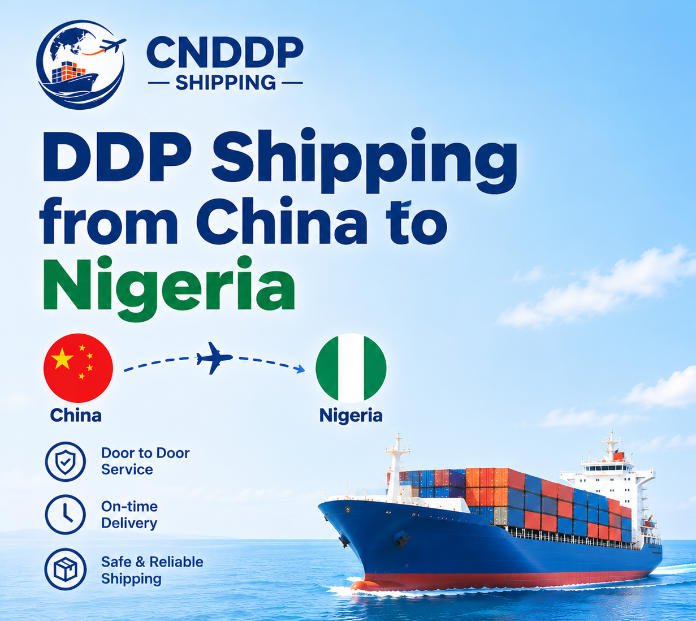
What is DDP Shipping from China to Nigeria?
DDP (Delivered Duty Paid) means the seller assumes all responsibilities and costs until the goods are delivered to the destination, with all duties and taxes paid. In the context of shipping from China to Nigeria, CNDDP Shipping takes full responsibility for every stage of the process: domestic warehouse pickup, export customs declaration, international transport, Nigerian import clearance, payment of customs duties and VAT, and final delivery by truck to the consignee’s specified address.
The key difference between DDP and terms like FOB or CIF is that the logistics provider manages all risks and tax-related obligations. Consignees do not need to independently source a customs broker, apply for a “Form M,” or handle SONCAP documentation. This is an ideal solution for small and medium-sized enterprises (SMEs) that are new to the Nigerian market, unfamiliar with local customs policies, or prefer not to invest time and effort into managing customs compliance.
| Shipping Term | Export Customs in China | Freight | Import Customs & Duties in Kuwait | Final Delivery |
|---|---|---|---|---|
| EXW | Buyer | Buyer | Buyer | Buyer |
| FOB | Seller (until port) | Buyer | Buyer | Buyer |
| CIF | Seller (to port) | Seller | Buyer | Buyer |
| DAP | Seller | Seller | Buyer | Buyer |
| DDP | Seller | Seller | Seller | Seller |
Nigerian customs regulations are complex, with high barriers to entry involving requirements such as SONCAP, Form M, PAAR, and CTN (Cargo Tracking Note). Choosing an established DDP service significantly reduces the risks of cargo seizure, port congestion, and heavy financial penalties.
DDP Shipping Methods from China to Nigeria
Key seaports in Nigeria include Apapa Port and Tin Can Island Port in Lagos, as well as Onne Port. For air freight, the primary destination is Murtala Muhammed International Airport (LOS) in Lagos, with Nnamdi Azikiwe International Airport (ABV) in Abuja serving as a secondary hub.
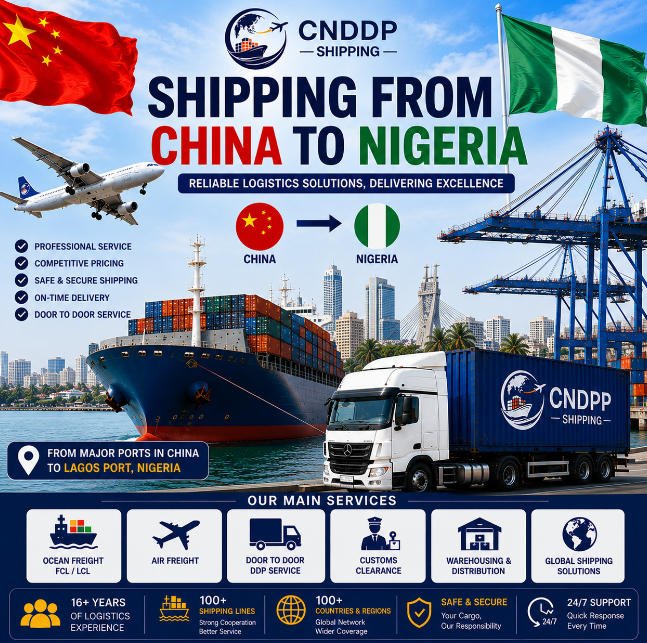
CNDDP Shipping offers three established DDP solutions—LCL (Less than Container Load) sea freight, FCL (Full Container Load) sea freight, and air freight—allowing sellers to choose the best channel based on shipment volume, delivery timeline, and budget.
Sea Freight DDP (LCL / FCL)
Sea freight is the most cost-effective primary shipping method from China to Nigeria. It is ideal for large-volume shipments of general cargo—such as furniture, construction materials, hardware, heavy machinery, bulk inventory, plastic raw materials, and kitchen or bathroom fixtures—where delivery time is less critical.
Shipments depart from major Chinese ports, including Shenzhen, Ningbo, Shanghai, and Xiamen, traveling via the Indian Ocean and the Cape of Good Hope to reach Lagos. LCL (shared container) is suitable for smaller, loose shipments (with a minimum volume of 1 CBM), while FCL (full container) is designed for large-scale factory orders, offering stable space availability and serving as an excellent option for regular, ongoing replenishment.
The typical transit time for sea freight DDP from China to Nigeria is 35–50 days.
Air Freight DDP
Air freight focuses on rapid delivery. It is the preferred choice for high-value goods, trade show samples, electronics, repair parts, and e-commerce inventory that requires urgent replenishment—ideal for clients who prioritize fast turnover.
Goods are shipped from airports in Guangzhou, Shenzhen, or Shanghai—either via direct flights or connecting routes—to Lagos Airport. Upon arrival, the local CNDDP team handles customs clearance and arranges final delivery by truck.
The transit time for air freight DDP is 5–8 business days, with a minimum chargeable weight typically starting at 45 kg.
Shipping Costs from China to Nigeria
Shipping costs from China to Nigeria are not fixed; they vary based on factors such as the city of origin, cargo type (general cargo, items with batteries, or sensitive goods), volumetric weight, whether DDP (tax-inclusive) service is selected, fuel surcharges, and port congestion fees. The table below lists market reference prices for 2026 (in USD) for budgeting purposes only; final quotes are subject to verification of shipment details.
| Shipping Method | Unit | Estimated Cost Range (USD) |
|---|---|---|
| Sea Freight LCL (Port to Port) | Per CBM | $80 – 150 |
| Sea FCL 20GP (Port to Port) | Per Container | $2000 – 4000 |
| Sea FCL 40HQ (Port to Port) | Per Container | $2500 – 4500 |
| Air Freight (Airport to Airport) | Per KG | $4 – 9 |
| DDP Sea Freight | Per CBM | $100 – 300 |
| DDP Air Freight | Per KG | $5 – 12 |
learn more: Cost of shipping 20ft & 40ft containers from China to Nigeria
Transit time for DDP shipments from China to Nigeria
| Shipping Method | Min Shipment | Transit Time | Suitable Cargo |
|---|---|---|---|
| Sea LCL DDP | 1 CBM | 35–50 days | Hardware, furniture, building materials, bulk general goods |
| Sea FCL DDP (20GP) | Full container | 40–55 days | Large machinery, mass factory stock |
| Air DDP | 45 KG | 5–8 working days | Electronic parts, samples, high-value goods |
DDP Shipping Process: China to Nigeria
CNDDP Shipping has standardized the DDP process for shipments from China to African nations, ensuring a simple and hassle-free experience for clients.
- Documentation & Pre-screening: Clients provide a packing list, commercial invoice, and photos of the goods. We conduct a pre-screening to verify if the items require SONCAP certification, check for any import prohibitions in Nigeria, and assess the best shipping channels and pricing.
- Domestic Pickup: We arrange for pickup from the client’s factory or warehouse, or the client may deliver the goods to a CNDDP consolidation warehouse in China, where they are palletized or loaded into containers.
- Export Customs Clearance: We handle the export declaration in China and verify the bill of lading details and the CTN (Cargo Tracking Note).
- International Transit: Once the cargo is loaded onto a vessel or departs via air freight, we provide the client with a tracking number.
- Destination Customs Preparation: We coordinate with the consignee in advance to process the Form M and PAAR, verify SONCAP certificates for regulated goods, and—upon arrival—promptly submit customs declarations and settle all applicable duties and taxes.
- Local Inspection & Release: Given the high probability of random inspections by Nigerian Customs, our local clearance team manages the inspection process and addresses any inquiries to prevent unnecessary delays or cargo detention.
- Final-Mile Delivery: Following customs release, we arrange trucking to deliver the goods to any location in Nigeria—including Lagos, Abuja, and Kano. The process concludes once the consignee signs for the delivery.
Customs Clearance Documentation and Cargo Restrictions for DDP Shipments to Nigeria
Nigeria is a country in West Africa with strict regulatory requirements; missing documentation is the primary reason for cargo detention. CNDDP Shipping provides proactive compliance pre-screening for clients.
Items subject to SONCAP (Standards Organisation of Nigeria Conformity Assessment Programme) regulations—such as electronics, electrical appliances, toys, auto parts, tires, gas-powered equipment, and steel products—require the appropriate certificates prior to shipment. Failure to provide SONCAP documentation will result in the return of the goods or the imposition of heavy fines.
While certain categories—including food, pharmaceuticals, and specific industrial raw materials—are exempt from SONCAP, they still require their own set of supporting documentation.
Required documents include: Commercial Invoice, Packing List, Bill of Lading/Air Waybill, CTN (Cargo Tracking Note), Form M, PAAR (Pre-Arrival Assessment Report), and a Certificate of Origin (if applicable).
Prohibited imports—such as certain restricted publications, gambling or lottery-related materials, and counterfeit or infringing products—are ineligible for DDP services.
Freight Forwarding from China to Nigeria
Why Choose CNDDP Shipping as Your Freight Forwarder for DDP Shipments from China to Nigeria?
- In-House Local Customs Clearance Team: We have dedicated, long-term customs clearance specialists based in Lagos. Well-versed in Nigerian customs inspection practices and the full declaration process—including Form M, PAAR, and SONCAP—our team ensures a faster response to any unexpected cargo holds compared to remote third-party agents.
- Diverse Shipping Options & Transparent Pricing: We offer a variety of transport modes, including LCL (Less than Container Load), FCL (Full Container Load), and air freight. Our DDP quotes are all-inclusive—covering duties, VAT, customs clearance fees, and final delivery—with every cost item clearly itemized to eliminate hidden charges at the destination port.
- Professional Compliance Pre-Screening: We review your cargo’s eligibility before accepting an order, distinguishing between goods subject to SONCAP regulations and those that are exempt. This proactive approach helps you avoid port demurrage costs caused by missing documentation—a common pitfall for many exporters who only discover the need for specific certifications after the goods have already shipped.
- Guaranteed Shipping Space: We maintain long-term, secured space allocations on both ocean and air freight routes from major Chinese ports to Lagos. This ensures your shipments are less likely to be “rolled” (bumped to a later vessel/flight) even during peak seasons—an ideal solution for manufacturers and exporters with consistent, long-term shipping needs.
- End-to-End Logistics Tracking: You can monitor your shipment’s status at every stage—from domestic pickup and vessel departure to port arrival, customs clearance, and final delivery. Real-time updates allow you to keep your Nigerian buyers informed about the progress of their orders.
- Extensive Experience in West Africa: Beyond Nigeria, we operate DDP services to Ghana, Qatar, Kuwait, and other destinations. With a deep understanding of the complex logistics landscape in Africa, we are well-equipped to navigate local challenges such as traffic congestion and delays in last-mile delivery.
FAQ:
Q1. For DDP shipments to Nigeria, does the consignee need to handle the “Form M” process themselves?
A: By law, the Form M application must be initiated by the local Nigerian importer through their bank. CNDDP Shipping will guide the consignee in submitting the necessary documentation and coordinate with our local agent to assist with the process, ensuring that errors in Form M information do not cause customs clearance delays.
Q2. Is a SONCAP certificate required for all shipments?
A: No. A SONCAP certificate is mandatory only for products included on the Standards Organisation of Nigeria (SON) controlled list. Food, pharmaceuticals, and certain industrial raw materials are exempt. Please provide us with the HS code for your products before shipment, and we will confirm whether a SONCAP certificate is required.
Q3. Can DDP shipments to Nigeria be delivered to cities outside of Lagos?
A: Yes. We provide final-mile delivery to cities such as Abuja, Kano, and Ibadan. Please note that deliveries to remote cities may take an additional 3–7 days, and an extra surcharge for local trucking will apply.
Q4. Who is responsible for port demurrage charges if the shipment is inspected by Nigerian customs?
A: If the charges arise due to errors in documentation submitted by CNDDP, we will cover the costs. If, however, the demurrage or fines result from issues with the goods themselves—such as misdeclaration of product names or values, or a lack of required documentation like a SONCAP certificate—the costs will be borne by the shipper. This is why we insist on a pre-shipment review of all goods.
Q5. Can electronic products or small household appliances containing batteries be shipped to Nigeria via our DDP service?
A: Yes, we can handle these items. However, you must provide an MSDS (Material Safety Data Sheet) and battery specifications. The goods must be declared in full compliance with Nigerian regulations; misdeclaration is strictly prohibited. Please note that shipping rates for electronic/battery-powered items differ from those for general cargo, so please request a separate quote.