Importing goods from China to Saudi Arabia involves more than just international sea or air freight; it encompasses a complex process that includes export customs clearance in China, import customs clearance in Saudi Arabia, the handling of duties and VAT, and final local delivery. For importers, wholesalers, retailers, and project procurement managers in Saudi Arabia, the seamless coordination of these stages is critical to managing overall logistics costs and ensuring efficient delivery.
“Door-to-door” shipping offers a highly convenient logistics solution. Goods are collected directly from the supplier or factory in China, processed through export formalities, transported internationally, cleared through Saudi customs upon arrival, and finally delivered to the client’s designated warehouse, office, or any other specified destination.
Within this framework, DDP (Delivered Duty Paid) is a particularly advantageous trade term to consider. Under DDP, the seller assumes responsibility for both import customs clearance and the payment of all applicable import duties and taxes, significantly reducing the administrative burden on the buyer.
CNDDP Shipping is a China-based freight forwarder specializing in logistics services from China to Saudi Arabia, including sea freight, air freight, DDP Shipping, and door-to-door delivery. Tailored shipping solutions can be arranged based on the nature of the goods, the volume of the shipment, and the final delivery location.
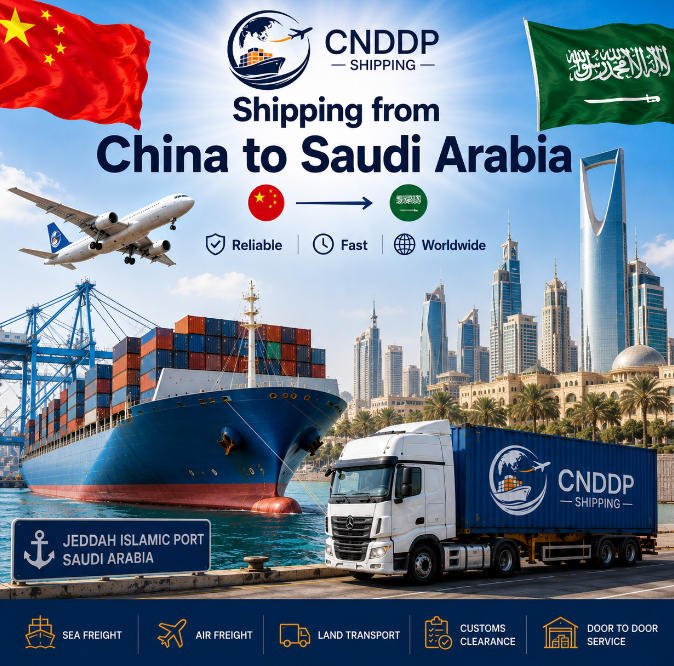
What is Door-to-Door Shipping from China to Saudi Arabia?
“Door-to-door” shipping refers to a logistics arrangement where a service provider coordinates the entire transport process—from the point of origin in China to the final delivery address specified by the buyer in Saudi Arabia.
Unlike traditional “port-to-port” shipping, door-to-door service encompasses not only international transit but also the handling of goods at both the origin and the destination.
It typically includes the following stages:
- Pickup from the supplier or factory in China;
- Receipt, inspection, and consolidation of goods at a warehouse in China;
- Export customs clearance and processing of relevant documentation;
- International sea or air freight;
- Import customs clearance in Saudi Arabia;
- Payment of import duties and related taxes (under DDP terms);
- Local transportation and final delivery within Saudi Arabia.
It is important to distinguish between “door-to-door” shipping and the term “DDP”.
“Door-to-door” refers to the scope of transport—from the sender’s address to the recipient’s address—whereas DDP pertains to the allocation of costs and responsibilities between the buyer and the seller. Not all door-to-door shipments are DDP; some services may require the consignee to personally cover import duties and customs clearance fees.
If a buyer wishes to minimize the operational burden at the destination, they should specifically request “DDP door-to-door shipping” when inquiring for a quote, and verify in advance whether the quoted price includes import customs clearance, taxes, and final delivery.
What are the door-to-door shipping options from China to Saudi Arabia?
There are well-established international logistics channels between China and Saudi Arabia. Depending on the weight, volume, and value of the goods, as well as the required delivery timeframe, customers can choose between sea freight and air freight.
Sea Freight Door-to-Door
Sea freight is ideal for large shipments where delivery time is not critically urgent. It is generally the most cost-effective option for goods such as furniture, construction materials, machinery and equipment, excavators, auto parts, plastic products, hardware tools, and daily consumer goods.
For sea shipments from China to Saudi Arabia, options include LCL and FCL:
- LCL (Less than Container Load): Suitable for smaller shipments that do not fill an entire container. Goods from multiple shippers are consolidated into one container, which helps reduce shipping costs for individual customers.
- FCL (Full Container Load): Suitable for larger shipments, a diverse range of goods, or cargo that requires a dedicated container. Common container types include 20GP, 40GP, and 40HQ.
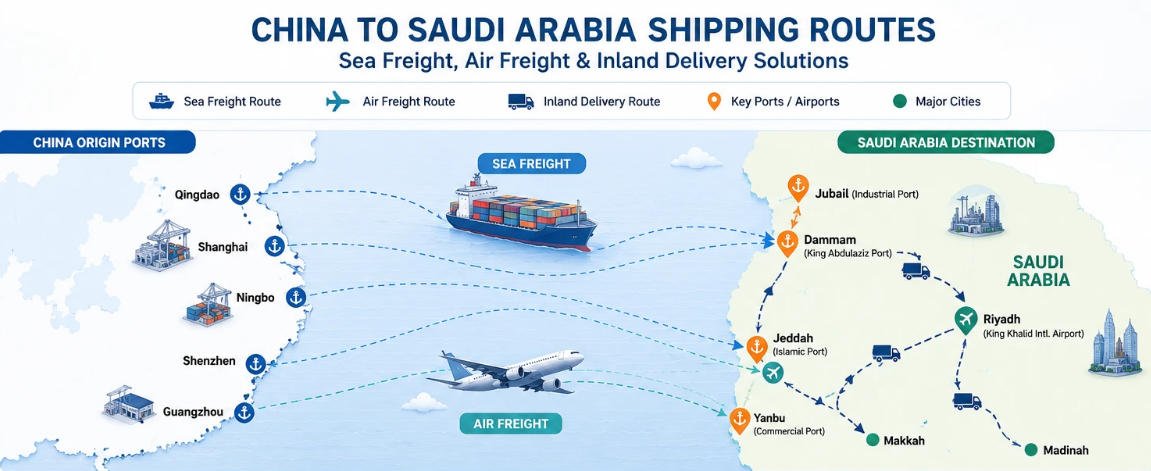
Major seaports in Saudi Arabia include:
- Jeddah Islamic Port
- King Abdulaziz Port (Dammam)
- King Fahd Industrial Port
The most suitable port of arrival depends on the final destination of the goods. For instance, Jeddah Islamic Port serves as a key gateway for cargo destined for western and parts of central Saudi Arabia, while King Abdulaziz Port (Dammam) is the preferred entry point for shipments destined for the eastern region.
Door-to-Door Air Freight from China to Saudi Arabia
For urgent shipments, high-value goods, or items with relatively small dimensions and weight, door-to-door air freight is an excellent option.
Air freight from China to Saudi Arabia is typically charged based on either the actual weight or the volumetric weight of the cargo. Once the goods arrive at a Saudi airport, the service includes import customs clearance and final local delivery.
Major international air cargo gateways in Saudi Arabia include:
- King Khalid International Airport (Riyadh)
- King Abdulaziz International Airport (Jeddah)
- King Fahd International Airport (Dammam)
Air freight is particularly well-suited for electronic accessories, apparel, product samples, precision components, commercial orders, and goods that require rapid replenishment.
Compared to ocean freight, air freight offers significantly shorter transit times, though the cost per unit is generally higher. For seasonal products or components urgently needed for production, air freight helps importers minimize waiting times.
DDP shipping from China to Saudi Arabia
If a buyer wishes to have goods shipped directly from a factory in China to a warehouse in Saudi Arabia—without having to personally handle import customs clearance or tax-related matters—then DDP shipping is an option worth considering.
The key feature of DDP is that the seller assumes responsibility for the agreed-upon transport, export customs clearance, import customs clearance, and all import duties and taxes, up until the point the goods are delivered to the designated destination. In practice, a freight forwarder can act as the seller’s logistics service provider, assisting with the entire shipping process.
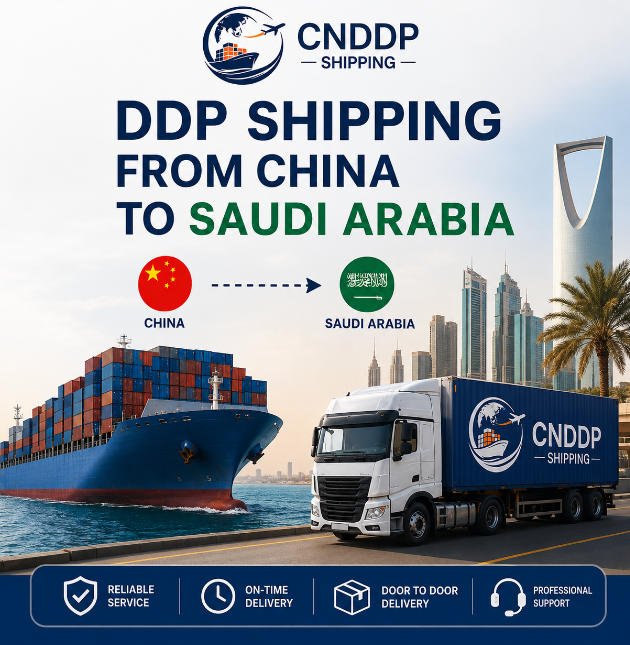
What services are included in DDP shipping from China to Saudi Arabia?
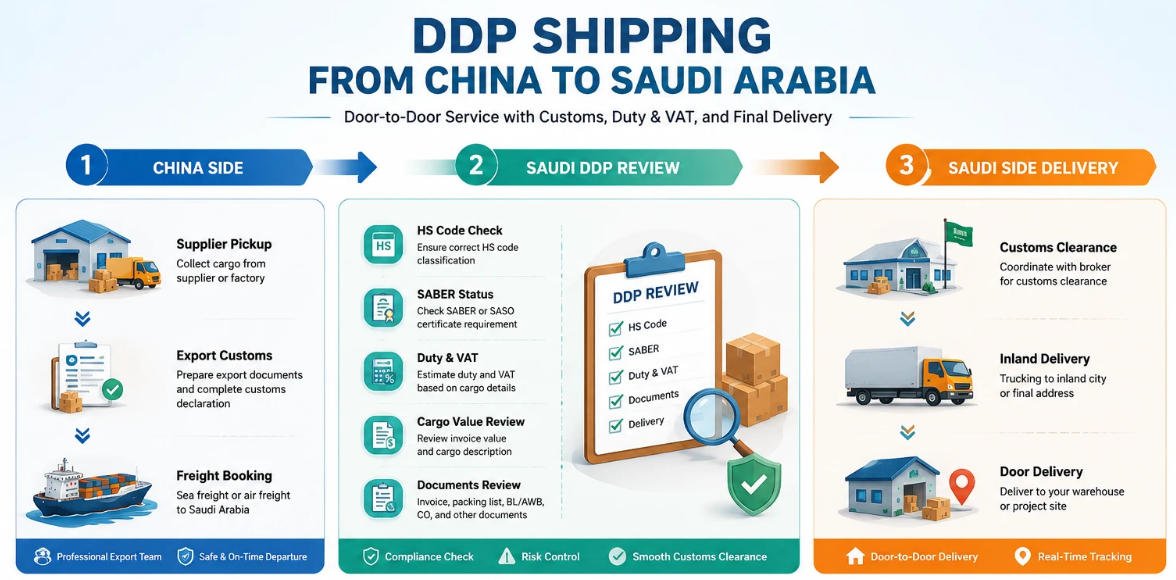
Step 1. Pickup within China
We can arrange for the pickup of goods from your suppliers’ locations. If you have multiple suppliers in different Chinese cities, we can consolidate your shipments at a warehouse to perform inspections, measurements, and packaging before arranging for export.
Step 2. Export Customs Clearance and International Transport
Depending on the nature of the cargo, we select either sea or air freight and handle all necessary export customs declarations, space booking, and shipping documentation. For goods with specific packaging requirements, we ensure that the packaging complies with transport standards prior to shipment.
Step 3. Import Customs Clearance in Saudi Arabia
Upon arrival in Saudi Arabia, goods must undergo import declaration based on their product category, declared value, and HS code. For DDP shipments, it must be clarified in advance which party will act as the importer of record and how the local customs clearance partner will manage the necessary procedures.
Step 4. Import Duties and VAT
Applicable Saudi import duties and taxes are calculated and settled according to the terms of the DDP contract. The standard VAT rate in Saudi Arabia is 15%; however, special regulations may apply to certain goods or types of transactions. The final amount is determined based on the specific products and the details of the customs declaration.
Step 5. Local Delivery in Saudi Arabia
Once the goods have cleared customs, they are delivered to the client’s designated address—whether it be a commercial warehouse in Riyadh, a wholesale market in Jeddah, an industrial zone in Dammam, or any other agreed-upon delivery location.
How Much does it Cost to Ship from China to Saudi Arabia
| Shipping Mode | Specification | Reference Cost (USD) |
|---|---|---|
| Sea FCL | 20GP | 1000‑3000 |
| Sea FCL | 40HQ | 1400‑4500 |
| Sea LCL | Per CBM | 65‑180 |
| Air Freight | Over 100KG (Per KG) | 3‑8 |
| DDP and Door‑to‑Door | Including customs duty & VAT | DDP Air Freight: 4.5‑10 DDP Sea Freight: 100‑250 |
learn more: Cost of Shipping 20ft & 40ft Containers from China to Saudi Arabia
Door-to-Door (DDP) Shipping from China to Saudi Arabia includes:
| Cost Items | Description |
|---|---|
| Pickup Charges | Pickup from Chinese suppliers |
| Export Customs Clearance | Export declaration in China |
| Origin Handling Charges | Warehouse handling and loading |
| International Freight | Sea freight or air freight |
| Destination Handling | Port or airport handling |
| Import Customs Clearance | Saudi customs clearance |
| Customs Duties | Applicable import duties |
| VAT | Applicable import VAT |
| Local Delivery | Delivery to the final address |
Shipping Transit Times from China to Saudi Arabia
The transit time for shipments from China to Saudi Arabia depends on various factors, including the departure city, port of origin, port of destination, flight or vessel schedules, customs clearance efficiency, and the distance to the final delivery destination.
Below are the estimated transit times for sea and air freight:
| Shipping Method | Estimated Transit Time |
|---|---|
| Sea Freight | 25–35 Days |
| Air Freight | 3–7 Days |
| Sea Freight DDP | 30–45 Days |
| Air Freight DDP | 5–12 Days |
Note: The above information regarding transit times from China to Saudi Arabia in 2026 is for reference only and does not constitute a binding commitment. Door-to-door delivery timelines also account for factors such as cargo pickup, export processing, customs clearance at the destination, and final-mile delivery. Specific orders will be subject to the actual shipping routes and operational arrangements.
How to arrange door-to-door delivery from China to various cities in Saudi Arabia?
Saudi Arabia has a large land area, and logistics arrangements as well as inland transportation costs vary by region.
- Riyadh: The capital of Saudi Arabia and a major commercial and logistics hub. Goods can enter the country via ports such as Jeddah or Dammam and then be transported inland; alternatively, air freight may be an option depending on flight availability.
- Jeddah: Located in the west near the Red Sea, this is a key gateway for international maritime shipping and is well-suited for distribution to the western region.
- Dammam: Located in the east near the Persian Gulf, this is an ideal entry point for the import of industrial equipment, construction materials, and other commercial goods.
- Mecca: Subsequent delivery can be arranged based on the port of arrival and local transport conditions; specific addresses and any local delivery restrictions should be confirmed in advance.
- Medina: Inland transportation can be arranged, with costs depending on the volume of goods and the delivery location.
If the delivery address is located within an industrial park, at a construction site, or at a large warehouse, it is advisable to verify in advance whether the site can accommodate large trucks and has the necessary facilities for unloading.
Import Customs Clearance, SABER Certification, and Import Duties and Taxes in Saudi Arabia
Saudi Arabia has specific customs and product compliance requirements for imported goods. For Chinese exporters, it is far better to understand the necessary customs clearance documentation and product certification requirements in advance, rather than having to provide additional paperwork only after the goods have arrived at the port.
Import Customs Clearance Documents for Saudi Arabia
| Required Documents | Purpose |
|---|---|
| Commercial Invoice | Declared cargo value and product details |
| Packing List | Cargo quantity, weight and dimensions |
| Bill of Lading | Sea freight transport document |
| Air Waybill | Air freight transport document |
| Certificate of Origin | Proof of country of origin |
| Import License | Required for certain products |
| Product Conformity Certificate | Required for regulated products |
| Other Supporting Documents | Depending on cargo type |
According to the import guidelines issued by the Zakat, Tax and Customs Authority (ZATCA) of Saudi Arabia, commercial invoices, bills of lading, and certificates of origin are essential import documents; certain goods may also require additional supporting documentation. Import declarations are typically processed via the Fasah platform, and official guidelines mandate that the necessary declaration preparations be completed prior to the expected arrival of the goods.
SABER Product Certification Requirements
For goods exported from China to Saudi Arabia, SABER is a critical compliance system that must be addressed prior to importation.
Managed by the Saudi Standards, Metrology and Quality Organization (SASO), the SABER platform facilitates processes such as product registration, the issuance of Certificates of Conformity (CoC), and the generation of Shipment Certificates of Conformity (SCoC).
Certain goods subject to technical regulations require a Product Certificate of Conformity (PCoC) and a Shipment Certificate of Conformity (SCoC), depending on the product category. Specific requirements are determined by the HS code and the applicable technical regulations.
Not all products follow the same certification process. It is highly recommended that clients request product model details, technical specifications, and relevant certification documentation from their suppliers during the procurement phase—this helps avoid situations where the absence of necessary documents is only discovered after the goods have already been shipped.
Import Taxes and Duties in Saudi Arabia
Import taxes and duties in Saudi Arabia are not applied at a uniform rate. Tariff rates vary by product, and certain goods may also be subject to excise taxes, special regulatory fees, or other applicable charges. In general, tariff rates for most products range from 5% to 20%.
- Most consumer goods (such as electronics, appliances, and daily necessities): Usually subject to a 5% tariff.
- Food and agricultural products: Tariffs are mostly between 5% and 15%.
- Luxury goods (such as perfumes, jewelry, and luxury vehicles): Tariffs are usually higher, around 20%.
- Pharmaceuticals and medical equipment: Usually exempt from tariffs or subject to lower tariffs, around 0% to 5%.
- Chemicals and industrial products: Usually subject to a 5% to 10% tariff.
Value Added Tax (VAT): The standard rate is 15%. VAT is usually calculated based on the CIF price of the goods plus the tariff.
When preparing a DDP quote, it is essential to provide the most accurate information possible, including a detailed product description, HS code, shipment value, and country of origin.
Providing only a generic product category—such as “electronic products,” “mechanical parts,” or “plastic goods”—is typically insufficient for an accurate calculation of the total import costs.
How to Choose a Freight Forwarder from China to Saudi Arabia
DDP shipping involves logistics operations in both China and Saudi Arabia. When selecting a freight forwarder, you should look beyond just the price; it is equally important to evaluate their capabilities regarding customs clearance at the destination and their overall management of the shipping process.
Consider the following key factors:
- Familiarity with Saudi Import Customs Requirements
The freight forwarder must be well-versed in the requirements for commercial invoices, certificates of origin, SABER certification, and other relevant documentation. They should also be able to proactively identify potential customs clearance risks specific to different types of goods. - Reliable Local Partnerships in Saudi Arabia
DDP shipping does not end when the cargo arrives at the port. Successful execution requires local support for customs clearance, tax and duty handling, warehousing, and last-mile delivery. - Transparent Pricing
Ensure the freight forwarder provides a clear breakdown of what is included in their quote—specifically covering customs duties, VAT, clearance fees, and last-mile delivery—to avoid “low-ball” quotes that omit essential costs. - Ability to Handle Shipments from Multiple Suppliers
For clients sourcing goods from various cities across China, a freight forwarder that offers centralized receiving, warehousing, cargo consolidation, and unified shipping can help reduce redundant transportation and administrative costs.
CNDDP Shipping offers DDP door-to-door shipping services from China to Saudi Arabia
As a China-based freight forwarder, CNDDP Shipping provides international importers with sea and air freight, DDP (inclusive of customs clearance and duties), and door-to-door delivery services.
For the Saudi Arabian market, we offer comprehensive logistics solutions tailored to your specific procurement needs and final delivery address—covering everything from pickup at the factory in China and export customs clearance to international transport, destination customs clearance, and final delivery.
Whether your goods are destined for Riyadh, Jeddah, Dammam, or any other verified location in Saudi Arabia, we can develop a shipping plan customized to the requirements of your specific cargo.
For clients who source from China on an ongoing basis, we also offer consolidation services: goods from various suppliers can be gathered at a warehouse in China and then shipped—either as LCL (Less than Container Load) or FCL (Full Container Load)—allowing for more efficient management of your logistics costs.
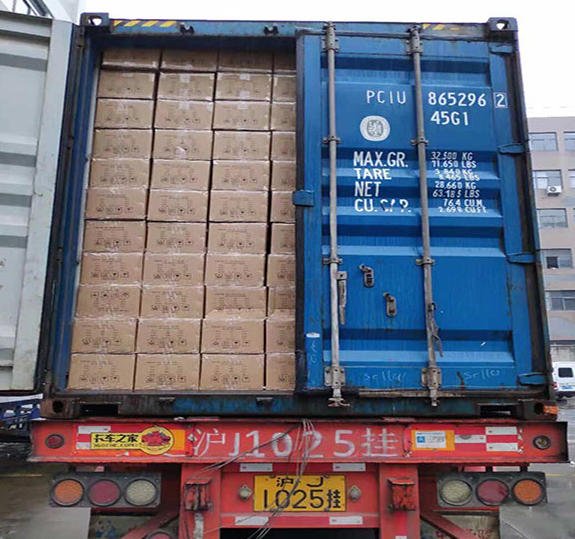
Case study from CNDDP Shipping: Shipping from Shanghai to Jeddah, Saudi Arabia – DDP, 20ft container, Invisible Nano Adhesive Hooks
FAQ:
Q1: Is DDP door-to-door shipping from China to Saudi Arabia available?
Yes. DDP services—via sea or air freight—can be arranged based on the type of goods and the destination. This typically includes pickup in China, export customs clearance, international transport, import customs clearance in Saudi Arabia, handling of agreed-upon import duties and taxes, and final delivery. Specific requirements regarding the importer of record and product compliance must be confirmed in advance.
Q2: For DDP shipments to Saudi Arabia, does the buyer need to handle customs clearance?
Under a standard DDP arrangement, the seller is responsible for import customs clearance, which is carried out through an agreed-upon party (importer of record). While the buyer generally does not need to manage the entire clearance process, they may still be required to provide documents such as a commercial registration, import licenses, or product-related information, depending on the nature of the goods and local regulations.
Q3: Is DDP shipping from China to Riyadh available?
Yes. Goods can be transported to Saudi Arabia via sea or air, with customs clearance and local delivery in Riyadh arranged as part of the service. The specific transport route will be determined based on shipping schedules, flight availability, and the delivery address.
Q4: What is the difference between sea freight DDP and air freight DDP from China to Saudi Arabia?
Sea freight is suitable for furniture, machinery, construction materials, and large-volume shipments, generally offering a more cost-effective solution. Air freight is ideal for samples, electronic components, and urgent orders; it is much faster but comes at a higher cost.
Q5: Does DDP shipping to Saudi Arabia include the 15% VAT?
Imported goods in Saudi Arabia are generally subject to a 15% standard VAT, though the specific tax treatment depends on the nature of the goods and applicable regulations. A DDP quote should clearly state whether it includes import VAT and any other relevant taxes or duties.
Q6: Can products containing batteries be shipped from China to Saudi Arabia via DDP?
Some products containing batteries can be shipped, subject to verification of the battery type, capacity, packaging, and the chosen mode of transport. Air shipments, in particular, often require specific documentation regarding the batteries and must comply with regulations for the transport of dangerous goods and air cargo.
Q7: Can DDP shipments consolidate goods from multiple suppliers in China?
Yes. Goods from various suppliers can first be consolidated at a warehouse in China, where they undergo inspection, measurement, and packaging before being combined for shipment via sea or air. This approach is particularly practical for importers in Saudi Arabia who source a wide variety of products.