
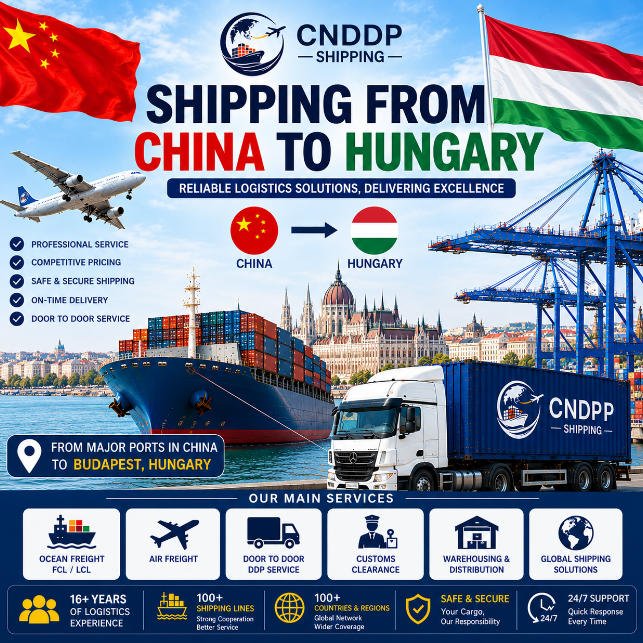
Hungary is a landlocked country within the EU, with no access to the sea. Its capital, Budapest, is a core logistics hub in Central and Eastern Europe, handling a large volume of Chinese machinery and equipment, furniture, auto parts, 3C accessories, and daily necessities. These goods also reach neighboring markets in Austria, Slovakia, and the Czech Republic.
Hungary adheres to EU customs regulations, with a standard VAT of up to 27%. Customs clearance documents and CE certification requirements are stringent. Many foreign trade clients easily overlook inland transshipment costs, leading to overspending on actual logistics. This article provides a comprehensive breakdown of various shipping options from China to Hungary, including overall cost structure, delivery time, and DDP (Delivered Duty Paid) risks, making it easier for companies and individuals to calculate shipping costs.
Shipping from China to Hungary
Hungary is a landlocked country with no seaports. Sea freight is generally transported to major European ports such as Koper and Hamburg, and then transferred to Budapest by rail or truck. Air freight provides direct service to Budapest-Liszt-Ferenc (BUD) Airport. The China-Europe Railway Express provides direct service to Budapest railway stations, with transit times between sea and air freight.
Ports of origin in China:
Shenzhen and Guangzhou are suitable for goods originating from South China; Ningbo and Shanghai are suitable for factories in East and North China; the China-Europe Railway Express mainly departs from Xi’an, Chengdu, and Chongqing.
Main receiving points in Hungary:
Budapest is where the vast majority of warehouses and wholesalers in Hungary are located, and it is also the distribution center for Central and Eastern Europe. Goods from other secondary cities require secondary transshipment in Budapest, incurring additional land transportation costs.
Trade terms differ:
FOB covers only domestic ports; CIF includes trunk freight and insurance, with destination port customs clearance and duties handled by the consignee; DDP is door-to-door after tax payment, where the freight forwarder handles export customs declaration, trunk freight, EU customs clearance, customs and VAT payment, and last-mile delivery, and is most commonly used by domestic exporters and small and medium-sized cross-border sellers.
Shipping Costs from China to Hungary
The table below shows reference prices for shipping from China to Hungary in 2026 (general cargo, destination Budapest, excluding special surcharges. Prices are in USD and are for market reference only; actual quotes may vary depending on cargo information):
| Shipping Option | Cost Reference | Service Type |
|---|---|---|
| Sea FCL 20GP | $2200‑4500 | Port to Budapest |
| Sea FCL 40HQ | $2600‑5200 | Port to Budapest |
| Sea LCL | $80‑160 /CBM | Port to Budapest |
| Sea DDP LCL | $150‑300 /CBM | Door‑to‑door |
| Rail LCL | $130‑250 /CBM | Station to Budapest |
| Rail DDP LCL | $200‑350 /CBM | Door‑to‑door |
| Air Freight | $4.2‑9.5 /KG | Airport to Airport |
| Air DDP | $5.0‑12.0 /KG | Door‑to‑door |
| Express Courier | $8.5‑15 /KG | Door‑to‑door |
Breakdown of Shipping Costs from China to Hungary
The total cost of shipping from China to Hungary is not simply the trunk line freight rate. It consists of five major components. Many customers only compare trunk line quotes, neglecting inland transshipment and port surcharges, ultimately resulting in higher actual expenses than budgeted.
- Domestic Origin Costs: Factory pickup trucking, export customs clearance fees, document fees, and port THC handling fees.
- Township Transportation Costs: Full container load (FCL)/Less container load (LCL) sea freight, China-Europe rail freight, and air freight trunk line costs, affected by oil prices and seasonal fluctuations in shipping capacity.
- European Transshipment Port Costs: Overseas port unloading, container transfer, and document fees; LCL sea freight may incur unpacking fees.
- Customs and Duties: EU customs duties range from 0-25% (according to HS codes), and Hungarian standard VAT is 27%, calculated based on the CIF value of the goods (value of goods + sea and air freight + insurance).
- Inland Transshipment and Delivery Costs: Truck/rail transshipment from European ports to Budapest, and last-mile delivery from Budapest to other cities in Hungary. These are costs that are easily hidden in landlocked countries.
Tip: When choosing DDP shipping services, CNDDP Shipping integrates most items into a one-stop quote, reducing the risk of temporary price increases at the destination port.
Cost of Shipping 20ft & 40ft Containers from China to Hungary
Sea freight is suitable for large quantities of goods with flexible delivery times. Machinery, furniture, building materials, and large quantities of daily necessities are preferred by sea freight. Because Hungary has no seaports, goods first arrive at major European ports and then are transported by truck/rail to Budapest, adding an extra inland transportation time and cost.
Full Container Load (FCL) is suitable for shipments of 15 CBM or more; Less than Container Load (LCL) is suitable for small replenishment shipments of 1-14 CBM, after which the container is unloaded at a European transshipment port and then transshipped to Hungary.
The cost of shipping a 20ft container from China to Hungary is between $2,200 and $4,500, while the freight for a 40ft container is around $2,600 to $5,200.
| POL (port of loading) | POD (port of discharge) | 20ft container cost | 40ft container cost |
|---|---|---|---|
| Shanghai | Budapest | $2350-$4550 | $2800-$4800 |
| Shenzhen | Budapest | $2200-$4600 | $2750-$4850 |
| Qingdao | Budapest | $2350-$4450 | $2850-$4750 |
| Ningbo | Budapest | $2400-$4300 | $2950-$4850 |
Important Note: Quotes must confirm the service end point—whether it’s a European transit port or a Budapest warehouse; some low-priced quotes only cover European ports and do not include Budapest transshipment costs. Due to limited space during peak season, we recommend booking 7-12 days in advance.
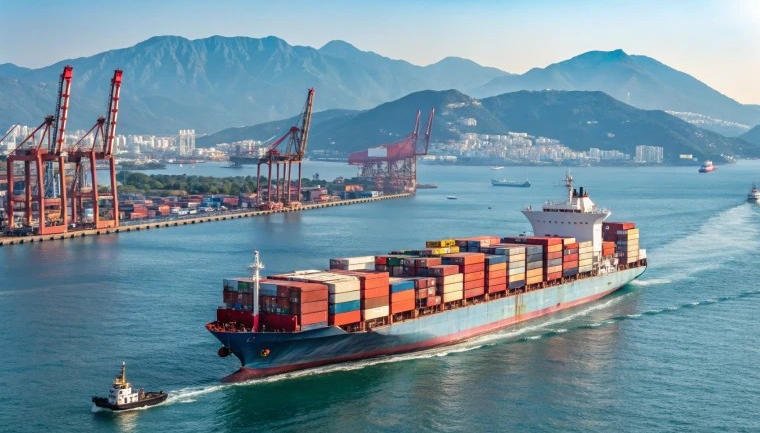
CNDDP Shipping offers domestic trucking and customs clearance, full container load (FCL) and less than container load (LCL) booking, European transshipment operations, and local customs clearance in Budapest. We support various trade terms including CIF, DDU, and DDP, and have mature operational solutions for overweight equipment and large cargo.
Air Freight Costs from China to Hungary
Air freight primarily lands at Budapest Airport (BUD), suitable for high-value shipments, urgent replenishment, and sample orders, such as electronic components and inventory from popular e-commerce platforms. General cargo air freight only handles airport-to-airport transport; the consignee is responsible for customs clearance and tax payment. Air freight with DDP (Delivered Duty Paid) integrates customs clearance, taxes, and last-mile delivery, offering a simple and hassle-free experience.
Air freight costs are calculated based on the greater of volumetric weight and actual weight, approximately $4.2 to $9.5 per kilogram. Bulk cargo with large volume but light weight will have a significantly higher unit price; shipments over 100kg have a more advantageous unit price; smaller packages weighing tens of kilograms are best handled through international express delivery. During peak seasons, air freight capacity is limited, and prices fluctuate significantly.
| Departure Airport (China) | Arrival Airport (Hungary) | Cost Per KG (USD) |
|---|---|---|
| Shanghai Pudong | Budapest | $4.80 – $9.50 |
| Guangzhou Baiyun | Budapest | $5.00 – $9.60 |
| Beijing Capital | Budapest | $4.90 – $9.40 |
| Shanghai Pudong | Debrecen | $4.70 – $9.70 |
| Guangzhou Baiyun | Debrecen | $4.80 – $9.20 |
| Beijing Capital | Debrecen | $5.00 – $9.50 |
Railway Transportation Costs from China to Hungary
The China-Europe Railway Express is a solution between sea and air freight, offering significantly faster transit times and lower prices than air freight. It’s suitable for medium-volume shipments from Xi’an, Chengdu, and Chongqing, with direct service to the BILK railway station in Budapest.
Less than Container Load (LCL) rail shipments are suitable for 2-15 CBM cargo; Full Container Load (FCL) is suitable for large-volume shipments.
| Shipping Mode | Cost Range | Transit Time | Suitable Cargo |
|---|---|---|---|
| Rail LCL (per CBM) | $130‑250 | 18‑26 days | Mid‑volume goods, balance cost & speed |
| Rail DDP LCL (per CBM) | $200‑350 | 22‑30 days | Door‑to‑door via China‑Europe train |
Important Notes: There are specific restrictions on electronic products and general cargo; dangerous goods cannot be transported by rail. Year-end slots are limited, and prices may increase. Port-to-station and DDP door-to-door services are also available.
CNDDP Shipping has stable connections with China-Europe Railway Express resources and can provide DDP rail freight with customs clearance and taxes included, offering a one-stop service from export customs declaration and overseas customs clearance and tax payment to final delivery to your door in Budapest.
Key Factors Affecting Shipping Costs from China to Hungary
- Destination City: The cost difference between shipping to Budapest and remote Hungarian cities, and between inland transshipment, is significant.
- Cargo Volume: Full container load (FCL) reduces unit cost; LCL shipments have lower per cubic meter prices for larger volumes; air freight prices are lower per kilogram for heavier weights.
- Cargo Attributes: General cargo has the lowest price; goods containing batteries, magnets, or oversized/overweight items incur additional handling fees; products requiring CE certification incur compliance costs.
- Seasonal Fluctuations: The second half of each year is the peak shipping season, with tight space on sea, rail, and air freight, leading to higher costs and longer delivery times.
- Trade Terms: FOB only covers domestic costs; CIF includes trunk freight and insurance; DDP includes customs duties and VAT, resulting in a significantly higher overall price.
Note: When choosing DDP service, CNDDP Shipping will integrate the vast majority of items into a one-stop quote, reducing the risk of temporary price increases at the destination port.
Shipping Time from China to Hungary
The shipping time from China to Hungary depends on the mode of transport, route, customs clearance, and final delivery location.
| Shipping Method | Estimated Transit Time | Best For |
|---|---|---|
| Express Shipping | 3–7 days | Samples and small parcels |
| Air Freight | 5–10 days | Urgent cargo and high-value goods |
| Rail Freight | 18–26 days | Medium cargo needing balanced cost and speed |
| Sea Freight + Inland Delivery | 30–45 days | Large shipments and container cargo |
DDP Shipping from China to Hungary
DDP (Delivered by Payment) involves the freight forwarder handling export customs declaration, trunk transportation, EU customs clearance, payment of customs duties and 27% VAT, and direct delivery to the Hungarian recipient address. The recipient does not need to handle customs clearance and tax payment processes, making it suitable for small and medium-sized wholesalers and cross-border e-commerce sellers unfamiliar with EU customs regulations.
Key Risks of DDP Shipping from China to Hungary:
- Mandatory CE Certification: Electronic products, home appliances, machinery, toys, etc., must have a CE certificate. Lack of a certificate will result in goods being detained, incurring high demurrage fees, or even return shipment.
- Strict Prohibition of Under-Declaring Value: Hungarian customs NAV inspections are strict. Under-declaring value will result in supplementary taxes and high fines. For DDP, it is essential to declare the true value of the goods.
- EORI Number: EU customs clearance requires an EORI number. Under DDP, the freight forwarder’s local EORI number is generally used for customs clearance.
- Inland Additional Costs: Please confirm whether the quoted price includes last-mile delivery to Budapest and other cities in Hungary. Some lower-priced quotes only cover delivery to the Budapest depot and do not include door-to-door delivery.
CNDDP Shipping: We accept DDP shipping (sea, rail, and air). Before shipment, we pre-screen products to determine if CE certification is required, fully calculate customs duties and VAT, provide transparent pricing details, and avoid unexpected charges at the destination port.
Essential Documents and Tips for Exporting to Hungary
Hungary follows the EU customs system. Incorrect documents and missing certifications are frequent reasons for cargo detention and inspection.
- Commercial Invoice: Complete product description, HS code, and value; accurate declaration.
- Packing List: Gross weight, net weight, volume, and number of cartons; data on the invoice and packing list must be completely consistent.
- Bill of Lading/Waybill: Accurate consignor and consignee information.
- Prepare CE certificates in advance for regulated products; machinery requires a declaration of conformity.
- EUR.1 Certificate of Origin can be obtained upon request, potentially offering tariff preferences.
- Allow for buffer time; random inspections are common in the EU. Allow 7-12 days for your shipment plan; do not ship on time.
How to Choose a Freight Forwarder from China to Hungary
Hungary is a landlocked country in the EU, with a long logistics chain involving European transshipment, EU customs clearance, and CE compliance. Choosing a freight forwarder shouldn’t be based solely on price; focus on the following:
- Practical Experience on Central and Eastern European Routes: Familiar with EU customs rules, understands CE certification requirements, has a local customs clearance agent in Budapest, and can handle unexpected situations such as container changes and inspections at transshipment ports. Many freight forwarders only handle routes from China to major European ports and lack local Hungarian capabilities.
- Complete and Transparent Pricing: Clearly states what fees are included, service nodes (port/terminal/door-to-door), and whether customs duties and VAT are included. Be wary of prices significantly below market rates, as these likely conceal additional European transshipment fees.
- Comprehensive Transportation Options: Offers full container load (FCL) and less than container load (LCL) sea freight, China-Europe rail freight, air freight, and DDP services, allowing clients to switch options based on cargo volume and delivery time. 4. Cargo Tracking and After-Sales Service: If goods are inspected or detained, the overseas agent can quickly follow up and handle the situation, avoiding shifting all risks to the shipper.
CNDDP Shipping specializes in the China-Hungary-Central and Eastern Europe route, with its own partner customs clearance team in Budapest. We provide a full-chain service including factory pickup, export customs declaration, sea/rail/air freight, EU customs clearance, and DDP door-to-door delivery. We can provide accurate quotes based on cargo volume, product type, and delivery address.
FAQ:
Q1: Hungary is a landlocked country, will sea freight always be much more expensive?
A: The price difference between mainline sea freight and Western Europe is not significant. The main difference lies in the land/rail transport costs from European ports to Budapest. Confirm with the freight forwarder before requesting a quote whether inland transport is included.
Q2: For DDP shipments to Hungary, is the 27% VAT fully included in the quote?
A: A standard DDP quote includes customs duties + 27% VAT. When requesting a quote from a freight forwarder, be sure to confirm whether all taxes are included to avoid additional charges later.
Q3: Compared to sea freight, what scenarios is the China-Europe Railway Express more suitable for?
A: For medium-volume shipments, if you don’t want to wait more than 35 days for sea freight, and your budget is insufficient for air freight, the China-Europe Railway Express is the preferred choice; suitable for auto parts, household goods, and general industrial products.
Q4: Can goods without a CE certificate be shipped to Hungary via DDP?
A: For EU-mandated CE-certified products, lacking the certificate will prevent normal customs clearance and result in goods being detained and returned. Please provide product information to CNDDP Shipping for pre-screening before shipment.
Q5: After arriving in Budapest, can the goods be transshipped to Austria or Slovakia?
A: Yes, Budapest, Hungary is a distribution center for Central and Eastern Europe. After customs clearance, goods can be trucked to neighboring EU countries, incurring cross-border land transportation costs.