

Saudi Arabia is one of China’s most important trading partners in the Middle East. Understanding the shipping costs from China to Saudi Arabia is crucial for cost control and maximizing profits.
Shipping from China to Saudi Arabia
Saudi Arabia is one of the largest trading partners between China and the Middle East, exporting goods including building materials, machinery and equipment, home furnishings, auto parts, and cross-border e-commerce goods. The main destination ports are Jeddah and Dammam, with Riyadh being the main inland receiving city.
Shipping channels from China to Saudi Arabia include Full Container Load (FCL) sea freight, Less than Container Load (LCL) sea freight, air freight, and DDP (Delivered Duty Paid) all-inclusive shipping.
Sea Freight from China to Saudi Arabia
Sea freight is the most popular mode of transport for large or heavy cargo (excavator). Whether it’s Full Container Load (FCL) or Less than Container Load (LCL), sea freight is cost-effective. Major Chinese ports such as Shanghai, Shenzhen, and Ningbo are directly connected to the land ports of Jeddah, Dammam, and Riyadh via reliable sea freight services.
Bulk cargo shipping is the cheapest option, suitable for long supply chains, but with a longer average transit time (20-30 days), which may be delayed due to weather conditions or port congestion.
Air Freight from China to Saudi Arabia
Air freight is the fastest way to transport goods from China to Saudi Arabia, especially suitable for high-value items or urgent deliveries. With direct flights to Saudi Arabia, air freight offers a safer mode of transport and faster delivery compared to sea freight.
High speed, high reliability, and low warehousing costs. Higher freight costs and limited capacity for heavier cargo.
DDP Shipping
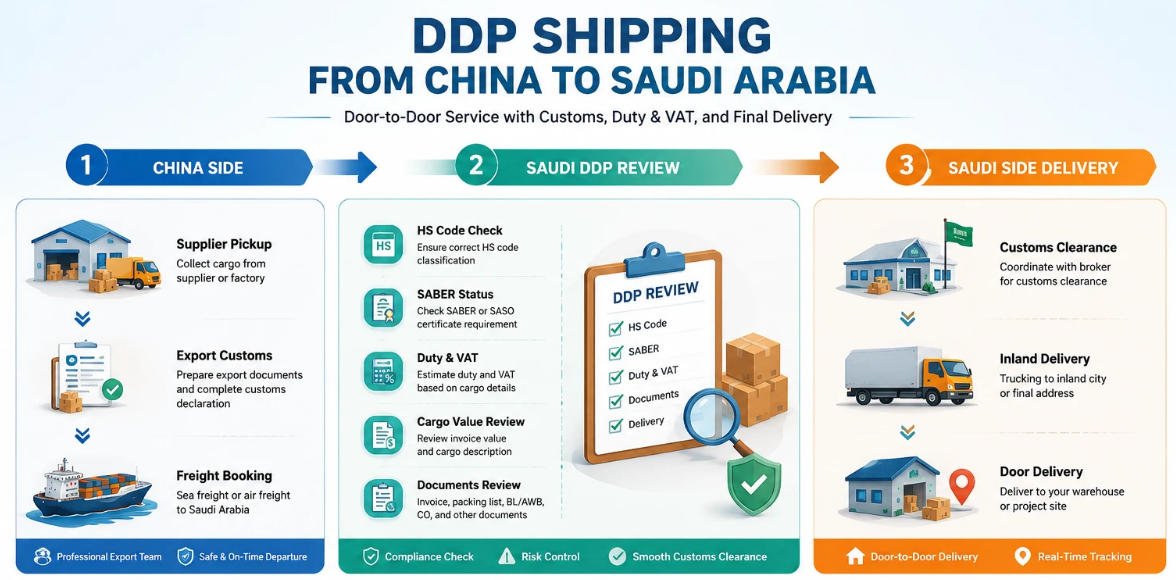
DDP shipping from China to Saudi Arabia can be a powerful solution for importers seeking more comprehensive freight services, including pick-up in China, export customs declaration, international freight, Saudi customs clearance coordination, handling of applicable tariffs and VAT, and final delivery to the confirmed destination.
DDP (Delivered Duty Paid) is especially useful for importers, e-commerce sellers, wholesalers, distributors, and B2B buyers who frequently import goods and have clear documentation. It can reduce the hassle for buyers to handle port clearance, destination fees, and local delivery separately.
Shipping Costs from China to Saudi Arabia
The cost of shipping from China to Saudi Arabia depends on the size and weight of the goods, the city of origin, the city of destination, the mode of transport, customs requirements, certificate status, and the final delivery scope.
| Shipping Mode | Specification | Reference Cost (USD) |
|---|---|---|
| Sea FCL | 20GP | 1000‑3000 |
| Sea FCL | 40HQ | 1400‑4500 |
| Sea LCL | Per CBM | 65‑180 |
| Air Freight | Over 100KG (Per KG) | 3‑9 |
| DDP and Door‑to‑Door | Including customs duty & VAT | DDP Air Freight: 4.5‑10 DDP Sea Freight: 100‑250 |
Note: The table above is only a market reference price for shipping from China to Riyadh, Jeddah, Dammam, etc., Saudi Arabia. It only represents the basic ocean freight and does not include domestic trucking, customs clearance, customs duties, VAT, or inland delivery. Freight rates are affected by fuel surcharges, space availability, and peak season fluctuations.

Sea Freight cost from China to Saudi Arabia
Sea freight costs are complex, involving multiple stages. It includes not only the basic freight rate but also additional fees, port charges, and fuel surcharges. There are two main service types:
- FCL (Full Container Load) Shipping: Recommended for bulk cargo filling an entire container (20-foot or 40-foot). Importers can enjoy the lowest unit freight rates for bulk shipments.
- LCL (Less than Container Load) Shipping: A good option for small-volume shipments. Freight forwarders consolidate multiple shipments into one container, reducing overall transportation costs for importers who don’t need full container loads.
Differences Between LCL and FCL and the Composition of Shipping Costs
Cost of Shipping 20ft & 40ft Containers from China to Saudi Arabia
| Departure Port | Arrival Port | 20ft Container (USD) | 40ft Container (USD) |
|---|---|---|---|
| Shanghai | Jeddah | $1280 | $2400 |
| Shenzhen | Jeddah | $1250 | $2550 |
| Ningbo | Jeddah | $1200 | $2400 |
| Qingdao | Jeddah | $1250 | $2750 |
| Shanghai | Dammam | $1280 | $2680 |
| Shenzhen | Dammam | $1350 | $2350 |
| Ningbo | Dammam | $1270 | $2270 |
| Qingdao | Dammam | $1180 | $2550 |
| Shanghai | Abha | $1150 | $2350 |
| Shenzhen | Abha | $1280 | $2450 |
| Ningbo | Abha | $1160 | $2370 |
| Qingdao | Abha | $1280 | $2400 |
LCL Shipping Cost from China to Saudi Arabia
| Departure Port | Arrival Port | LCL Shipping Cost (USD) |
|---|---|---|
| Shanghai | Jeddah | $60 – $125 |
| Shenzhen | Jeddah | $70 – $130 |
| Ningbo | Jeddah | $65 – $125 |
| Qingdao | Jeddah | $60 – $130 |
| Shanghai | Dammam | $75 – $135 |
| Shenzhen | Dammam | $80 – $120 |
| Ningbo | Dammam | $60 – $120 |
| Qingdao | Dammam | $65 – $130 |
| Shanghai | Abha | $60 – $135 |
| Shenzhen | Abha | $60 – $125 |
| Ningbo | Abha | $70 – $120 |
| Qingdao | Abha | $65 – $125 |
Other costs for sea freight from China to Saudi Arabia
Fuel Surcharge
Fuel surcharges are adjusted based on fuel price fluctuations, typically ranging from $50 to $500, varying depending on the shipping route and fuel price changes.
Port Charges
Port charges are incurred during cargo loading and unloading. Loading and unloading charges at Jeddah Port can range from $150 to $500, depending on the type of cargo and port conditions. Port charges at Dammam Port are generally lower, typically between $100 and $400.
Destination Charges
These are charges incurred at the port of destination, including unloading fees. They typically range from $100 to $300, depending on the type of cargo.
Insurance
Insurance costs incurred during cargo transportation are the expenses incurred to protect goods from accidental damage during transit. They are typically 0.2% to 2% of the cargo’s value.
Differences in Shipping Costs Between Saudi Ports
When choosing a shipping route from China to Saudi Arabia, different ports and airports will result in varying shipping costs due to factors such as geographical location, facilities, service quality, and logistics efficiency.
Ranking of Saudi Arabia’s Top 10 Ports
Jeddah Port
Most goods; most shipping routes, lowest cost, fastest customs clearance.
Dammam Port
Construction machinery, building materials; slightly higher costs, fewer shipping routes.
Reasons for Cost Differences:
- Different port handling fees (THC, terminal charges)
- Trucking costs from the factory
- Shipping company availability at different ports
- Jeddah is the cheapest, fastest, and most frequently used port.
- Dammam is typically $100–$300 more expensive per container than Jeddah.
Air Freight Costs from China to Saudi Arabia
Air freight is faster, but more expensive, costing approximately $3 to $9 per kilogram. Understanding the detailed components and influencing factors of air freight costs can help optimize transportation choices and balance timeliness and cost. Here are the cost details:
| Weight Break | Air Freight Cost (USD) | Notes |
|---|---|---|
| 50-100 kg | $5 – $9/kg | Cheapest rates available for general cargo |
| 100-500 kg | $4 – $7/kg | More cost-effective than express delivery |
| 500-1000 kg | $3.5 – $5.5/kg | Suitable for industrial goods and wholesale goods. |
| 1000 kg+ | $3 – $5/kg | Best for larger shipments |
Other costs for Air freight from China to Saudi Arabia
Basic Freight
The actual weight and volumetric weight are compared, and the larger value is used for chargeable weight. The formula is: Volumetric weight (kg) = Length (cm) × Width (cm) × Height (cm) / 6000
Fuel Surcharge
Typically $0.5 – $1.5 per kilogram, depending on fuel price fluctuations.
Airline Surcharge
This is an additional charge levied by airlines for certain special circumstances or special cargo, typically $50 – $200, depending on the type of cargo and special requirements.
Demurrage and Port Demurrage Fees
Typically $20 – $100 per day, depending on the volume of the cargo and airport policies.
Key Factors Affecting Shipping Costs from China to Saudi Arabia
Port of Origin and Destination Selection
South China ports like Shenzhen and Guangzhou offer numerous direct flights and significant price advantages; East China ports like Ningbo and Shanghai have ample cargo space suitable for large-volume shipments. Jeddah port has high cargo volume, making it the preferred choice for shipments to western Saudi cities; Dammam port is more suitable for the eastern region; if the destination is inland Riyadh, substantial inland trucking costs will be incurred.
Cargo Type and Volume
General cargo has the lowest freight rates; shipments containing batteries, magnets, or certain textiles require special declarations, increasing costs. For shipments exceeding 15 CBM, full container load (FCL) is preferred due to lower unit costs; smaller batches are suitable for LCL (Less than Container Load). Some products require SABER certification; failure to obtain certification will result in cargo seizure and hefty fines, indirectly increasing overall costs.
Peak and Off-Peak Seasons and Geopolitical Factors
During the peak shipping season before Ramadan and from August to December each year, space is tight, and freight rates increase by 15%-30%. The Red Sea route is occasionally affected by international events, resulting in temporary surcharges; bookings should allow for buffer time.
Cost Differences Between DDP and DDU(DAP) Models
DDU only covers transportation to the destination port; customs duties, VAT, and clearance fees are all borne by the consignee. Under the DDP model, the freight rate includes customs duties, VAT, and clearance fees, making it more convenient for buyers unfamiliar with Saudi customs.
Easily Overlooked Additional Costs in Shipping from China to Saudi Arabia
Many clients only compare basic freight rates, neglecting local costs at the destination port, leading to budget overruns. Major costs are settled in USD:
- Container Demurrage: USD 60-110/day. Shipping companies typically offer 7-10 days of free container time; charges apply after this period.
- Port Storage Fees: USD 45-90/day. Customs clearance delays can quickly result in high storage costs.
- Destination Port THC, Documentation Fees, and Security Fees: Fixed charges per full container.
- Inland Trucking from Port to Riyadh: USD 280-700/container.
- Customs Inspection Fees: Occurring during random inspections; actual costs are charged.
Choosing CNDDP Shipping DDP service provides a unified quote for all taxes and miscellaneous fees, reducing unexpected additional expenses at the destination port.
DDP shipping from China to Saudi Arabia
Saudi DDP (Delivered Duty Paid) is currently the most popular shipping method for foreign trade and cross-border e-commerce sellers. The entire process includes domestic pickup, export customs declaration, international sea freight, Sabel/Fasah customs clearance at the destination port, payment of customs duties and VAT, and delivery throughout inland China. The consignee does not need to handle any customs clearance procedures or pay any additional fees.
CNDDP Shipping’s dedicated Saudi DDP route offers significant advantages, stably handling most common goods such as furniture, building materials, electromechanical products, daily necessities, auto parts, and Amazon FBA e-commerce goods, covering delivery to cities throughout Saudi Arabia, including Jeddah, Dammam, Riyadh, Medina, and Mecca. Compared to traditional port-to-port transportation, the DDP model completely avoids Saudi Arabia’s complex certification audits, customs inspections, hidden fees at the destination port, and the risk of port congestion.
The comprehensive cost of Saudi DDP is a flat, packaged price, with all taxes, handling fees, and inland freight costs fully transparent, making it suitable for foreign trade companies with long-term, stable shipments. Standard ocean freight DDP has a stable overall transit time of 28-40 days, ensuring efficient customs clearance and delivery even during peak seasons, greatly reducing uncertainty in the customer’s supply chain.
Before confirming DDP, it is essential to verify the product type, HS code, SABER status, cargo value, customs duties/VAT, and delivery address.
Main Saudi Ports, Airports and Inland Delivery Points
| Gateway | Type | Best For | Common Final Destinations |
|---|---|---|---|
| Jeddah Islamic Port | Seaport | Western Saudi Arabia, Red Sea route | Jeddah, Makkah, Madinah, Taif |
| King Abdulaziz Port Dammam | Seaport | Eastern Province and Riyadh cargo | Dammam, Riyadh, Khobar, Jubail |
| Jubail ports | Industrial / commercial ports | Industrial and project cargo | Jubail, Eastern Province |
| Yanbu ports | Industrial / commercial ports | Western industrial shipments | Yanbu and Red Sea industrial areas |
| King Khalid International Airport, Riyadh | Airport | Air freight to central Saudi Arabia | Riyadh and inland cities |
| King Abdulaziz International Airport, Jeddah | Airport | Air freight to western Saudi Arabia | Jeddah, Makkah, Madinah |
| King Fahd International Airport, Dammam | Airport | Air freight to Eastern Province | Dammam, Khobar, Jubail |
Saudi Arabia’s import tariffs
Tariffs are taxes and fees levied by the customs or relevant government agencies of the importing country upon the entry of goods. They are typically calculated based on the value, type, weight, or quantity of the goods. Tariff = CIF Price × Tariff Rate
Tariff rates generally vary depending on the type of goods. Generally, tariff rates for most goods range from 5% to 20%.
- Most consumer goods (such as electronics, appliances, and daily necessities): Usually subject to a 5% tariff.
- Food and agricultural products: Tariffs are mostly between 5% and 15%.
- Luxury goods (such as perfumes, jewelry, and luxury vehicles): Tariffs are usually higher, around 20%.
- Pharmaceuticals and medical equipment: Usually exempt from tariffs or subject to lower tariffs, around 0% to 5%.
- Chemicals and industrial products: Usually subject to a 5% to 10% tariff.
Value Added Tax (VAT): The standard rate is 15%. VAT is usually calculated based on the CIF price of the goods plus the tariff.
Customs Clearance in Saudi Arabia
Saudi customs has strict digital clearance requirements. Goods packaging must clearly display a “Made in China” label; the commercial invoice, packing list, and bill of lading must be consistent. Some product categories require a SABER certificate, which must be obtained in advance; goods without a certificate will be detained.
Note: SABER accounts can only be registered and managed by local Saudi importers; exporters in China cannot apply for certificates independently. The PC (Product Certificate) is an annual certificate for the product, while the SC (Shipment Certificate) is specific to each individual shipment; customs will not release goods without an SC.
Freight Forwarding from China to Saudi Arabia
Logistics in Saudi Arabia has high barriers to entry, requiring freight forwarders to have strong local resources and document processing capabilities. Ordinary freight forwarders are unfamiliar with the SABER and FASAH platform processes, which can easily lead to cargo detention and arbitrary charges at the destination port.
CNDDP Shipping has been deeply involved in Middle Eastern freight forwarding for over ten years, providing one-stop services from China to Saudi Arabia including full container load (FCL), less than container load (LCL), air freight, and DDP door-to-door delivery. We support domestic pick-up, export customs clearance and booking, are familiar with Jeddah and Dammam port operations, and handle customs clearance and tax payment, as well as nationwide delivery. We can transport general cargo such as building materials, machinery, daily necessities, and auto parts. Cargo tracking is available throughout the entire process, and pricing is transparent, making us a reliable logistics partner for foreign trade companies exporting to Saudi Arabia.